Saturn rings detail
1344×768 · AVIF · CC BY 4.0
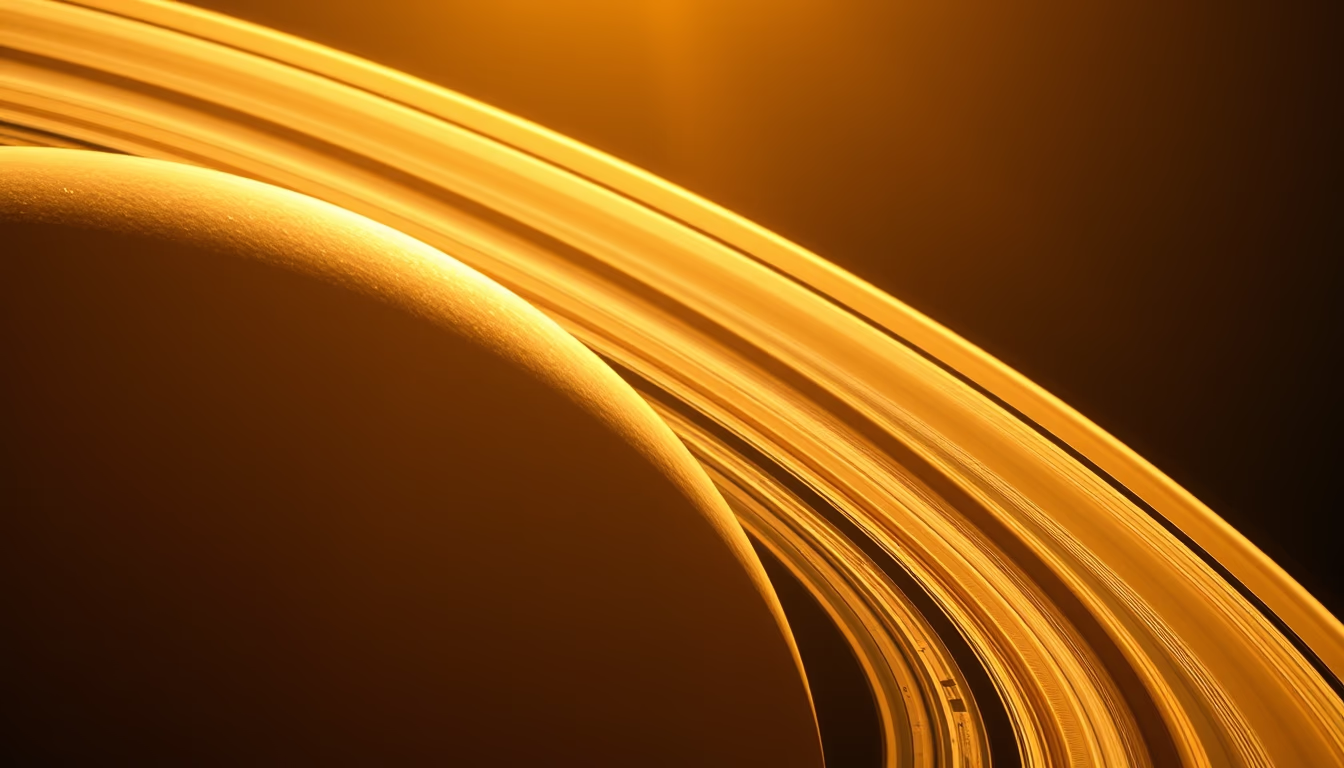
Saturn's rings are composed of billions of ice and rock particles, revealing the dynamics of the solar system.
About this subject
Saturn's rings are one of the most stunning features in the solar system. They span about 282,000 kilometers from the planet's equator but are only tens of meters thick. Composed of 99.9% water ice with traces of dust and rock, the particles range in size from microscopic grains to house-sized chunks. The intricate structure includes divisions like the Cassini Division, separating the A and B rings, and dozens of fainter ringlets.
The origin of the rings is debated. One theory suggests they formed from the breakup of a moon or comet captured by Saturn's gravity about 100 million years ago. Another hypothesis points to debris from collisions among ancient moons. Data from NASA's Cassini mission, which orbited Saturn from 2004 to 2017, revealed that the rings are gradually losing material, falling onto the planet as "ring rain," indicating they might disappear in a few hundred million years.
Beyond visual beauty, Saturn's rings serve as a natural laboratory for studying planetary processes. Shepherd moons like Prometheus and Pandora use gravity to maintain ring shapes. Ripples and helical structures in the rings hint at the influence of moons and passing comets. Cassini also discovered that the rings emit radio waves and have their own atmosphere of molecular oxygen, generated by UV radiation breaking ice molecules.
Interestingly, Saturn is not the only planet with rings. Jupiter, Uranus, and Neptune also have ring systems, but they are much fainter and darker. Saturn's rings, however, are the brightest and easiest to observe, even with small telescopes. They stand as a reminder of the cosmos's complexity and beauty, inspiring scientists and stargazers alike.
Frequently Asked Questions
What are Saturn's rings made of?
The rings are mostly water ice (99.9%) with small amounts of dust and rocky particles. Particle sizes range from micrometers to meters.
Why do Saturn's rings have gaps?
Gaps like the Cassini Division are created by gravitational resonances with Saturn's moons. Shepherd moons also clear particles, forming sharp edges.
Will Saturn's rings disappear?
Yes, the rings are slowly losing material through 'ring rain'. Estimates suggest they could vanish in about 100 to 300 million years.
Direct URL
https://pub-c7d6a6ea828543ac903a74a341ccb2e1.r2.dev/imagens/saturn-rings-detail-travel-photography-p6.avifHow to credit
Include a visible link back to UtilizAí. Copy one of the snippets below:
<a href="https://xn--utiliza-eza.com/en/midia/imagens/saturn-rings-detail-travel-photography-p6">Saturn rings detail</a> by <a href="https://xn--utiliza-eza.com">UtilizAí</a>, licensed under <a href="https://creativecommons.org/licenses/by/4.0/">CC BY 4.0</a>.
[Saturn rings detail](https://xn--utiliza-eza.com/en/midia/imagens/saturn-rings-detail-travel-photography-p6) by [UtilizAí](https://xn--utiliza-eza.com), CC BY 4.0
License: CC-BY-4.0