Saturn rings detail closeup
1344×768 · AVIF · CC BY 4.0
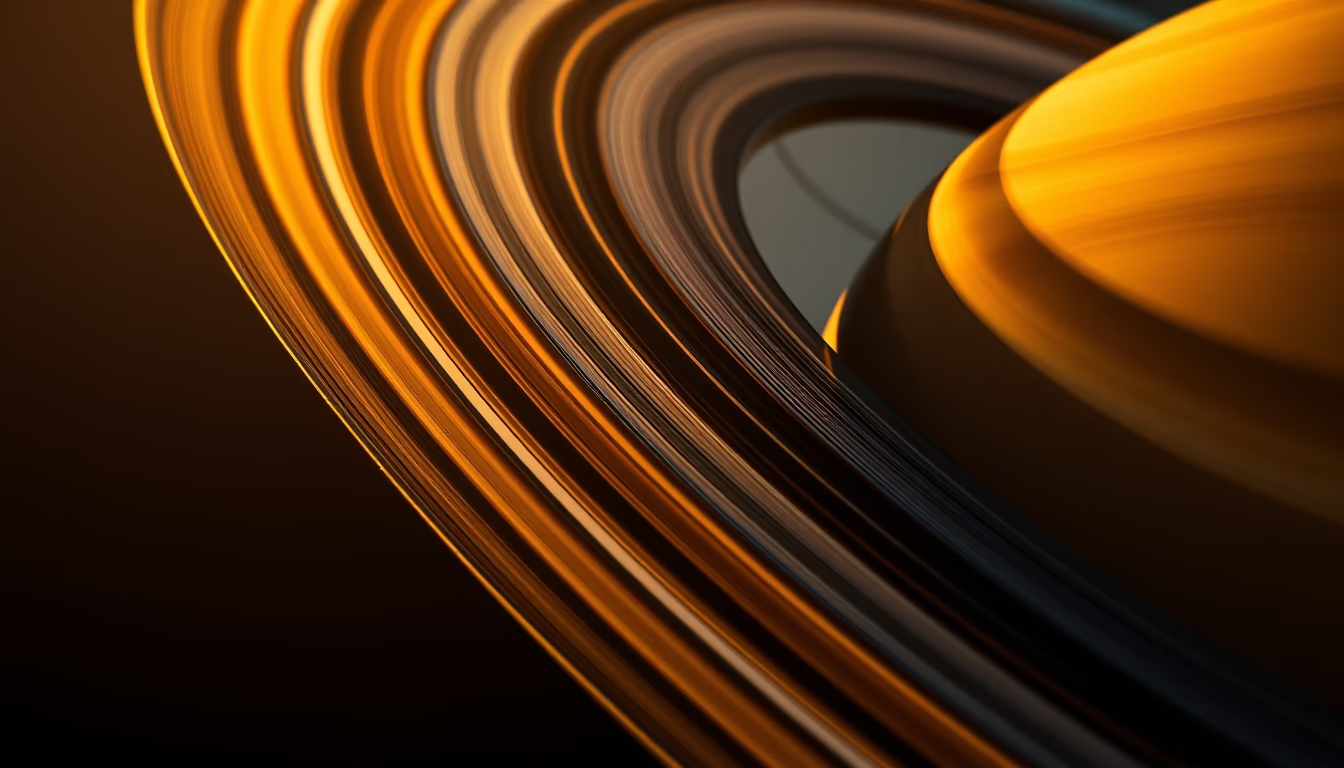
Saturn's rings, composed primarily of ice and rocky particles, reveal a complex structure in close-up that fascinates scientists and observers.
About this subject
Saturn's rings are one of the most impressive planetary ring systems in the Solar System. Composed mainly of water ice with traces of dust and rocky debris, they extend hundreds of thousands of kilometers from the planet but are only a few tens of meters thick. This thinness explains why, from Earth, the rings seem to disappear when viewed edge-on. The particles range in size from microscopic grains to boulders the size of mountains, orbiting Saturn at different speeds, creating gaps and density waves. The most prominent is the Cassini Division, a dark band about 4,700 km wide separating the A and B rings, discovered by Giovanni Cassini in 1675.
The detailed structure of the rings was revealed primarily by NASA's Cassini-Huygens mission, which orbited Saturn from 2004 to 2017. Close-up images showed complex patterns such as spiral waves, needle-like structures, and small shepherd moons that sculpt the rings with their gravity. For instance, the moon Prometheus creates ripples in the F ring, while Pandora keeps its edge sharp. These dynamic interactions make the rings a natural laboratory for studying celestial mechanics. Moreover, it was discovered that the rings are relatively young, perhaps only 100 to 400 million years old, and may be gradually disappearing due to a rain of particles into Saturn's atmosphere.
Culturally, Saturn's rings symbolize the mystery and beauty of the cosmos. From Galileo Galilei's first telescopic observation in 1610, which he described as "ears" or handles, to the iconic images sent by Voyager and Cassini, they inspire awe. In 2025, with the James Webb Space Telescope and future missions, scientists continue to study their composition and evolution, seeking to understand how they formed and whether other planets around distant stars might have similar systems. For the hypothetical space traveler, seeing the rings up close would be a breathtaking experience, a vision that blends science and art.
Frequently Asked Questions
What are Saturn's rings made of?
The rings are composed mainly of water ice, with a small fraction of dust and rocky debris. Particles range from microscopic grains to boulder-sized chunks.
How many rings does Saturn have?
Saturn has several main rings labeled A, B, C, D, E, F, and G, along with fainter ringlets. They are separated by divisions such as the Cassini Division between rings A and B.
Are Saturn's rings disappearing?
Yes, the rings are gradually losing material that falls into Saturn's atmosphere due to gravitational pull and micrometeoroid bombardment. They are estimated to disappear entirely in about 100 to 300 million years.
Direct URL
https://pub-c7d6a6ea828543ac903a74a341ccb2e1.r2.dev/imagens/saturn-rings-detail-closeup-travel-photography-p10.avifHow to credit
Include a visible link back to UtilizAí. Copy one of the snippets below:
<a href="https://xn--utiliza-eza.com/en/midia/imagens/saturn-rings-detail-closeup-travel-photography-p10">Saturn rings detail closeup</a> by <a href="https://xn--utiliza-eza.com">UtilizAí</a>, licensed under <a href="https://creativecommons.org/licenses/by/4.0/">CC BY 4.0</a>.
[Saturn rings detail closeup](https://xn--utiliza-eza.com/en/midia/imagens/saturn-rings-detail-closeup-travel-photography-p10) by [UtilizAí](https://xn--utiliza-eza.com), CC BY 4.0
License: CC-BY-4.0