Saturn rings detail closeup
1344×768 · AVIF · CC BY 4.0
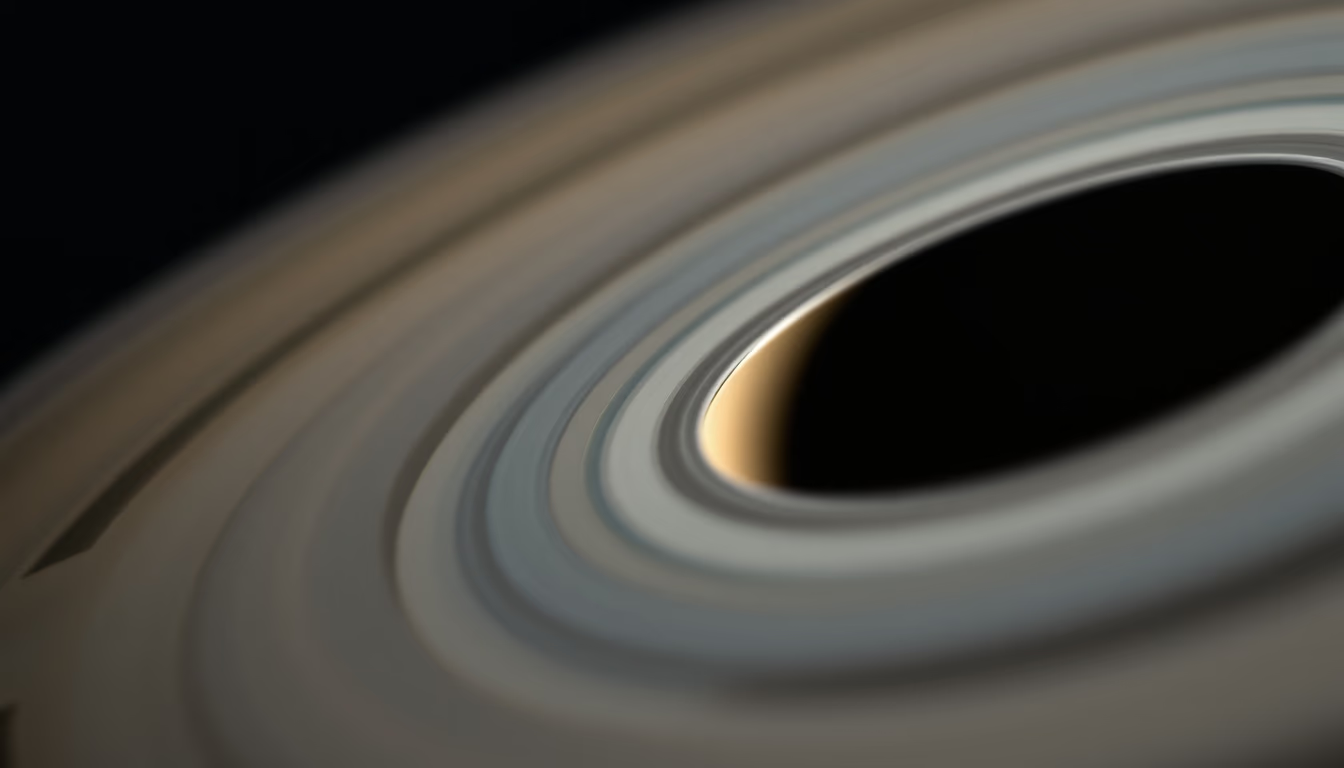
Saturn's rings, composed of billions of ice and rock particles, reveal stunning details in a close-up captured by the Cassini spacecraft.
About this subject
Saturn's rings are among the most fascinating structures in the Solar System. Composed mainly of water ice with a small fraction of dust and rocky debris, they extend about 282,000 kilometers from the planet's equator but are only 10 to 100 meters thick in their thinnest parts. The Cassini spacecraft, which orbited Saturn from 2004 to 2017, provided ultra-high-resolution images that allowed study of details such as density waves, wavy structures, and small shepherd moons that sculpt the rings.
The rings are divided into seven main groups, named A through G, with the most prominent being the A, B, and C rings. Between the A and B rings lies the Cassini Division, a 4,700-kilometer gap that, contrary to earlier belief, is not empty but contains sparse particles. The origin of the rings is still debated: they may be remnants of a shattered moon or of a comet or asteroid captured and fragmented by Saturn's gravity about 100 million years ago. Recent Cassini data suggest the rings are relatively young, with an estimated age between 10 and 100 million years, and are gradually losing material to the planet, a phenomenon known as "ring rain."
Notable features include transient "spokes" that appear in the rings, likely formed by electrostatically charged particles, and tiny moons like Pan and Atlas that orbit within the rings, creating gaps and waves. Studying Saturn's rings not only reveals the dynamics of planetary disks but also helps understand the formation of planetary systems around other stars. The Cassini-Huygens mission, a collaboration among NASA, ESA, and ASI, was instrumental in these advances, ending with the spacecraft diving into Saturn's atmosphere in 2017 to avoid contamination of the moons.
Frequently Asked Questions
What are Saturn's rings made of?
The rings are composed mainly of water ice, with a small percentage of dust and rocky debris. Particles range from tiny grains to house-sized chunks.
How many rings does Saturn have and how are they named?
Saturn has seven main rings designated by the letters A, B, C, D, E, F, and G, in order of discovery. The brightest and most visible are the A, B, and C rings.
Why are Saturn's rings so thin?
The thinness is due to gravitational flattening and interactions with shepherd moons. Particles tend to concentrate in the planet's equatorial plane, forming a very thin structure relative to its width.
Direct URL
https://pub-c7d6a6ea828543ac903a74a341ccb2e1.r2.dev/imagens/saturn-rings-detail-closeup-tilt-shift-miniature-p0.avifHow to credit
Include a visible link back to UtilizAí. Copy one of the snippets below:
<a href="https://xn--utiliza-eza.com/en/midia/imagens/saturn-rings-detail-closeup-tilt-shift-miniature-p0">Saturn rings detail closeup</a> by <a href="https://xn--utiliza-eza.com">UtilizAí</a>, licensed under <a href="https://creativecommons.org/licenses/by/4.0/">CC BY 4.0</a>.
[Saturn rings detail closeup](https://xn--utiliza-eza.com/en/midia/imagens/saturn-rings-detail-closeup-tilt-shift-miniature-p0) by [UtilizAí](https://xn--utiliza-eza.com), CC BY 4.0
License: CC-BY-4.0