Saturn rings detail closeup
1344×768 · AVIF · CC BY 4.0
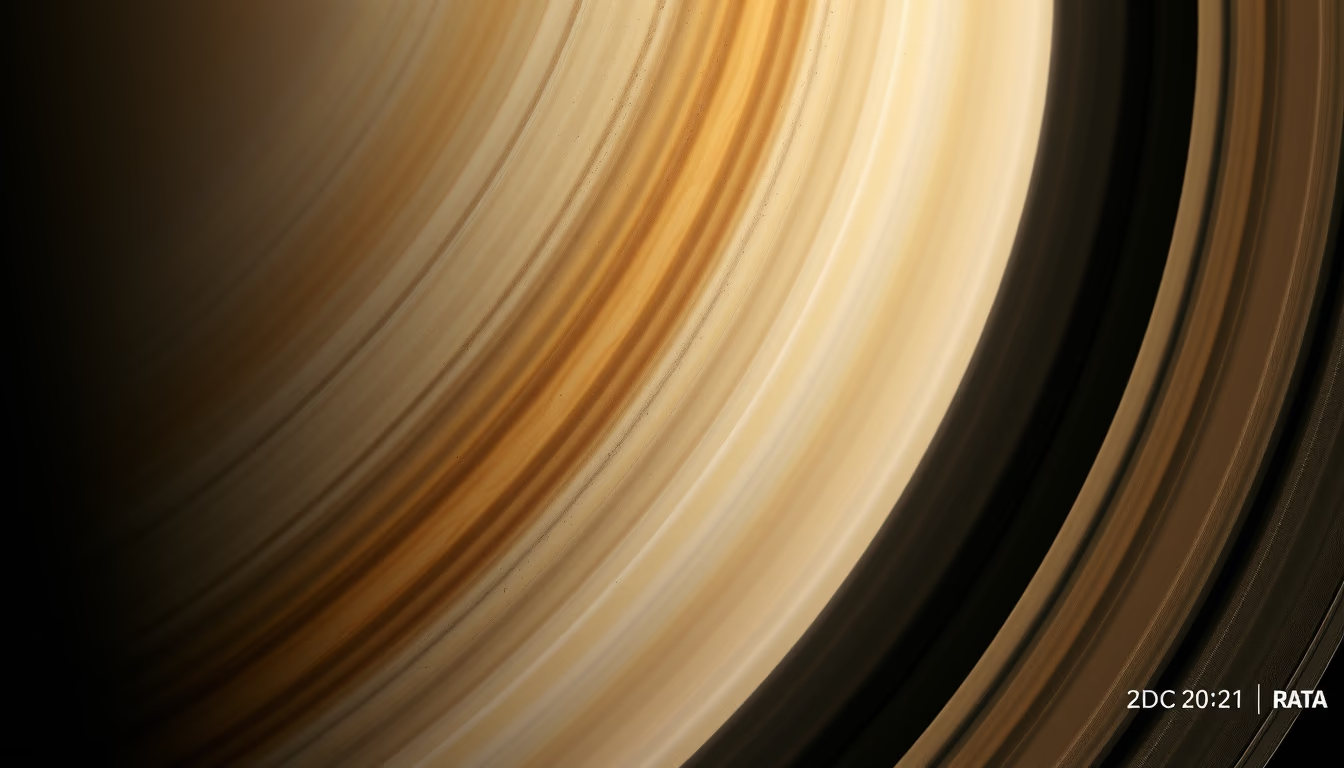
Close-up of Saturn's rings: ice and rock composition, gaps like the Cassini Division, and mysteries about their origin and lifespan.
About this subject
Saturn's rings are among the most iconic wonders of the Solar System. Composed of billions of water-ice particles, dust, and rocky debris, they extend more than 280,000 kilometers from the planet but are only about 10 meters thick in most regions. This extremely thin structure, when viewed up close, reveals an impressive complexity: thousands of individual rings separated by gaps such as the Cassini Division, discovered in 1675 by Giovanni Cassini. This apparent void is actually a region where particle density is much lower, due to gravitational resonance with the moon Mimas.
The origin of the rings is still debated. One theory suggests they are the remnants of a moon or comet that came too close to Saturn and was torn apart by gravity about 100 million years ago, making them relatively young on a geological scale. Another hypothesis is that the rings are leftovers from the nebula that formed the planet, but that would require them to be much older. Missions like Voyager (1980s) and Cassini-Huygens (2004-2017) provided crucial data: Cassini revealed that the rings are losing mass to the planet in a phenomenon called “ring rain”, indicating they may disappear in a few hundred million years.
Interestingly, Saturn's rings are not uniform. The Cassini probe detected vertical structures, such as “mountains” of ice up to 3 kilometers high on some edges, as well as wavy patterns caused by small shepherd moons (like Prometheus and Pandora). These moons keep the edges of specific rings stable. The detailed image of the rings also shows color variations: bluer areas indicate pure ice, while reddish tones suggest a higher concentration of organic dust. This level of detail helps astronomers understand the dynamics of protoplanetary disks and the evolution of ring systems around other giant planets, such as Jupiter, Uranus, and Neptune.
Frequently Asked Questions
How many rings does Saturn have?
Saturn has thousands of individual rings, but the main ones are seven groups named A through G. The entire system is extremely thin and full of gaps, such as the Cassini Division and the Encke Gap.
Are Saturn's rings solid?
No. They consist of billions of ice and rock particles ranging from micrometers to meters in size. The particles orbit Saturn independently, like tiny moons.
Will Saturn's rings disappear?
Yes, eventually. The Cassini probe detected that the rings are losing material to Saturn through 'ring rain'. At this rate, they are estimated to vanish in about 300 million years.
Direct URL
https://pub-c7d6a6ea828543ac903a74a341ccb2e1.r2.dev/imagens/saturn-rings-detail-closeup-national-geographic-style-p11.avifHow to credit
Include a visible link back to UtilizAí. Copy one of the snippets below:
<a href="https://xn--utiliza-eza.com/en/midia/imagens/saturn-rings-detail-closeup-national-geographic-style-p11">Saturn rings detail closeup</a> by <a href="https://xn--utiliza-eza.com">UtilizAí</a>, licensed under <a href="https://creativecommons.org/licenses/by/4.0/">CC BY 4.0</a>.
[Saturn rings detail closeup](https://xn--utiliza-eza.com/en/midia/imagens/saturn-rings-detail-closeup-national-geographic-style-p11) by [UtilizAí](https://xn--utiliza-eza.com), CC BY 4.0
License: CC-BY-4.0