Saturn rings detail closeup
1344×768 · AVIF · CC BY 4.0
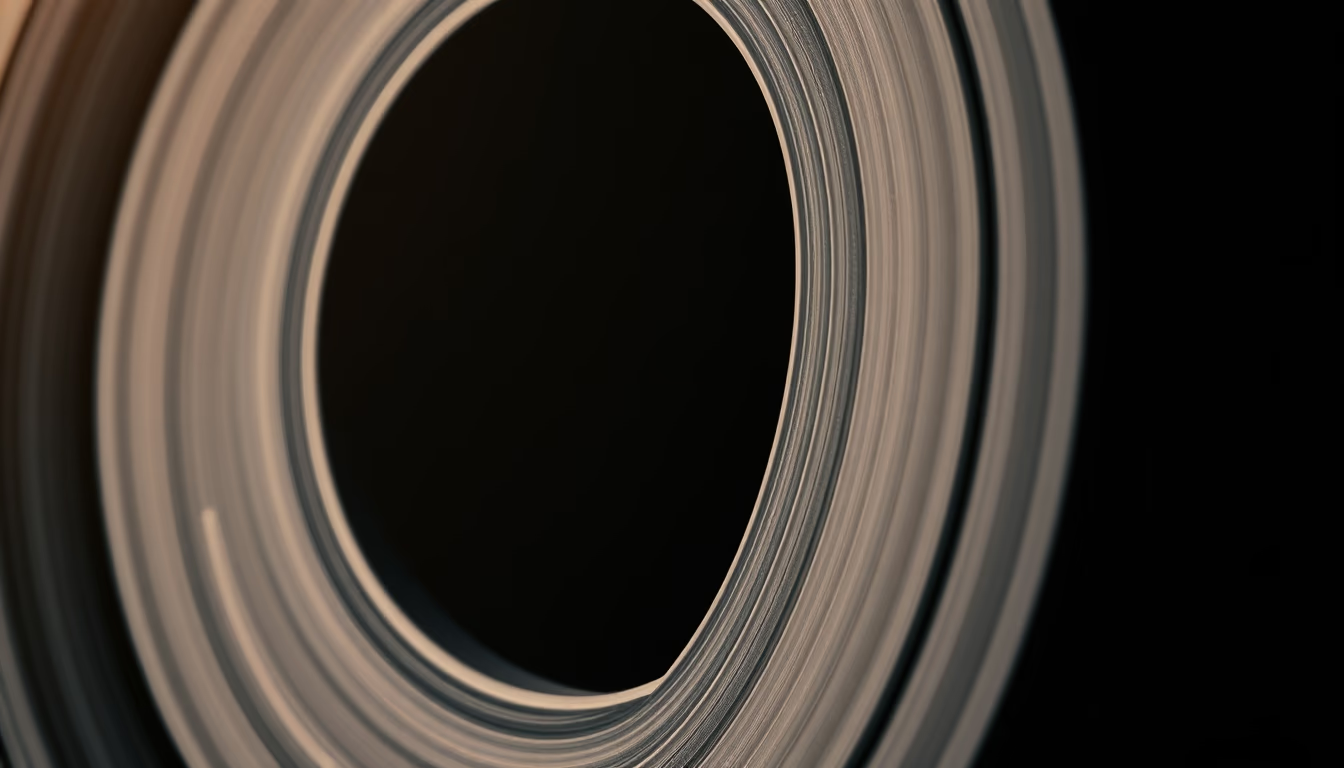
Saturn's rings consist of billions of ice and rock particles, revealing fascinating details about the formation of the solar system.
About this subject
Saturn's rings are among the most iconic features in the solar system, extending up to 282,000 km from the planet's equator but averaging only about 10 meters in thickness. They are composed primarily of water ice, with traces of rocky material and dust, ranging in size from microscopic grains to house-sized chunks. The origin of the rings is still debated, but the most accepted theory suggests they are remnants of a moon or comet that was torn apart by Saturn's gravity billions of years ago.
The ring structure is complex and divided into several main groups named in alphabetical order of discovery: the D, C, B, A, F, G, and E rings, with the B ring being the brightest and densest. Between them are gaps, such as the Cassini Division, 4,800 km wide, separating the A and B rings. These gaps are maintained by gravitational resonances with Saturn's moons, particularly Mimas and Enceladus. Observations from the Cassini spacecraft, which orbited Saturn from 2004 to 2017, revealed surprising details, such as vertical structures up to 2.5 km high in the rings, formed by gravitational perturbations.
The rings are not static; they are constantly evolving, with particles colliding, clumping, and disintegrating. Recent studies indicate the rings may be relatively young, less than 100 million years old, and are slowly disappearing as material falls into Saturn or is ejected into space. This process, called 'ring rain,' releases about 10,000 kg of material per second. Understanding Saturn's rings helps scientists better understand the dynamics of proto-planetary disks and the evolution of the solar system.
Frequently Asked Questions
What are Saturn's rings made of?
The rings are composed mostly of water ice, with a small percentage of rocky material and dust. Particles range from microscopic grains to house-sized chunks.
How many rings does Saturn have?
Saturn has several main rings: D, C, B, A, F, G, and E, along with numerous fainter rings and gaps. The alphabetical designation follows the order of discovery.
Are Saturn's rings disappearing?
Yes, the rings are gradually losing material. The Cassini spacecraft detected about 10,000 kg of particles falling into Saturn per second, which could cause the rings to vanish in 100 to 300 million years.
Direct URL
https://pub-c7d6a6ea828543ac903a74a341ccb2e1.r2.dev/imagens/saturn-rings-detail-closeup-magazine-editorial-p8.avifHow to credit
Include a visible link back to UtilizAí. Copy one of the snippets below:
<a href="https://xn--utiliza-eza.com/en/midia/imagens/saturn-rings-detail-closeup-magazine-editorial-p8">Saturn rings detail closeup</a> by <a href="https://xn--utiliza-eza.com">UtilizAí</a>, licensed under <a href="https://creativecommons.org/licenses/by/4.0/">CC BY 4.0</a>.
[Saturn rings detail closeup](https://xn--utiliza-eza.com/en/midia/imagens/saturn-rings-detail-closeup-magazine-editorial-p8) by [UtilizAí](https://xn--utiliza-eza.com), CC BY 4.0
License: CC-BY-4.0