Saturn rings detail closeup
1344×768 · AVIF · CC BY 4.0
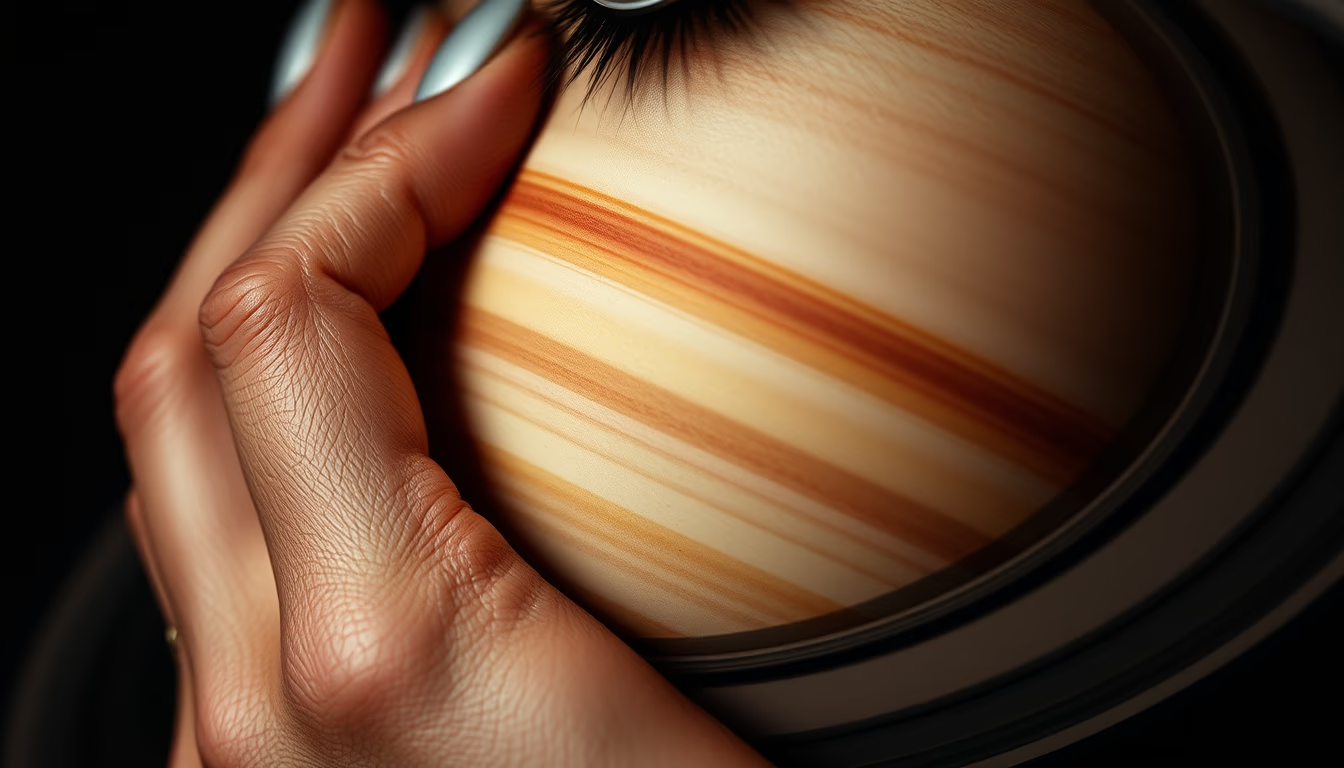
Stunning details of Saturn's rings, composed of billions of ice and rock particles, reveal the complexity of the Solar System's most famous ring system.
About this subject
Saturn's rings are one of the most fascinating spectacles in the Solar System. Stretching more than 280,000 kilometers in diameter, they are predominantly composed of water ice particles, with traces of dust and rock. The system is divided into seven main rings, labeled A through G, with the B ring being the brightest and most massive. Notable gaps exist between them, such as the Cassini Division, a 4,800-kilometer gap between the A and B rings discovered by astronomer Giovanni Cassini in the 17th century. The thickness of the rings is surprisingly small, in most places less than 10 meters, despite their immense lateral extent.
The discovery of Saturn's rings dates back to 1610, when Galileo Galilei observed the planet with his primitive telescope and described the lateral protrusions as 'ears.' It was not until 1655 that Christiaan Huygens, using a more powerful telescope, correctly identified the structure as a ring around the planet. Since then, ground-based and space-based observations have refined our understanding. The Cassini-Huygens mission, which orbited Saturn from 2004 to 2017, provided high-resolution images that revealed minute details, such as small shepherd moons that sculpt sharp edges and density waves propagating through the material.
The origin of the rings is debated. The most accepted theory suggests they formed from debris of comets, asteroids, or moons that disintegrated due to Saturn's tidal forces. This process would have occurred in the last 100 million years, making the rings relatively young on a geological timescale. Dynamic phenomena, such as spokes that appear as radial dark or bright marks, are influenced by Saturn's magnetic field. The gravity of inner moons, like Prometheus and Pandora, also acts to confine particles and maintain the structure of the rings over time.
Although iconic, Saturn's rings may not be eternal. Recent studies indicate that material is falling into the planet's atmosphere at a rate that could make the rings disappear entirely in 300 million years. Future missions, such as Dragonfly (which will study Titan but also observe Saturn), and telescopes like the James Webb will continue to monitor these changes. Every new detail of the rings offers clues about the history of the Saturnian system and the processes that shape giant planets.
Frequently Asked Questions
What are Saturn's rings made of?
Saturn's rings are primarily composed of water ice, with a small fraction of dust and rocky debris. The particles range in size from microscopic grains to chunks as large as mountains.
How many rings does Saturn have?
Saturn has seven main rings, designated by letters A through G (in order of discovery). There are also fainter rings and gaps like the Cassini Division. In reality, each main ring consists of thousands of smaller ringlets.
Are Saturn's rings permanent?
No, studies suggest the rings may be relatively young (around 100 million years old) and are slowly losing material to Saturn. They could completely disappear in 300 million years.
Direct URL
https://pub-c7d6a6ea828543ac903a74a341ccb2e1.r2.dev/imagens/saturn-rings-detail-closeup-high-fashion-editorial-p12.avifHow to credit
Include a visible link back to UtilizAí. Copy one of the snippets below:
<a href="https://xn--utiliza-eza.com/en/midia/imagens/saturn-rings-detail-closeup-high-fashion-editorial-p12">Saturn rings detail closeup</a> by <a href="https://xn--utiliza-eza.com">UtilizAí</a>, licensed under <a href="https://creativecommons.org/licenses/by/4.0/">CC BY 4.0</a>.
[Saturn rings detail closeup](https://xn--utiliza-eza.com/en/midia/imagens/saturn-rings-detail-closeup-high-fashion-editorial-p12) by [UtilizAí](https://xn--utiliza-eza.com), CC BY 4.0
License: CC-BY-4.0





