Saturn rings detail closeup
1344×768 · AVIF · CC BY 4.0
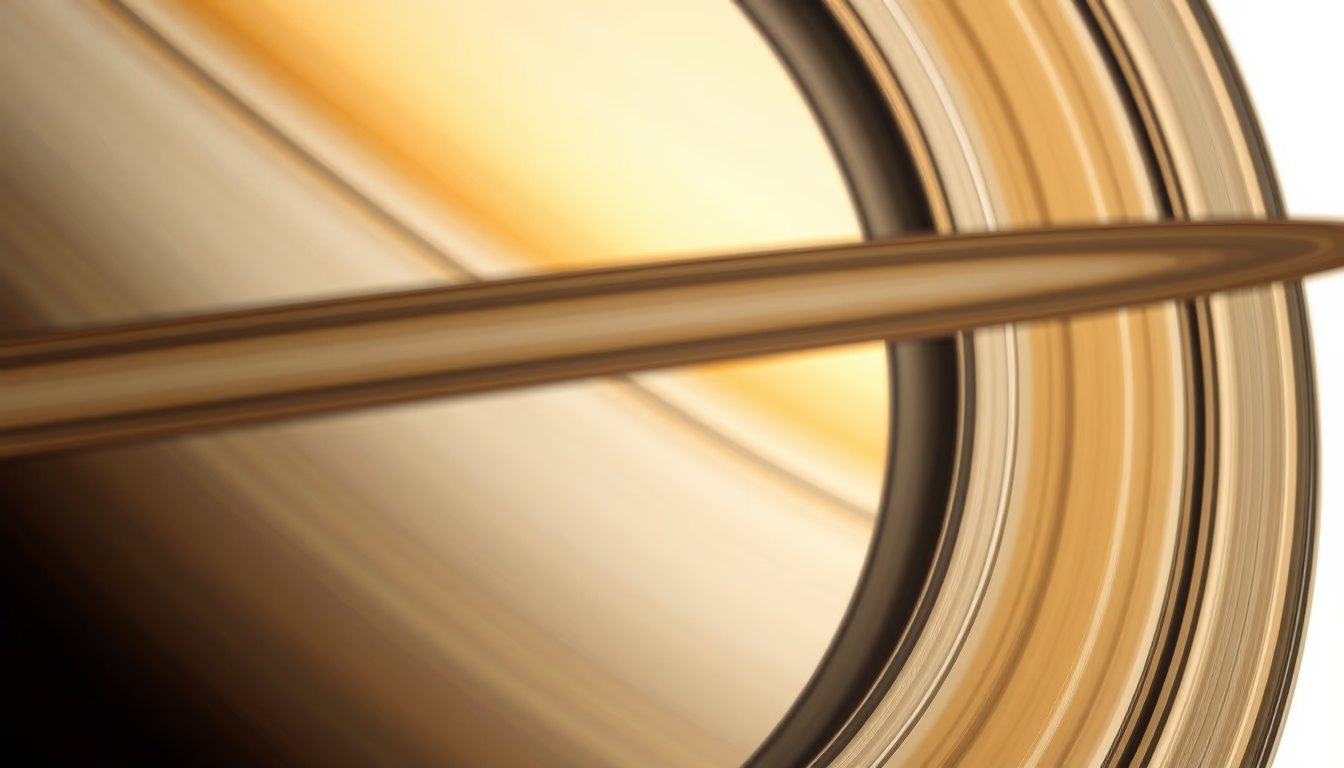
Saturn's rings consist of billions of ice and rock particles, revealing stunning details in close-ups captured by space probes.
About this subject
Saturn's rings are one of the most striking phenomena in the Solar System, composed of particles ranging from dust grains to mountain-sized chunks. These particles consist primarily of water ice, with traces of rocky materials and organic compounds. The rings are estimated to have formed about 100 million years ago, relatively young in geological terms, possibly from the breakup of moons or comets that came too close to the planet.
The ring structure is incredibly complex, divided into main rings designated by letters A, B, C, D, E, F, and G, with the B ring being the widest and brightest. Between the A and B rings lies the Cassini Division, a gap approximately 4,700 kilometers wide, discovered by astronomer Giovanni Cassini in the 17th century. The ring particles are not static; they move in Keplerian orbits around Saturn, with speeds decreasing as they move farther from the planet.
Detailed observations by probes such as Cassini-Huygens, which orbited Saturn from 2004 to 2017, revealed fine structures like density waves, small shepherd moons that sculpt the rings, and shadowing effects creating three-dimensional patterns. Cassini also detected that the rings are gradually losing material, falling into Saturn's atmosphere, suggesting they may disappear in a few tens of millions of years.
Beyond their visual beauty, Saturn's rings are natural laboratories for studying orbital dynamics and gravitational interactions. They also help scientists better understand the history of the Solar System and similar processes that may occur on exoplanets. Although other giant planets like Jupiter, Uranus, and Neptune have ring systems, Saturn's are the most extensive and brightest, visible from Earth with amateur telescopes.
Frequently Asked Questions
What are Saturn's rings made of?
The rings are composed mostly of water ice, with rock and dust particles. Their sizes range from microscopic grains to chunks several meters across.
How many rings does Saturn have?
There are several main rings designated by letters A through G, with the most prominent being the A, B, and C rings. There are also divisions and fainter ringlets.
Will Saturn's rings disappear?
Yes, the rings are gradually losing material to Saturn's atmosphere. They are estimated to dissipate completely in about 100 million years.
Direct URL
https://pub-c7d6a6ea828543ac903a74a341ccb2e1.r2.dev/imagens/saturn-rings-detail-closeup-commercial-product-photography-p9.avifHow to credit
Include a visible link back to UtilizAí. Copy one of the snippets below:
<a href="https://xn--utiliza-eza.com/en/midia/imagens/saturn-rings-detail-closeup-commercial-product-photography-p9">Saturn rings detail closeup</a> by <a href="https://xn--utiliza-eza.com">UtilizAí</a>, licensed under <a href="https://creativecommons.org/licenses/by/4.0/">CC BY 4.0</a>.
[Saturn rings detail closeup](https://xn--utiliza-eza.com/en/midia/imagens/saturn-rings-detail-closeup-commercial-product-photography-p9) by [UtilizAí](https://xn--utiliza-eza.com), CC BY 4.0
License: CC-BY-4.0