Satellite in orbit earth blue
1344×768 · AVIF · CC BY 4.0
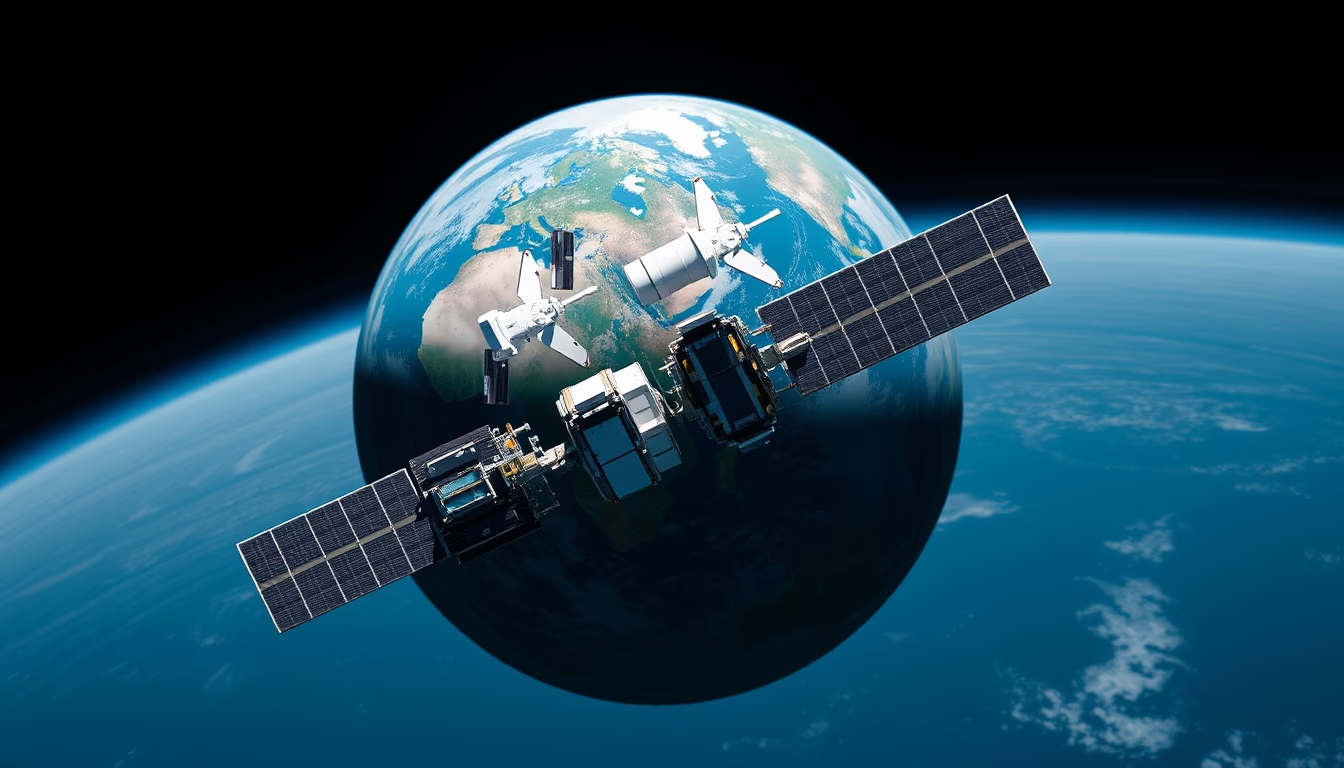
Satellites orbiting Earth are critical for communications, climate monitoring, and global navigation, with thousands currently in operation.
About this subject
Artificial satellites have been orbiting Earth since Sputnik 1, launched by the Soviet Union on October 4, 1957. Today, over 8,000 active and inactive satellites circle the planet, with about 5,000 operational as of 2024. They occupy different altitudes: low Earth orbit (LEO, up to 2,000 km), home to the International Space Station and constellations like Starlink; geostationary orbit (GEO, 35,786 km), used for communications and weather satellites; and medium Earth orbit (MEO), utilized by navigation systems such as GPS and Galileo.
Satellite functions span telecommunications (TV, internet, telephony), Earth observation (satellite imagery for agriculture, disaster monitoring, urban planning), meteorology (weather forecasting), navigation (GPS/GLONASS/BeiDou), and scientific research (astronomy, fundamental physics). Each orbit offers specific advantages: LEO provides low latency for communications and high spatial resolution for imaging; GEO allows a satellite to 'see' the same region of Earth constantly, ideal for continuous broadcasts.
Brazil operates its own satellites, such as SCD-1 (launched in 1993) and the CBERS series (in partnership with China), focused on environmental monitoring of the Amazon and natural resources. The Brazilian space program also develops the geostationary satellite SGDC for defense and communications. However, the country depends on international agreements for launches, using bases like Alcântara (MA) or foreign services.
A curious fact: the International Space Station travels at about 28,000 km/h, completing an orbit every 90 minutes. A geostationary satellite must be at 35,786 km altitude to remain fixed over a point on the equator. The growing number of satellites, especially in LEO with megaconstellation projects, has raised concerns about light pollution and collision risks in space.
Frequently Asked Questions
How many artificial satellites are currently orbiting Earth?
Over 8,000 satellites (including inactive ones) are in orbit. About 5,000 are operational as of 2024.
What is the difference between low Earth orbit (LEO) and geostationary orbit (GEO)?
LEO ranges up to 2,000 km in altitude, with satellites moving fast and having low latency. GEO is at 35,786 km, where a satellite remains fixed over one Earth spot, ideal for continuous communication.
Does Brazil have its own satellites?
Yes. The first was SCD-1 (1993). Today, the country operates CBERS satellites (with China) and SGDC, used for environmental monitoring and communications.
Direct URL
https://pub-c7d6a6ea828543ac903a74a341ccb2e1.r2.dev/imagens/satellite-in-orbit-earth-blue-minimalist-composition-p5.avifHow to credit
Include a visible link back to UtilizAí. Copy one of the snippets below:
<a href="https://xn--utiliza-eza.com/en/midia/imagens/satellite-in-orbit-earth-blue-minimalist-composition-p5">Satellite in orbit earth blue</a> by <a href="https://xn--utiliza-eza.com">UtilizAí</a>, licensed under <a href="https://creativecommons.org/licenses/by/4.0/">CC BY 4.0</a>.
[Satellite in orbit earth blue](https://xn--utiliza-eza.com/en/midia/imagens/satellite-in-orbit-earth-blue-minimalist-composition-p5) by [UtilizAí](https://xn--utiliza-eza.com), CC BY 4.0
License: CC-BY-4.0