Satellite in orbit earth blue
1344×768 · AVIF · CC BY 4.0

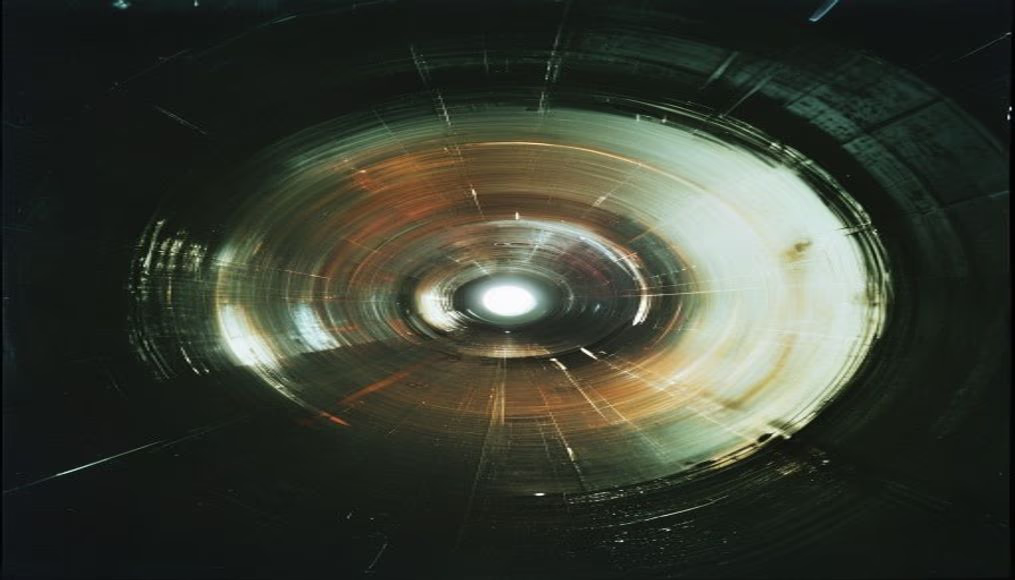
Satellites in Earth orbit are essential for communications, climate monitoring, and observing the blue planet.
About this subject
Artificial satellites orbit Earth at various altitudes, from Low Earth Orbit (LEO) to Geostationary Orbit (GEO). In LEO, about 200 to 2,000 km high, reside the International Space Station and most Earth observation satellites, such as Landsat and ESA's Sentinel series. These platforms capture multispectral imagery to monitor deforestation, urbanization, and ocean changes.
In geostationary orbit, roughly 36,000 km up, satellites like the GOES series or Brazil's SGDC-1 remain fixed over a single point, crucial for weather forecasting and telecommunications. Brazil's equatorial location offers launch advantages, making the Alcântara Launch Center (MA) one of the closest to the Equator worldwide.
The proliferation of satellites, especially mega-constellations like Starlink and OneWeb, has raised concerns about space debris. Over 30,000 objects are cataloged in orbit, including active satellites and fragments. Remediation efforts, such as magnetic nets or lasers, are under development to address the issue.
By 2026, trends point to smaller, cheaper satellites (CubeSats) and greater onboard AI integration, enabling real-time data analysis. The Earth observation market is projected to exceed US$7 billion, driven by agricultural, environmental, and national security applications.
Frequently Asked Questions
How many satellites are currently in Earth orbit?
It is estimated that over 8,000 satellites are in orbit, of which about 5,000 are operational. Most are in Low Earth Orbit (LEO), including internet constellations.
Why are Earth observation satellites important for Brazil?
Satellites like CBERS (Brazil-China partnership) and Amazonia-1 monitor the Amazon and other biomes, providing crucial data for environmental policies, deforestation prevention, and precision agriculture.
What is space debris and how does it affect satellites?
Space debris consists of non-functional objects in orbit, such as rocket stages and collision fragments. They pose an impact risk and can damage active satellites, requiring constant evasive maneuvers.
Direct URL
https://pub-c7d6a6ea828543ac903a74a341ccb2e1.r2.dev/imagens/satellite-in-orbit-earth-blue-aerial-drone-shot-p3.avifHow to credit
Include a visible link back to UtilizAí. Copy one of the snippets below:
<a href="https://xn--utiliza-eza.com/en/midia/imagens/satellite-in-orbit-earth-blue-aerial-drone-shot-p3">Satellite in orbit earth blue</a> by <a href="https://xn--utiliza-eza.com">UtilizAí</a>, licensed under <a href="https://creativecommons.org/licenses/by/4.0/">CC BY 4.0</a>.
[Satellite in orbit earth blue](https://xn--utiliza-eza.com/en/midia/imagens/satellite-in-orbit-earth-blue-aerial-drone-shot-p3) by [UtilizAí](https://xn--utiliza-eza.com), CC BY 4.0
License: CC-BY-4.0