Retired investor reviewing real estate fund portfolio
1344×768 · AVIF · CC BY 4.0

Retired investor reviews real estate fund portfolio in the late afternoon, focusing on passive income strategies.
About this subject
Real estate investment trusts (REITs) in Brazil, known as Fundos Imobiliários (FIIs), pool capital to invest in properties like shopping malls, corporate offices, and logistics warehouses. For retired investors, these funds provide monthly tax-free income for individuals, subject to certain limits. The depicted investor, likely in his 60s, is reviewing his portfolio in the late afternoon, a strategic time after market close to calmly analyze dividend distributions and share price appreciation.
Choosing FIIs in retirement is common in Brazil, as many funds yield returns above inflation, such as those tracked by the IFIX index. The investor may be checking portfolio composition, which ideally should be diversified across sectors like logistics, retail, and residential income. Vacancy risk is a key factor affecting dividends.
A notable fact: unlike stocks, FIIs are required to distribute 95% of net profit semiannually, making them attractive for predictable cash flow. However, share prices can fluctuate with interest rates like the Selic. Retired investors must balance income generation with volatility protection.
The late-afternoon natural light in the image suggests a study and planning environment. Many investors use spreadsheets or platforms like CEI to track their FIIs. Periodic portfolio review is essential to adjust allocations as real estate and economic conditions change.
Frequently Asked Questions
What are real estate investment trusts (FIIs)?
FIIs are collective investments that allocate capital to real estate projects like shopping malls, corporate offices, and logistics warehouses. They distribute periodic income to shareholders, often tax-free for individuals.
Why do retired investors choose FIIs?
FIIs provide predictable monthly income, with potential to outpace inflation. The mandatory distribution of 95% of net profit and tax exemption for individuals make them attractive for retirement income.
How to analyze an FII portfolio in retirement?
Key factors include sector diversification, dividend history, property vacancy rates, and interest rate sensitivity. Tools like the IFIX index and spreadsheets help monitor performance.
Direct URL
https://pub-c7d6a6ea828543ac903a74a341ccb2e1.r2.dev/imagens/retired-investor-reviewing-real-estate-fund-portfolio-wide-late-afternoon-2.avifHow to credit
Include a visible link back to UtilizAí. Copy one of the snippets below:
<a href="https://xn--utiliza-eza.com/en/midia/imagens/retired-investor-reviewing-real-estate-fund-portfolio-wide-late-afternoon-2">Retired investor reviewing real estate fund portfolio</a> by <a href="https://xn--utiliza-eza.com">UtilizAí</a>, licensed under <a href="https://creativecommons.org/licenses/by/4.0/">CC BY 4.0</a>.
[Retired investor reviewing real estate fund portfolio](https://xn--utiliza-eza.com/en/midia/imagens/retired-investor-reviewing-real-estate-fund-portfolio-wide-late-afternoon-2) by [UtilizAí](https://xn--utiliza-eza.com), CC BY 4.0
License: CC-BY-4.0
Tags
Related images
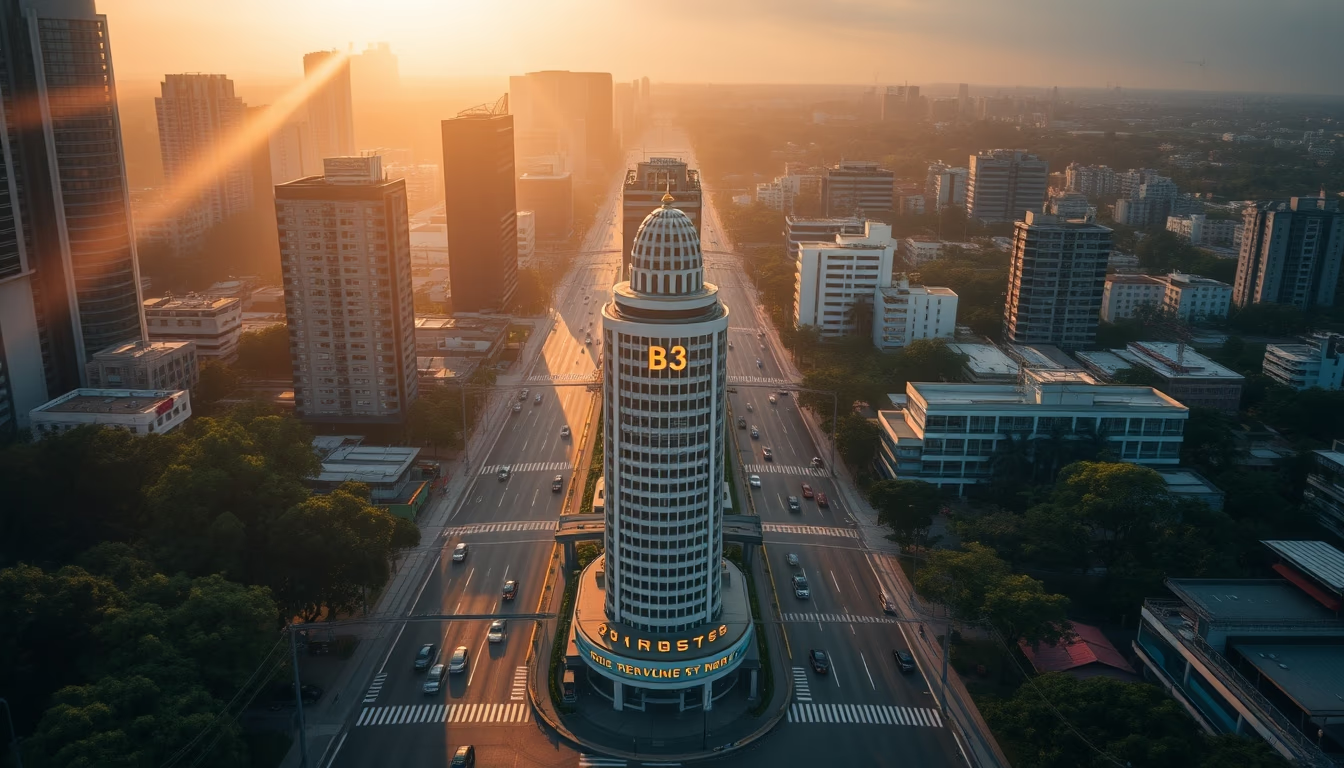 Aerial view of São Paulo financial district at golden hour with B3 building
 Aerial view of São Paulo financial district at golden hour with B3 building
 Aerial view of São Paulo financial district at golden hour with B3 building
 Aerial view of São Paulo financial district at golden hour with B3 building
 Aerial view of São Paulo financial district at golden hour with B3 building
 Aerial view of São Paulo financial district at golden hour with B3 building