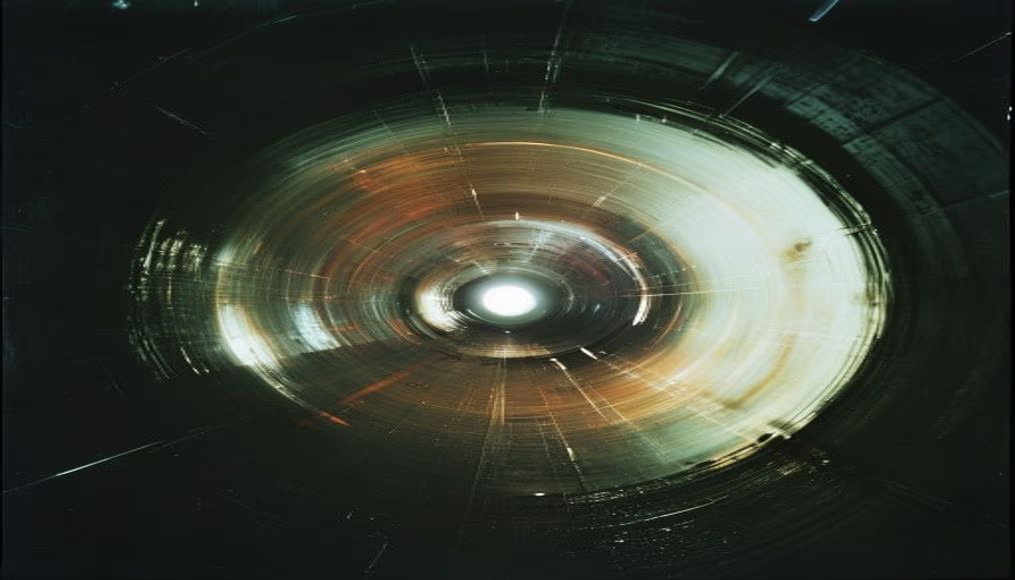
Red giant star expanding
1344×768 · AVIF · CC BY 4.0

Red giant stars are advanced stages of stellar evolution, when the core hydrogen is exhausted and the star expands dramatically.
About this subject
A red giant star is a late stage in the life of low- to intermediate-mass stars, including our Sun. When hydrogen in the core is depleted, nuclear fusion ceases temporarily, and the core contracts under gravity, heating up. This heat causes the outer layers to expand and cool, making the star much larger and redder. The radius can increase tens to hundreds of times the original size. For example, Aldebaran, a red giant in Taurus, has a radius about 44 times that of the Sun. Betelgeuse in Orion, a red supergiant, has a radius roughly 700 times solar, but it is a more massive star.
The red giant phase is relatively short, lasting hundreds of millions of years. During this stage, the star may undergo helium flashes in the core, burning helium into carbon and oxygen. Eventually, the outer layers are ejected, forming a planetary nebula, while the remaining core becomes a white dwarf. The Sun will experience this fate in about 5 billion years, expanding to Earth's orbit and possibly engulfing the inner planets.
Red giants are important for understanding the chemical evolution of the galaxy, as they produce and disperse heavy elements into interstellar space. Variables such as Mira (Omicron Ceti) are pulsating red giants that change brightness over months, a phenomenon observed by amateur and professional astronomers. Observing these stars helps calibrate stellar evolution models and cosmic distances.
Frequently Asked Questions
What is a red giant star?
A red giant is a star that has exhausted the hydrogen in its core and expanded its outer layers, becoming larger and cooler with a reddish color.
What will happen when the Sun becomes a red giant?
The Sun will expand to roughly Earth's orbit, engulfing Mercury and Venus, and eventually shed its outer layers to form a planetary nebula, leaving a white dwarf.
What are examples of red giant stars?
Aldebaran (Taurus) and Mira (Cetus) are classic examples. Betelgeuse (Orion) is a red supergiant, a more massive version.
Direct URL
https://pub-c7d6a6ea828543ac903a74a341ccb2e1.r2.dev/imagens/red-giant-star-expanding-fish-eye-wide-angle-p0.avifHow to credit
Include a visible link back to UtilizAí. Copy one of the snippets below:
<a href="https://xn--utiliza-eza.com/en/midia/imagens/red-giant-star-expanding-fish-eye-wide-angle-p0">Red giant star expanding</a> by <a href="https://xn--utiliza-eza.com">UtilizAí</a>, licensed under <a href="https://creativecommons.org/licenses/by/4.0/">CC BY 4.0</a>.
[Red giant star expanding](https://xn--utiliza-eza.com/en/midia/imagens/red-giant-star-expanding-fish-eye-wide-angle-p0) by [UtilizAí](https://xn--utiliza-eza.com), CC BY 4.0
License: CC-BY-4.0