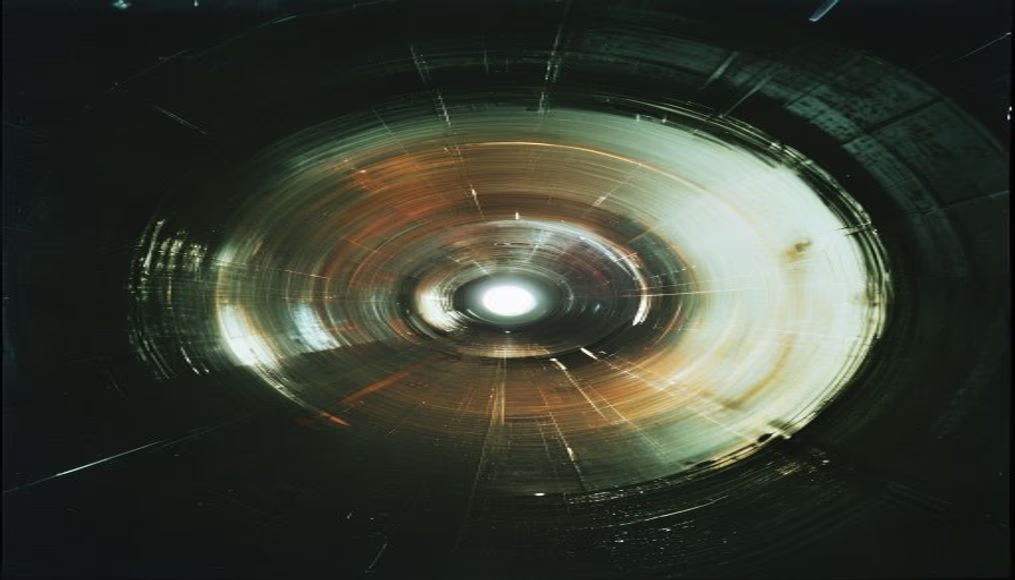
Red giant star expanding
1344×768 · AVIF · CC BY 4.0

Red giant stars represent a late stage of stellar evolution, characterized by expansion and intense brightness, exemplified by Betelgeuse in the constellation Orion.
About this subject
A red giant is a star that has exhausted the hydrogen in its core and begun fusing helium, causing its outer layers to expand. This process occurs in low to intermediate mass stars, such as the Sun, which will become a red giant in about 5 billion years. During this phase, the star's diameter can increase hundreds of times while its surface temperature drops, giving it the characteristic reddish color.
The star Betelgeuse, in the constellation Orion, is a prominent example of a red giant. Approximately 700 times the Sun's diameter, it is one of the brightest stars in the night sky. Recent observations have shown unusual brightness variations, sparking speculation about a possible supernova explosion, though this could take thousands of years. Another famous red giant is Aldebaran, the brightest star in the constellation Taurus.
The red giant phase is relatively short, lasting a few million years compared to the star's total lifetime of billions of years. Eventually, the star sheds its outer layers, forming a planetary nebula, while the core becomes a white dwarf. In more massive stars, evolution can lead to supernova explosions and the formation of neutron stars or black holes.
Studying red giants is crucial for understanding the chemical evolution of the universe, as they produce and disperse heavy elements like carbon and oxygen. These elements are essential for the formation of planets and life as we know it.
Frequently Asked Questions
What causes the reddish color of a red giant?
The color results from low surface temperatures, typically between 3,000 and 4,000 Kelvin, compared to hotter stars. The emitted light shifts toward the red end of the visible spectrum.
Will the Sun become a red giant? When?
Yes, the Sun will evolve into a red giant in about 5 billion years. Its diameter will increase enough to engulf Mercury and Venus, and possibly Earth.
What is the difference between a red giant and a red supergiant?
Red supergiants are very massive stars, over 10 solar masses, that also expand but are larger and more luminous. Examples include Antares and VY Canis Majoris.
Direct URL
https://pub-c7d6a6ea828543ac903a74a341ccb2e1.r2.dev/imagens/red-giant-star-expanding-commercial-product-photography-p10.avifHow to credit
Include a visible link back to UtilizAí. Copy one of the snippets below:
<a href="https://xn--utiliza-eza.com/en/midia/imagens/red-giant-star-expanding-commercial-product-photography-p10">Red giant star expanding</a> by <a href="https://xn--utiliza-eza.com">UtilizAí</a>, licensed under <a href="https://creativecommons.org/licenses/by/4.0/">CC BY 4.0</a>.
[Red giant star expanding](https://xn--utiliza-eza.com/en/midia/imagens/red-giant-star-expanding-commercial-product-photography-p10) by [UtilizAí](https://xn--utiliza-eza.com), CC BY 4.0
License: CC-BY-4.0