Quantum computer in research lab
1344×768 · AVIF · CC BY 4.0
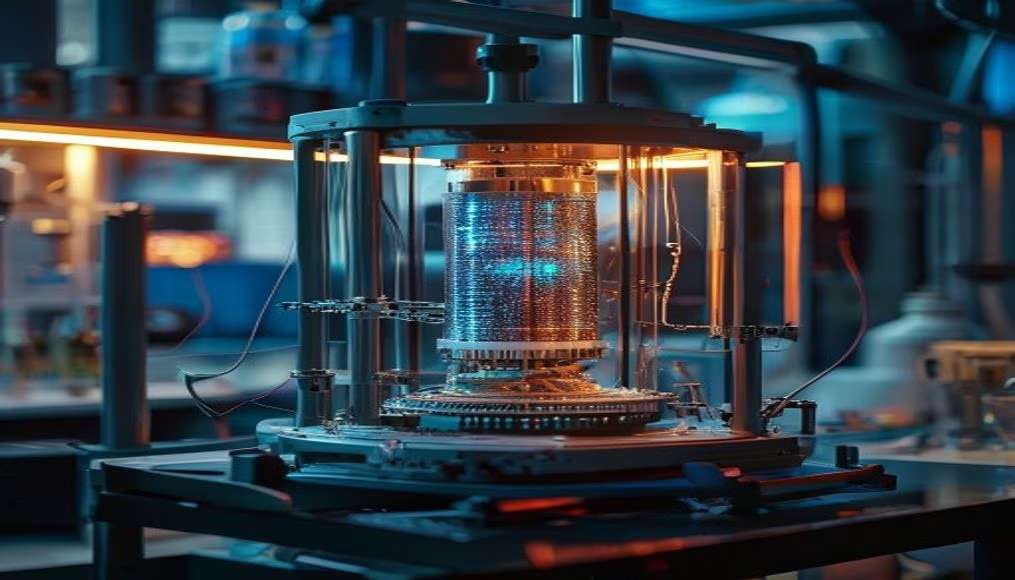
Quantum computers in research labs represent the frontier of computing, exploiting quantum mechanics phenomena to solve complex problems.
About this subject
Quantum computers operate with qubits, which can represent both 0 and 1 simultaneously thanks to quantum superposition. This property allows them to perform calculations exponentially faster than classical computers for specific tasks. Currently, laboratories like IBM Quantum Network and Google Quantum AI lead research, with systems that have already achieved so-called quantum supremacy in sampling problems.
In Brazil, the National Synchrotron Light Laboratory (LNLS) and universities such as USP and Unicamp develop research in quantum computing, focusing on algorithms, error correction, and materials for superconducting qubits. The country also participates in international collaborations, such as the IBM Quantum Hub project. Despite advances, quantum computers still require temperatures near absolute zero (-273°C) and extreme isolation to function, limiting their use outside the controlled lab environment.
Quantum computing promises to revolutionize areas like cryptography, molecular simulation, and logistics optimization. For instance, Shor's algorithm could break widely used RSA encryption systems, while quantum simulators may unravel mechanisms of complex chemical reactions. However, hardware remains experimental and faces challenges of scalability and qubit coherence. Companies like Rigetti and IonQ already offer remote access to quantum prototypes via the cloud, allowing researchers worldwide to test their algorithms.
Frequently Asked Questions
What is a quantum computer and how does it differ from a classical computer?
A quantum computer uses qubits instead of classical bits, exploiting quantum superposition and entanglement to process information. While classical computers work with 0 or 1, qubits can be in both states at once, enabling massive parallelism in certain calculations.
What are the main challenges in building a practical quantum computer?
Key challenges include maintaining qubit coherence (the time they retain their quantum state), reducing errors from environmental noise, and scaling the system to thousands of reliable qubits. Currently, most qubits require cryogenic temperatures and vibration isolation.
Does Brazil have active research in quantum computing?
Yes, institutions like LNLS, USP, Unicamp, and CBPF conduct theoretical and experimental research. The country participates in international quantum algorithm test networks and studies superconducting materials and trapped-ion technologies.
Direct URL
https://pub-c7d6a6ea828543ac903a74a341ccb2e1.r2.dev/imagens/quantum-computer-in-research-lab-street-photography-v11.avifHow to credit
Include a visible link back to UtilizAí. Copy one of the snippets below:
<a href="https://xn--utiliza-eza.com/en/midia/imagens/quantum-computer-in-research-lab-street-photography-v11">Quantum computer in research lab</a> by <a href="https://xn--utiliza-eza.com">UtilizAí</a>, licensed under <a href="https://creativecommons.org/licenses/by/4.0/">CC BY 4.0</a>.
[Quantum computer in research lab](https://xn--utiliza-eza.com/en/midia/imagens/quantum-computer-in-research-lab-street-photography-v11) by [UtilizAí](https://xn--utiliza-eza.com), CC BY 4.0
License: CC-BY-4.0