Quantum computer chip
1344×768 · AVIF · CC BY 4.0
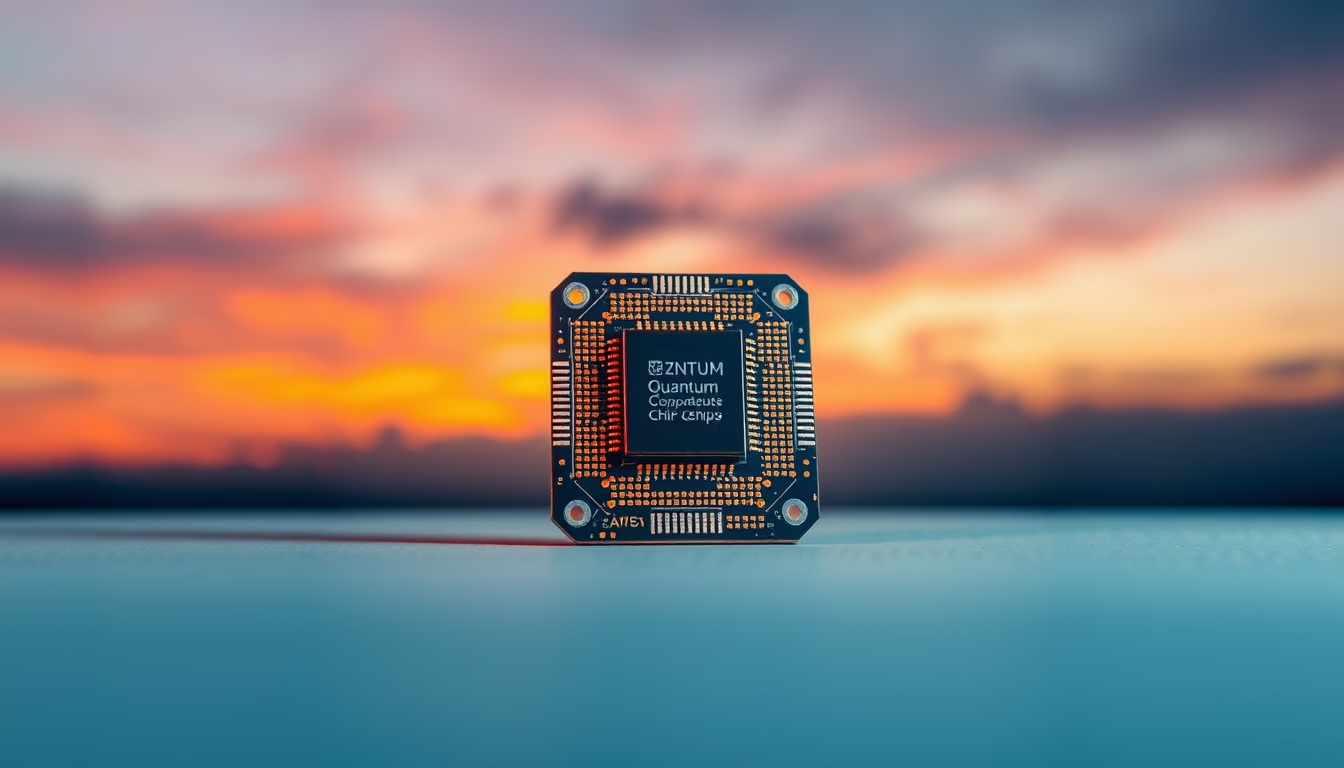
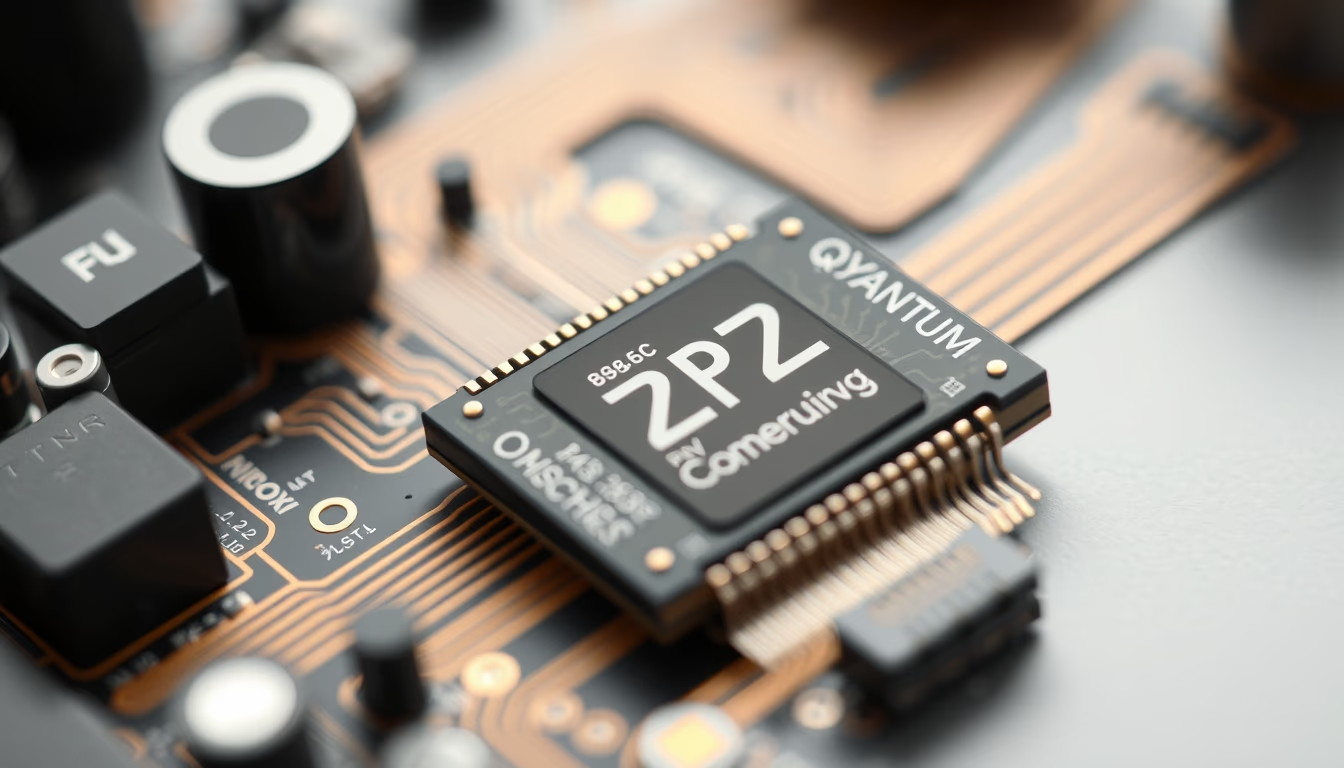
Quantum computer chips use qubits to process information exponentially faster than classical chips, revolutionizing fields like cryptography and molecular simulation.
About this subject
A quantum computer chip is the central component of a quantum computer, responsible for hosting and manipulating qubits. Unlike classical bits (0 or 1), qubits can exist in a superposition of states, thanks to principles of quantum mechanics. This property allows quantum computers to solve certain complex problems in minutes, while classical supercomputers would take thousands of years.
Currently, several technologies compete to build scalable quantum chips. The main approaches include superconducting qubits (used by Google and IBM), trapped ions (as in IonQ), and topological qubits (under development by Microsoft). Each has advantages and challenges: for instance, superconducting qubits operate at temperatures near absolute zero and are susceptible to noise, while trapped ions have longer coherence times but limited scalability.
Developing quantum chips faces significant obstacles. Quantum error correction is a major bottleneck, as qubits are extremely sensitive to external disturbances. To achieve practical quantum supremacy, millions of logical qubits (each composed of several physical qubits) are needed. In 2023, the largest superconducting quantum processor had 1,121 qubits (IBM Osprey), but still far from what is necessary for widespread commercial applications.
Despite challenges, recent advances show progress. In 2023, Google's Sycamore processor demonstrated a task that would take 10,000 years on a classical supercomputer. Companies and governments invest billions of dollars in the field, and the first fault-tolerant quantum computers are expected by the end of the decade, impacting sectors like pharmaceuticals, finance, and artificial intelligence.
Frequently Asked Questions
What is a quantum computer chip?
It is the hardware that houses and manipulates qubits, the fundamental building blocks of quantum computing. It operates based on quantum phenomena like superposition and entanglement.
What are the main types of quantum chips?
The main types are: superconducting (IBM, Google), trapped ion (IonQ), and topological qubits (Microsoft). Each uses a different technology to create and control qubits.
What challenges still need to be overcome for practical quantum computing?
Major challenges include quantum error correction, scalability (reaching millions of logical qubits), and maintaining low temperatures for stable operation.
Direct URL
https://pub-c7d6a6ea828543ac903a74a341ccb2e1.r2.dev/imagens/quantum-computer-chip-long-exposure-p6.avifHow to credit
Include a visible link back to UtilizAí. Copy one of the snippets below:
<a href="https://xn--utiliza-eza.com/en/midia/imagens/quantum-computer-chip-long-exposure-p6">Quantum computer chip</a> by <a href="https://xn--utiliza-eza.com">UtilizAí</a>, licensed under <a href="https://creativecommons.org/licenses/by/4.0/">CC BY 4.0</a>.
[Quantum computer chip](https://xn--utiliza-eza.com/en/midia/imagens/quantum-computer-chip-long-exposure-p6) by [UtilizAí](https://xn--utiliza-eza.com), CC BY 4.0
License: CC-BY-4.0