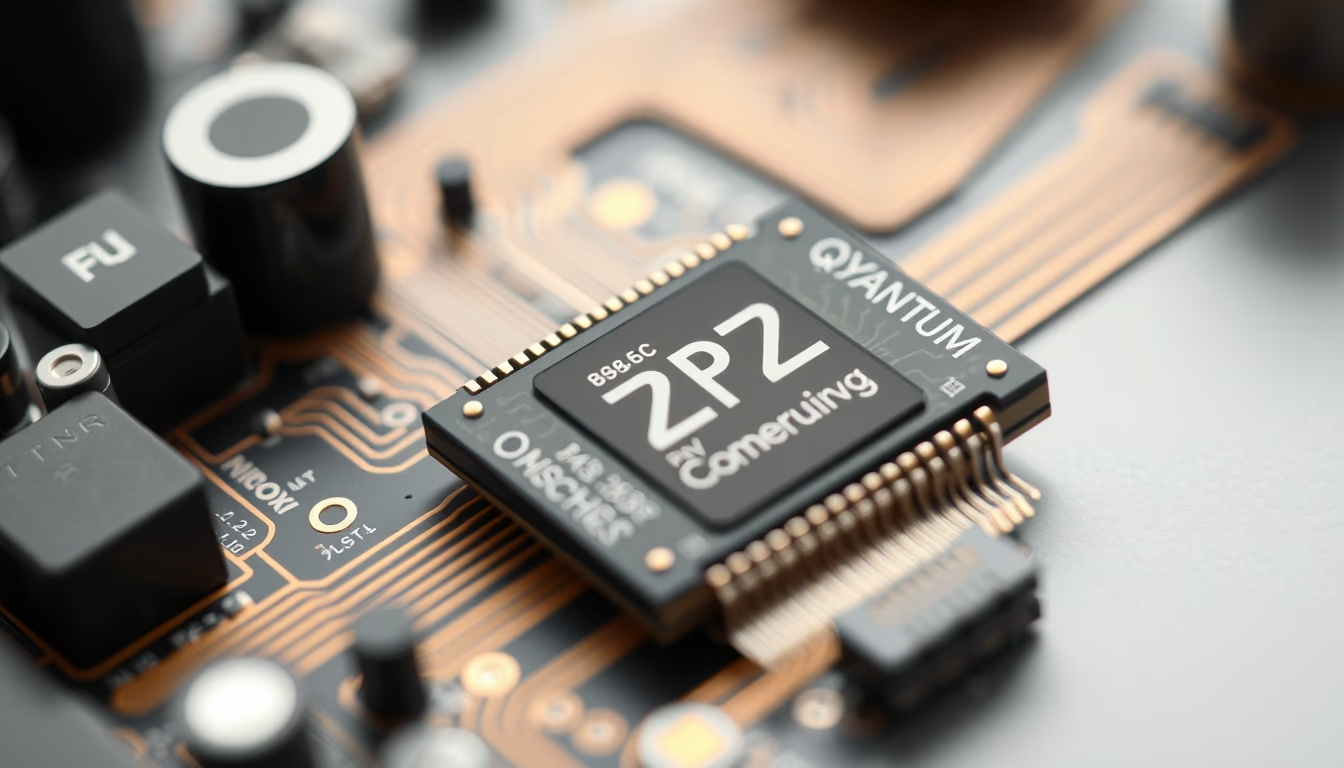
Quantum computer chip detail
1344×768 · AVIF · CC BY 4.0
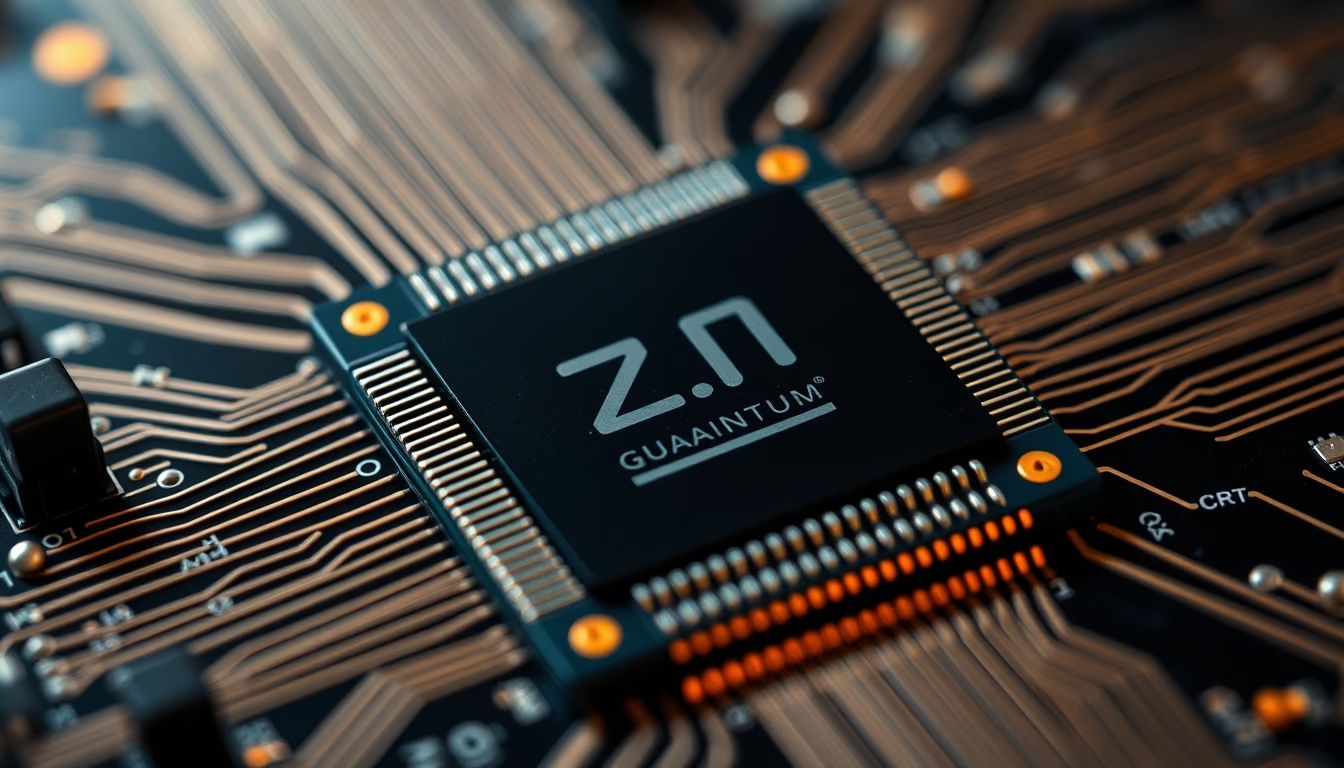
Close-up details of a quantum computer chip reveal the complex architecture of superconducting qubits and cryogenic control circuits.
About this subject
A quantum computer chip is the core of a system that exploits principles of quantum mechanics, such as superposition and entanglement, to perform calculations exponentially faster than classical computers for certain tasks. Unlike traditional chips that use transistors to represent bits (0 or 1), quantum chips utilize qubits. Qubits can exist in a superposition of states, enabling simultaneous processing of multiple possibilities. The most advanced chips currently employ superconducting qubits made of metals like niobium or aluminum, operating at temperatures near absolute zero (about 15 millikelvin) in dilution cryostats. This extreme cooling is necessary to maintain qubit coherence and minimize thermal noise that would cause decoherence. Companies like Google, with its Sycamore chip, and IBM, with the Eagle series, have demonstrated quantum supremacy and processors with over 100 qubits, but they still face challenges in scalability and error correction. Visual details of a quantum chip, often captured via electron microscopy or macro photography, reveal fine niobium lines forming capacitors and resonators, along with readout and coupling circuits. Each component is meticulously engineered to control interactions between qubits, a feat combining materials science, cryogenics, and nanotechnology. These chips are the result of decades of research in university labs and private companies, representing a promising leap for fields like cryptography, molecular simulation, and optimization.
Frequently Asked Questions
How does a quantum computer chip work?
A quantum chip uses qubits that can be in a superposition of 0 and 1, as well as entanglement between them, to process information in parallel. They are controlled by microwave pulses and operate at cryogenic temperatures to maintain coherence.
What is the difference between a qubit and a classical bit?
A classical bit is either 0 or 1. A qubit, due to superposition, can be both 0 and 1 simultaneously, and entanglement allows correlated qubits to process information exponentially in parallel.
Why do quantum chips need to be cooled to extremely low temperatures?
To prevent decoherence caused by thermal fluctuations. Superconducting qubits are highly sensitive to heat and noise; operating near absolute zero (around 15 millikelvin) ensures quantum states remain stable enough to perform computations.
Direct URL
https://pub-c7d6a6ea828543ac903a74a341ccb2e1.r2.dev/imagens/quantum-computer-chip-detail-fine-art-photography-p10.avifHow to credit
Include a visible link back to UtilizAí. Copy one of the snippets below:
<a href="https://xn--utiliza-eza.com/en/midia/imagens/quantum-computer-chip-detail-fine-art-photography-p10">Quantum computer chip detail</a> by <a href="https://xn--utiliza-eza.com">UtilizAí</a>, licensed under <a href="https://creativecommons.org/licenses/by/4.0/">CC BY 4.0</a>.
[Quantum computer chip detail](https://xn--utiliza-eza.com/en/midia/imagens/quantum-computer-chip-detail-fine-art-photography-p10) by [UtilizAí](https://xn--utiliza-eza.com), CC BY 4.0
License: CC-BY-4.0