Quantum computer chip detail
1344×768 · AVIF · CC BY 4.0
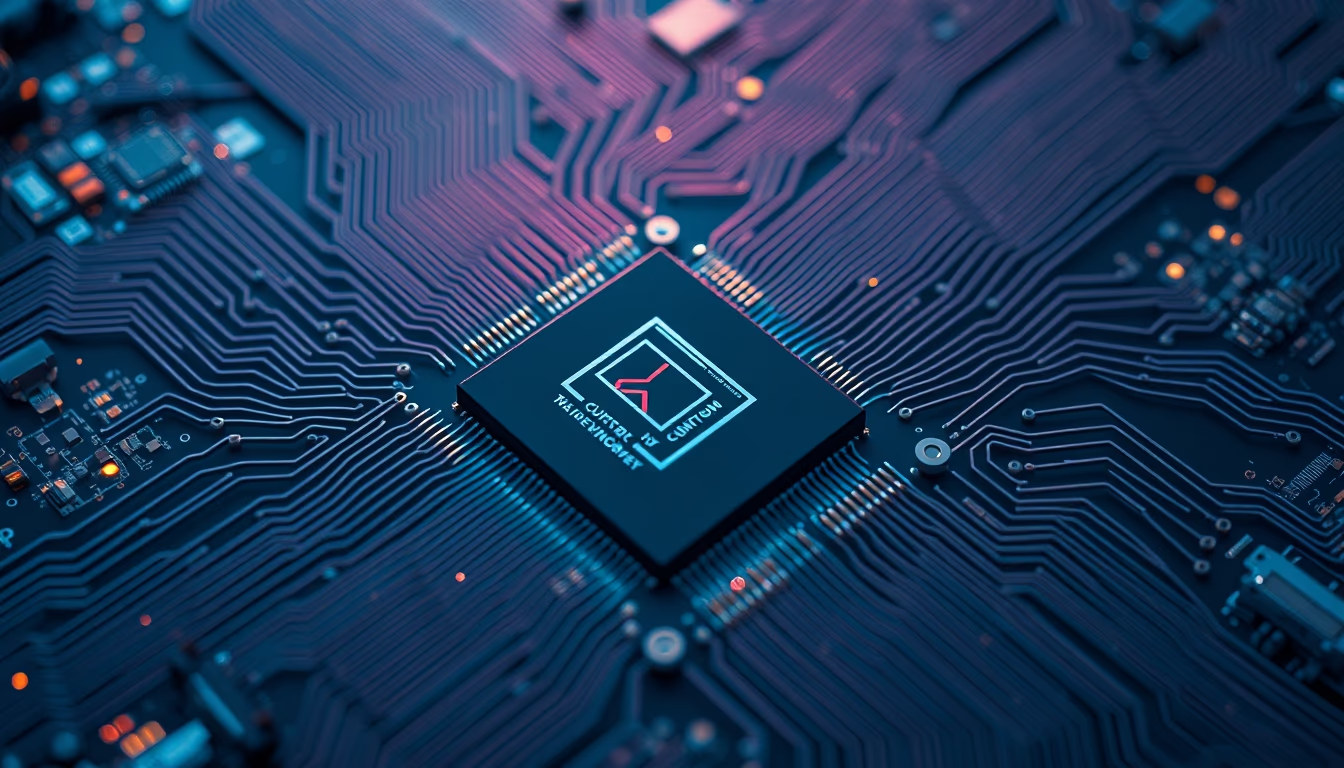
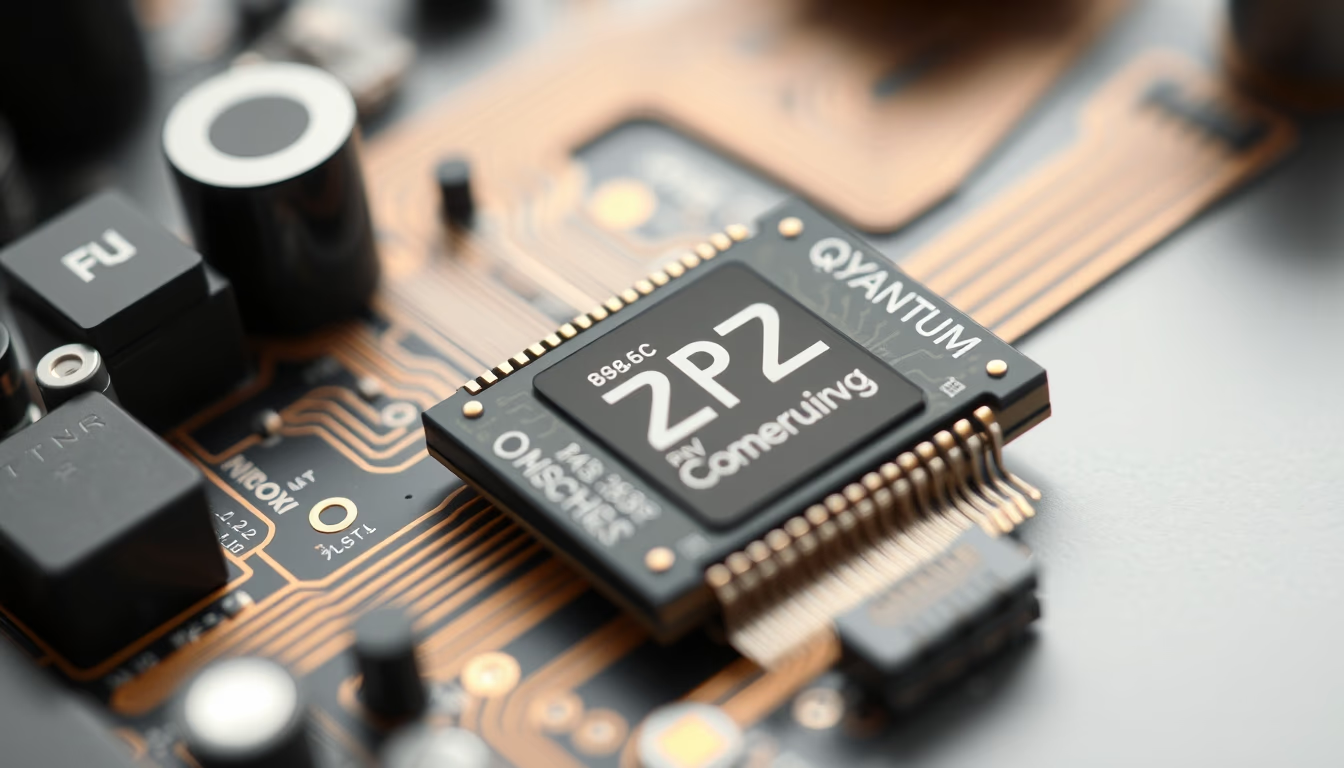
Detail of a quantum computer chip, showing superconducting qubits and microwave circuits on a silicon substrate.
About this subject
The quantum computer chip is the heart where qubits are fabricated. Unlike classical silicon chips that use transistors to represent bits (0 or 1), quantum chips exploit quantum mechanical phenomena like superposition and entanglement. Qubits can be implemented in various ways: trapped ions, quantum dots, or, as in this chip, superconducting circuits. These circuits operate at temperatures near absolute zero (about -273°C) inside a dilution refrigerator to minimize thermal noise and maintain quantum coherence.
Each superconducting qubit is essentially a small LC circuit (inductor-capacitor) that behaves as an artificial atom. The chip shown features several such qubits connected by microwave resonators that allow control and readout of quantum states. Fabricating these chips requires nanoscale precision lithography techniques similar to the semiconductor industry, but using materials like niobium and aluminum. Companies like Google, IBM, and Rigetti have demonstrated chips with dozens of qubits, but large-scale error correction remains distant.
In the Brazilian context, quantum chip development is still nascent. The country has research groups such as the Institute of Physics of São Carlos (USP) and the National Center for Research in Energy and Materials (CNPEM) studying materials and devices for quantum computing, but full chip fabrication is not done locally. Internationally, there is a race to achieve quantum supremacy, where a quantum computer solves a problem impossible for a classical one. The detailed chip, with its complex geometry, symbolizes this technological frontier.
Frequently Asked Questions
How many qubits does a quantum chip have today?
State-of-the-art chips from IBM and Google have between 50 and 100 qubits. IBM plans a 1000-qubit chip by 2025, but error-corrected qubits require many physical qubits per logical qubit.
Why do quantum chips need to be cooled to such low temperatures?
Superconducting qubits must be cooled to millikelvin temperatures to enter a quantum state. Otherwise, thermal agitation would destroy quantum coherence, preventing the computer from functioning.
What is the difference between a quantum chip and a classical chip?
A classical chip uses transistors that switch between 0 and 1, while a quantum chip uses qubits that can be in superposition of both states. Classical chips operate at room temperature; quantum chips require cryogenics.
Direct URL
https://pub-c7d6a6ea828543ac903a74a341ccb2e1.r2.dev/imagens/quantum-computer-chip-detail-aerial-drone-shot-p7.avifHow to credit
Include a visible link back to UtilizAí. Copy one of the snippets below:
<a href="https://xn--utiliza-eza.com/en/midia/imagens/quantum-computer-chip-detail-aerial-drone-shot-p7">Quantum computer chip detail</a> by <a href="https://xn--utiliza-eza.com">UtilizAí</a>, licensed under <a href="https://creativecommons.org/licenses/by/4.0/">CC BY 4.0</a>.
[Quantum computer chip detail](https://xn--utiliza-eza.com/en/midia/imagens/quantum-computer-chip-detail-aerial-drone-shot-p7) by [UtilizAí](https://xn--utiliza-eza.com), CC BY 4.0
License: CC-BY-4.0