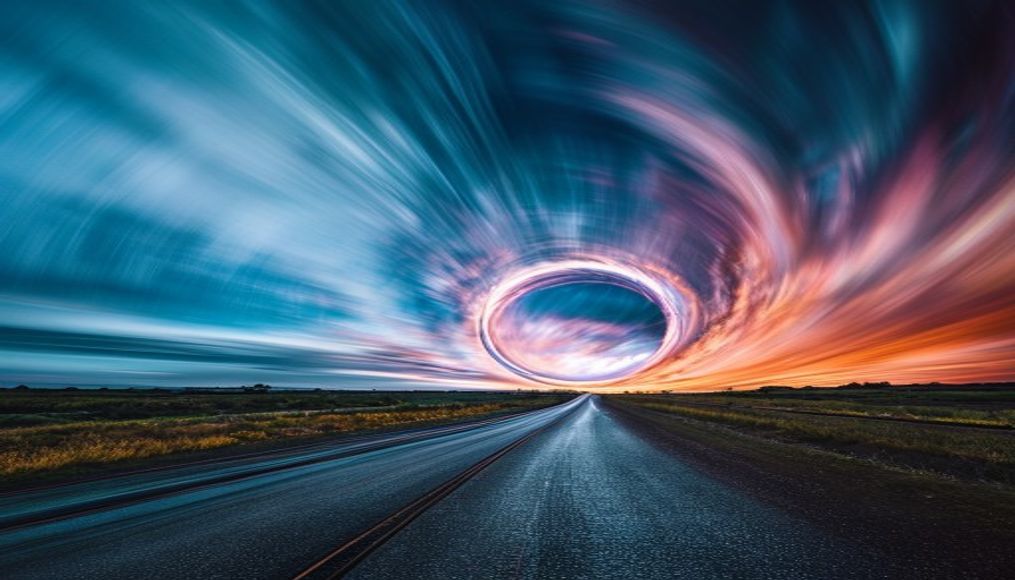
Protoplanetary disk forming
1344×768 · AVIF · CC BY 4.0

Protoplanetary disks are structures of gas and dust around young stars, where planets form over millions of years.
About this subject
Protoplanetary disks are remnants of molecular cloud collapse that give birth to stars. Composed mainly of hydrogen, helium, dust, and ice, these disks rotate around the central star and provide the material needed for planet formation. Observations with telescopes such as ALMA (Atacama Large Millimeter/submillimeter Array) have revealed rings and gaps in these disks, indicating the presence of forming planets clearing their orbits.
The typical dissipation timescale of a protoplanetary disk is 1 to 10 million years. During this period, dust particles collide and aggregate, forming increasingly larger bodies: first grains, then pebbles, planetesimals, and finally protoplanets. The process is influenced by gravitational forces, stellar radiation, and disk winds. Notable examples include the disk around the star HL Tauri, which shows sharp ring structures, and the PDS 70 system, where two giant planets have been directly imaged.
Culturally, the study of protoplanetary disks connects astronomy to the origin of the Solar System. Our own planetary system formed from a similar disk 4.6 billion years ago. Understanding these disks helps explain the diversity of exoplanets found in the galaxy, from super-Earths to hot Jupiters. The tilt-shift effect present in the image is a photographic technique that simulates a shallow depth of field, making distant objects appear miniature, but does not alter the disk's physical nature.
Frequently Asked Questions
What is a protoplanetary disk?
It is a structure of gas and dust orbiting a young star, serving as the birthplace of future planets. These disks consist of material leftover from star formation.
How long does a protoplanetary disk last?
Typically, protoplanetary disks last between 1 and 10 million years. After that, the gas dissipates and dust either clumps into planets or is expelled.
Can we see planets forming inside protoplanetary disks?
Yes, telescopes like ALMA and the Very Large Telescope (VLT) have directly imaged forming planets, such as in the PDS 70 system, where two giant planets are visible.
Direct URL
https://pub-c7d6a6ea828543ac903a74a341ccb2e1.r2.dev/imagens/protoplanetary-disk-forming-tilt-shift-miniature-p0.avifHow to credit
Include a visible link back to UtilizAí. Copy one of the snippets below:
<a href="https://xn--utiliza-eza.com/en/midia/imagens/protoplanetary-disk-forming-tilt-shift-miniature-p0">Protoplanetary disk forming</a> by <a href="https://xn--utiliza-eza.com">UtilizAí</a>, licensed under <a href="https://creativecommons.org/licenses/by/4.0/">CC BY 4.0</a>.
[Protoplanetary disk forming](https://xn--utiliza-eza.com/en/midia/imagens/protoplanetary-disk-forming-tilt-shift-miniature-p0) by [UtilizAí](https://xn--utiliza-eza.com), CC BY 4.0
License: CC-BY-4.0