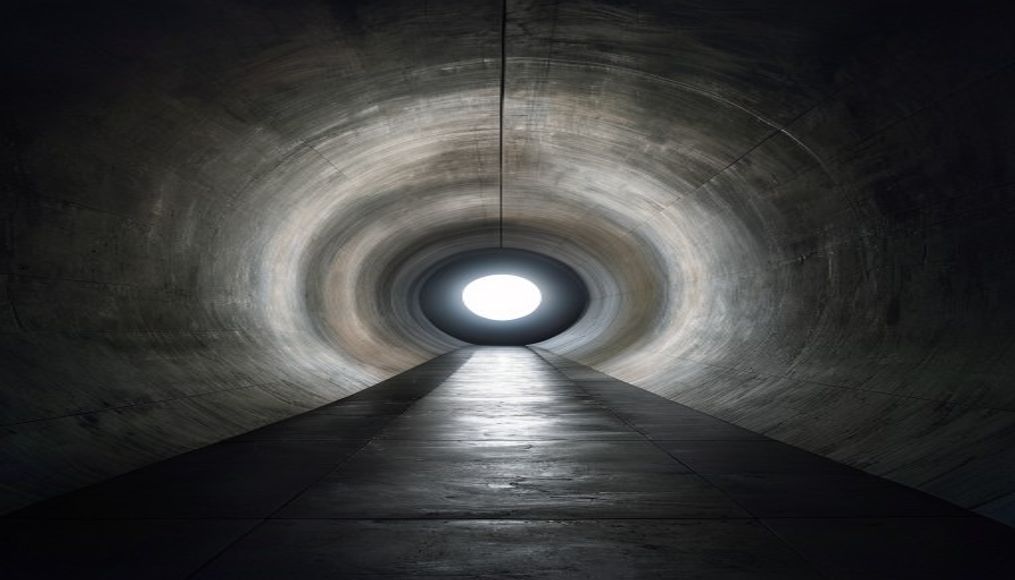
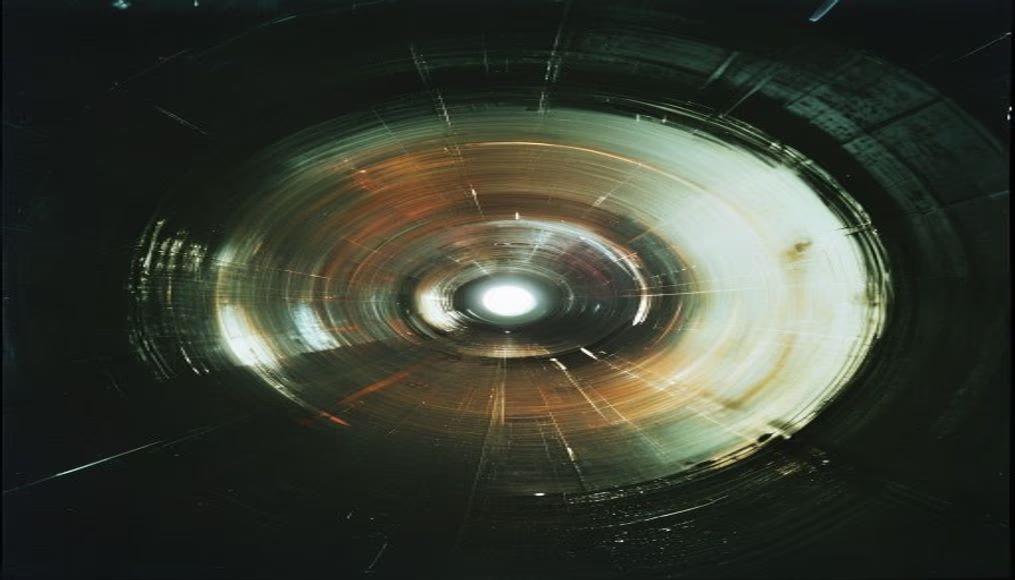
Protoplanetary disk forming
1344×768 · AVIF · CC BY 4.0
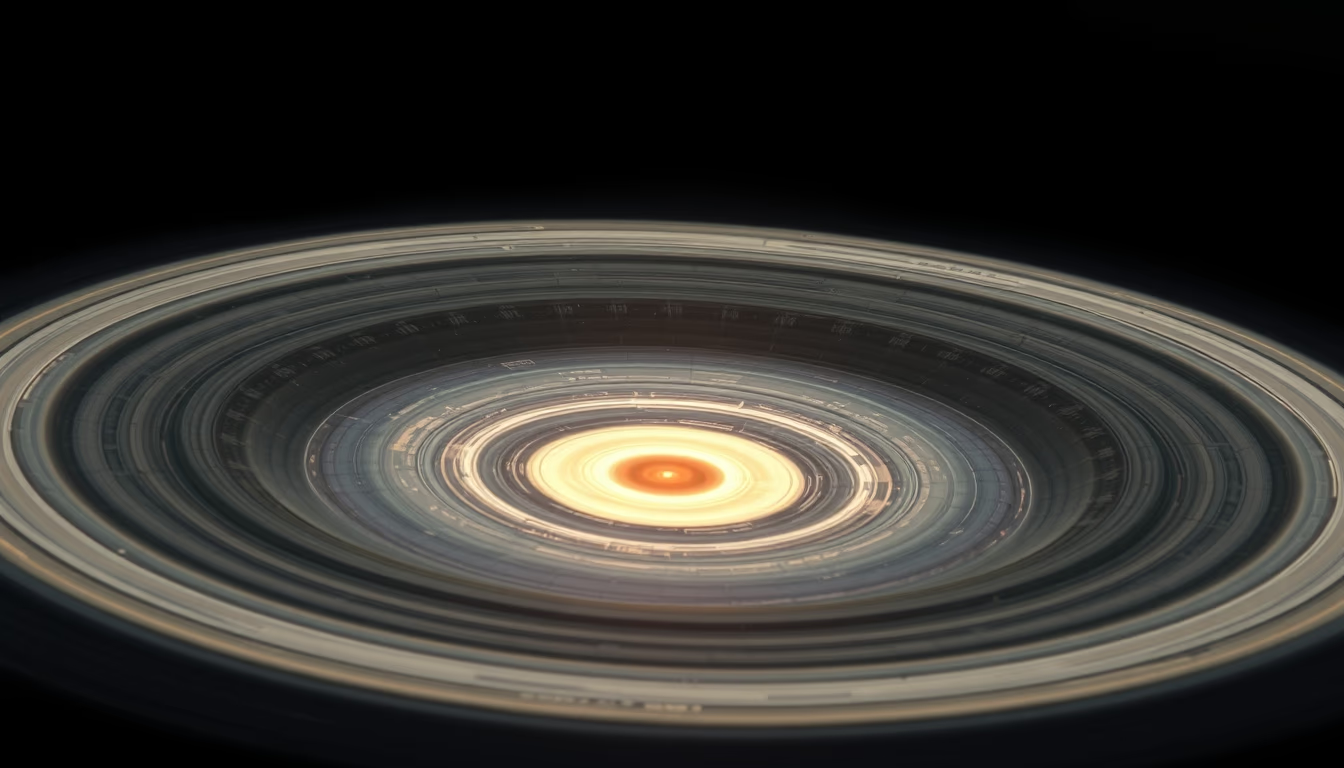
Discover how protoplanetary disks, clouds of gas and dust around young stars, give rise to planets like those in our Solar System.
About this subject
A protoplanetary disk is a rotating structure of gas and dust surrounding a newly formed star. These disks are the cradles of planetary systems, where dust grains collide and coalesce to form ever-larger bodies: first planetesimals, then protoplanets, and finally complete planets. The process takes from a few million to tens of millions of years, depending on the star's mass and disk density.
These disks are common in star-forming regions such as the Orion Nebula and the Rho Ophiuchi cloud complex. Telescopes like ALMA (Atacama Large Millimeter/submillimeter Array) and the James Webb Space Telescope have revealed stunning details: rings and gaps carved by forming planets, spiral structures, and shadows cast by giant planets. One of the most iconic images is the disk around HL Tauri, which shows sharp concentric rings at only 1 million years old.
The composition of a protoplanetary disk is mostly molecular hydrogen and helium, with about 1% dust made of silicates, carbon compounds, and ices. This dust is the raw material for forming rocky planets and the cores of gas giants. Studies indicate that the accretion rate (material falling onto the star) directly influences the disk's lifetime, which dissipates on timescales of 5 to 10 million years. If a planet does not form by then, the material is lost to interstellar space.
The study of protoplanetary disks is fundamental to understanding the origin of the Solar System. Our own system would have been born from a similar disk 4.6 billion years ago. Observing disks at different stages and ages allows astronomers to test planetary formation models and predict the diversity of exoplanetary systems discovered in recent decades. With each new observation, the complexity and beauty of these cosmic nurseries become ever more intriguing.
Frequently Asked Questions
How long does it take for a protoplanetary disk to form planets?
Planet formation within a protoplanetary disk takes from a few million to tens of millions of years. Rocky planets like Earth form relatively quickly, while gas giants like Jupiter need to accumulate large gas envelopes before the disk dissipates, usually within 10 million years.
How do astronomers observe protoplanetary disks?
Astronomers use telescopes such as ALMA, which operates at radio and submillimeter wavelengths, and the James Webb Space Telescope, which captures infrared light. These instruments can penetrate the dust to reveal the disk's internal structure and detect molecules and signs of forming planets.
What is the connection between protoplanetary disks and the Solar System?
The Solar System formed from a protoplanetary disk about 4.6 billion years ago. Evidence such as the composition of planets, the existence of the asteroid belt, and isotopes in meteorites confirm this model. Studying young disks helps reconstruct the initial conditions of our own system.
Direct URL
https://pub-c7d6a6ea828543ac903a74a341ccb2e1.r2.dev/imagens/protoplanetary-disk-forming-magazine-editorial-p8.avifHow to credit
Include a visible link back to UtilizAí. Copy one of the snippets below:
<a href="https://xn--utiliza-eza.com/en/midia/imagens/protoplanetary-disk-forming-magazine-editorial-p8">Protoplanetary disk forming</a> by <a href="https://xn--utiliza-eza.com">UtilizAí</a>, licensed under <a href="https://creativecommons.org/licenses/by/4.0/">CC BY 4.0</a>.
[Protoplanetary disk forming](https://xn--utiliza-eza.com/en/midia/imagens/protoplanetary-disk-forming-magazine-editorial-p8) by [UtilizAí](https://xn--utiliza-eza.com), CC BY 4.0
License: CC-BY-4.0