Protoplanetary disk forming
1344×768 · AVIF · CC BY 4.0
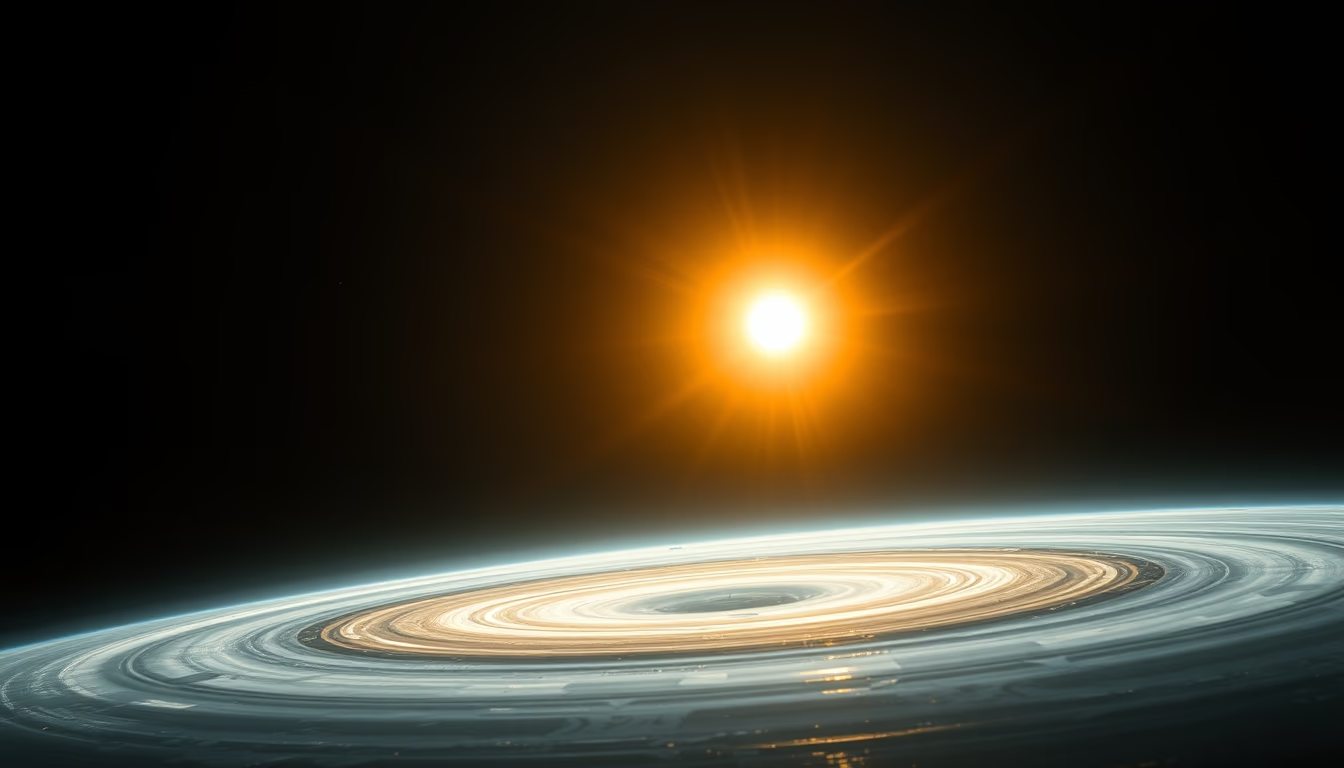
Protoplanetary disks are clouds of gas and dust around young stars where planets are born.
About this subject
Protoplanetary disks are fundamental structures in the formation of planetary systems. They form from the gravitational collapse of a giant molecular cloud, giving rise to a young star surrounded by a rotating disk of gas and dust. This material is the cradle of planets: dust particles collide and aggregate, forming ever-larger bodies from planetesimals to protoplanets and finally full planets. The process takes millions of years and is influenced by the star's radiation and winds.
Observations with telescopes such as ALMA and Hubble have revealed hundreds of protoplanetary disks in the Milky Way, many with rings and gaps indicating the presence of forming planets. One famous example is the disk around the star HL Tauri, which shows sharp concentric ring structures. These images provide clues about how our own Solar System formed 4.6 billion years ago.
The composition of disks varies: besides hydrogen and helium, they contain ice, silicates, and organic compounds. The so-called ice line, where temperature allows water condensation, is crucial for the formation of giant planets like Jupiter. More massive disks tend to form larger planets, while short-lived disks may not allow enough time for planets to fully form.
Studying protoplanetary disks helps understand the diversity of exoplanetary systems already discovered. Although artistic images may show idealized colors and shapes, the underlying science is rich in detail and ongoing discoveries. Each new piece of data from telescopes like the James Webb promises to reveal even more about these cosmic nurseries.
Frequently Asked Questions
What is a protoplanetary disk?
It is a rotating cloud of gas and dust orbiting a young star, where planets form through accretion.
How long does it take for planets to form in a protoplanetary disk?
The process takes from a few million to tens of millions of years, depending on the disk and star mass.
How do astronomers observe protoplanetary disks?
They use telescopes like ALMA (radio) and Hubble (visible/infrared) to detect emissions from dust and gas.
Direct URL
https://pub-c7d6a6ea828543ac903a74a341ccb2e1.r2.dev/imagens/protoplanetary-disk-forming-fine-art-photography-p7.avifHow to credit
Include a visible link back to UtilizAí. Copy one of the snippets below:
<a href="https://xn--utiliza-eza.com/en/midia/imagens/protoplanetary-disk-forming-fine-art-photography-p7">Protoplanetary disk forming</a> by <a href="https://xn--utiliza-eza.com">UtilizAí</a>, licensed under <a href="https://creativecommons.org/licenses/by/4.0/">CC BY 4.0</a>.
[Protoplanetary disk forming](https://xn--utiliza-eza.com/en/midia/imagens/protoplanetary-disk-forming-fine-art-photography-p7) by [UtilizAí](https://xn--utiliza-eza.com), CC BY 4.0
License: CC-BY-4.0