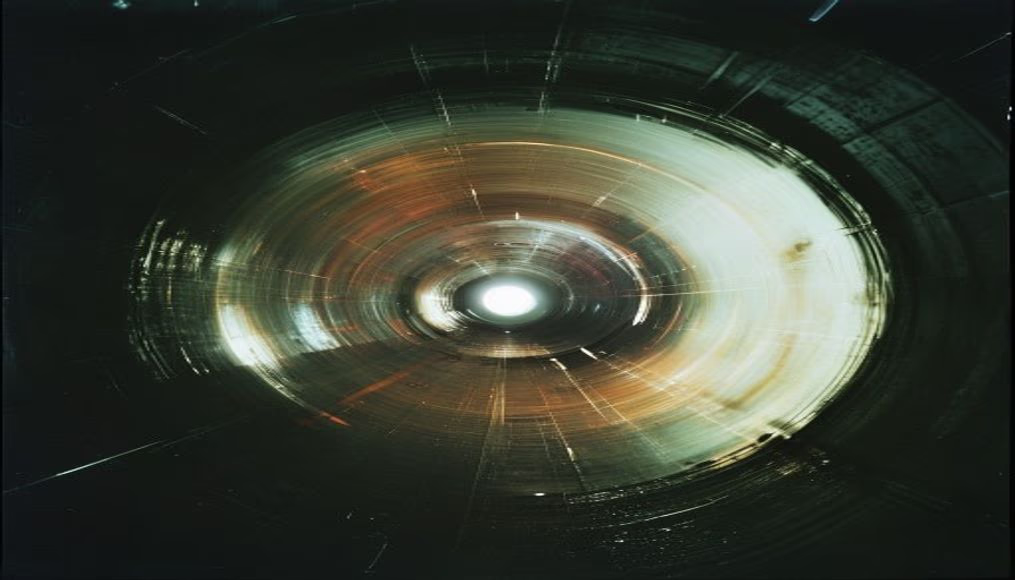
Protoplanetary disk forming
1344×768 · AVIF · CC BY 4.0

Protoplanetary disk forming: cradle of planets around young stars, observed in regions like the Orion Nebula.
About this subject
A protoplanetary disk is a rotating structure of gas and dust surrounding a newly formed star. These disks are remnants of the star formation process and supply the raw material for creating planets, moons, and other celestial bodies. Density and temperature vary radially, with hot inner regions and cold outer regions where ices and volatile compounds can condense.
Planet formation occurs through accretion: dust particles collide and stick together, forming larger bodies, planetesimals, protoplanets, and eventually planets. Notable examples include the disk around HL Tauri, which revealed ring and gap structures indicating forming planets, and TW Hydrae, the closest protoplanetary disk to Earth at about 176 light-years. The ALMA telescope (Atacama Large Millimeter/submillimeter Array) revolutionized the study of these disks by providing high-resolution images.
Protoplanetary disks have a limited lifespan, lasting from 1 to 10 million years before dissipating through stellar accretion, winds, or photoevaporation. The chemical composition of the disk influences the types of planets formed, such as gas giants or rocky worlds. Studies of disks at different stages help us understand the evolution of our own Solar System and the diversity of exoplanetary systems.
Frequently Asked Questions
How does a planet form in a protoplanetary disk?
Planets form through accretion: dust particles in the disk collide and stick together, forming planetesimals. These grow through collisions and gravitational attraction until they become protoplanets and eventually planets.
What is the difference between a protoplanetary disk and an accretion disk?
A protoplanetary disk is a specific type of accretion disk around a young star where planets can form. Accretion disks also occur around other objects, such as black holes or neutron stars, where material is heated and emits radiation.
Which telescopes study protoplanetary disks?
ALMA (Atacama Large Millimeter/submillimeter Array) is the primary telescope for observing protoplanetary disks at millimeter wavelengths. The Hubble Space Telescope and the future James Webb Space Telescope (JWST) also contribute with observations in visible and infrared light.
Direct URL
https://pub-c7d6a6ea828543ac903a74a341ccb2e1.r2.dev/imagens/protoplanetary-disk-forming-commercial-product-photography-p9.avifHow to credit
Include a visible link back to UtilizAí. Copy one of the snippets below:
<a href="https://xn--utiliza-eza.com/en/midia/imagens/protoplanetary-disk-forming-commercial-product-photography-p9">Protoplanetary disk forming</a> by <a href="https://xn--utiliza-eza.com">UtilizAí</a>, licensed under <a href="https://creativecommons.org/licenses/by/4.0/">CC BY 4.0</a>.
[Protoplanetary disk forming](https://xn--utiliza-eza.com/en/midia/imagens/protoplanetary-disk-forming-commercial-product-photography-p9) by [UtilizAí](https://xn--utiliza-eza.com), CC BY 4.0
License: CC-BY-4.0