Planet jupiter atmosphere
1344×768 · AVIF · CC BY 4.0
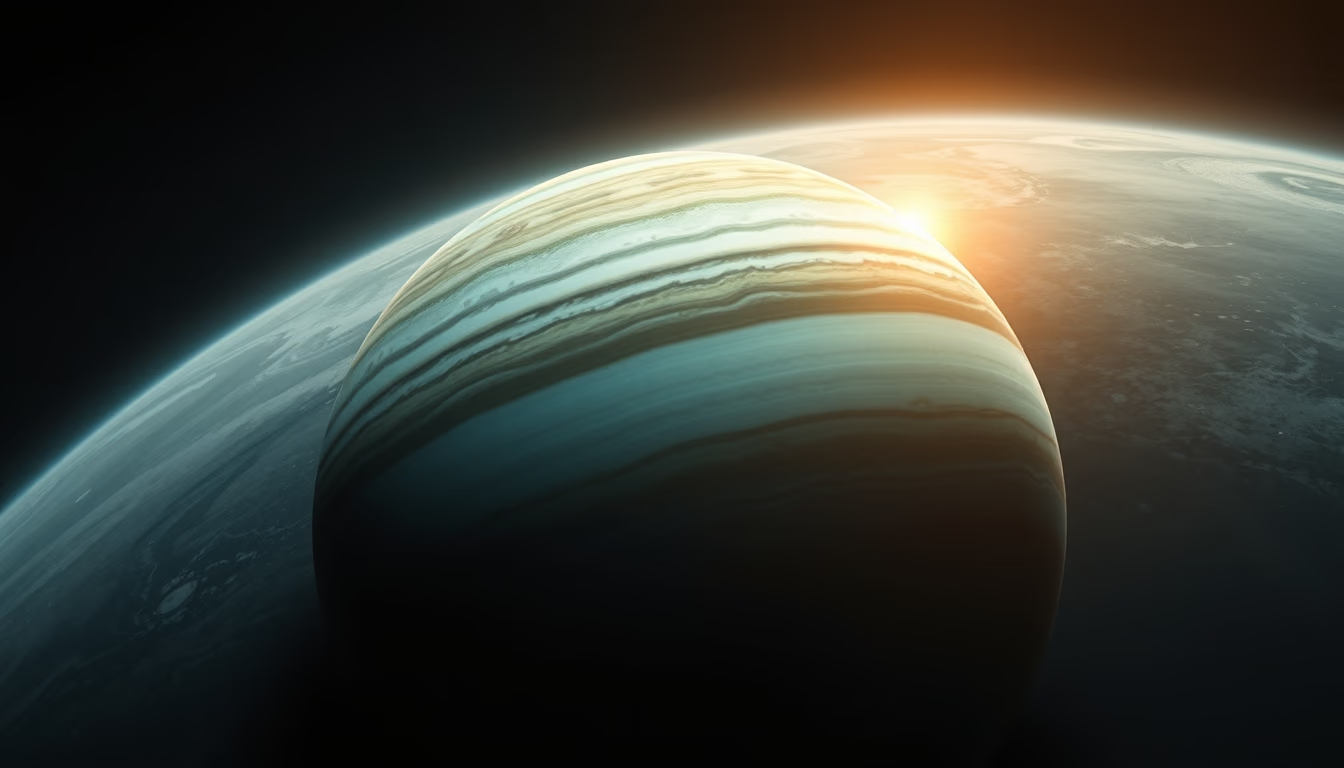
Jupiter's atmosphere, the largest in the solar system, is a natural laboratory of extreme storms and weather phenomena.
About this subject
Jupiter's atmosphere is the largest and most dynamic in the solar system. Composed mainly of hydrogen (about 90%) and helium (10%), with traces of methane, ammonia, and water vapor, it stretches thousands of kilometers and lacks a solid surface, the planet is essentially a gas giant. Its most striking feature is the Great Red Spot, an anticyclonic storm that has persisted for centuries and is larger than Earth's diameter. First observed by astronomers in the 17th century, this colossal storm boasts winds up to 640 km/h, and its reddish hue is still studied, possibly caused by phosphorus or sulfur compounds.
The colorful bands encircling the planet, known as zones and belts, are formed by gas currents moving in different directions and altitudes. Zones, lighter in color, are high‑pressure, low‑temperature regions, while belts, darker, correspond to low‑pressure, higher‑temperature areas. This banding pattern results from Jupiter's rapid rotation, a day lasts about 10 hours, which generates strong jet streams and atmospheric turbulence.
NASA's Juno spacecraft, orbiting Jupiter since 2016, has revolutionized our understanding of its atmosphere. Juno's data show that storms can extend tens of kilometers below cloud tops and that the planet's magnetic field interacts with the atmosphere in complex ways, producing intense auroras. The mission also detected concentrated ammonia zones and atmospheric circulation patterns that challenge previous climate models. Jupiter's atmosphere also hosts lightning in water clouds, similar to Earth's but far more powerful. These lightning flashes, observed by both probes and telescopes, indicate the presence of water droplets and ice in deeper atmospheric layers. Continuous study of Jupiter not only helps understand gas giant climates but also provides clues about solar system formation and exoplanet atmospheres.
Frequently Asked Questions
Why does Jupiter's atmosphere have colorful bands?
The bands are caused by gas currents moving in different directions and altitudes, driven by the planet's rapid rotation. Bright zones are high‑pressure regions with ammonia clouds, while dark belts are low‑pressure, higher‑temperature areas.
Could the Great Red Spot disappear?
Yes, observations show it has been slowly shrinking for decades. It remains unclear whether it will vanish completely or stabilize at a smaller size. It is a long‑lasting storm, but not eternal.
How important is the Juno mission for studying Jupiter's atmosphere?
Juno has provided detailed data on atmospheric composition, structure, and dynamics, including measurements of magnetic and gravitational fields. It revealed deep storms, ammonia patterns, and auroral interactions, transforming our understanding of the planet.
Direct URL
https://pub-c7d6a6ea828543ac903a74a341ccb2e1.r2.dev/imagens/planet-jupiter-atmosphere-magazine-editorial-p5.avifHow to credit
Include a visible link back to UtilizAí. Copy one of the snippets below:
<a href="https://xn--utiliza-eza.com/en/midia/imagens/planet-jupiter-atmosphere-magazine-editorial-p5">Planet jupiter atmosphere</a> by <a href="https://xn--utiliza-eza.com">UtilizAí</a>, licensed under <a href="https://creativecommons.org/licenses/by/4.0/">CC BY 4.0</a>.
[Planet jupiter atmosphere](https://xn--utiliza-eza.com/en/midia/imagens/planet-jupiter-atmosphere-magazine-editorial-p5) by [UtilizAí](https://xn--utiliza-eza.com), CC BY 4.0
License: CC-BY-4.0