Planet jupiter atmosphere
1344×768 · AVIF · CC BY 4.0
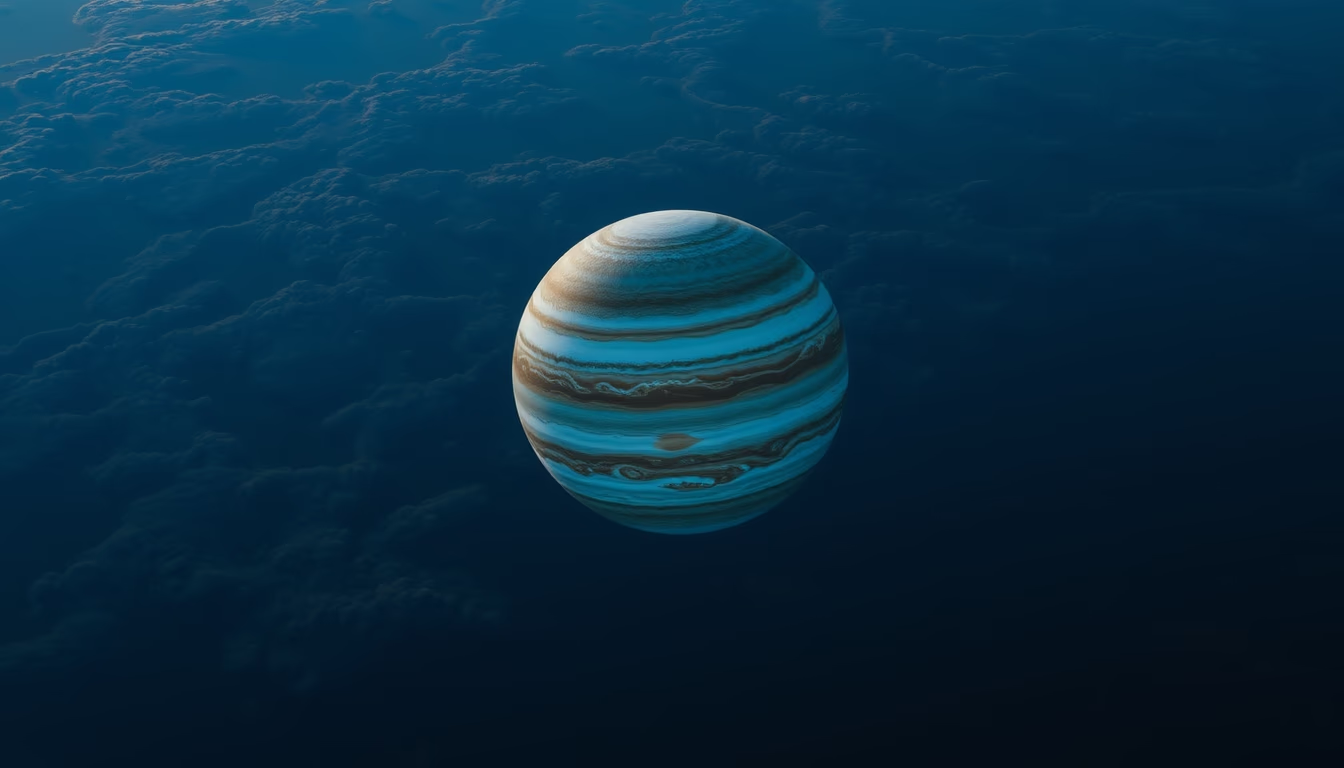
Jupiter, the largest planet in the Solar System, has a turbulent atmosphere with colorful bands, giant storms like the Great Red Spot, and winds up to 600 km/h.
About this subject
Jupiter's atmosphere consists mainly of hydrogen (about 90%) and helium (10%), with traces of methane, ammonia, and water vapor. The colorful bands, visible even with amateur telescopes, result from different chemical compositions and altitudes. The light zones are high-pressure regions where air rises, while the dark bands (belts) are low-pressure areas with descending air. The movement of these air masses generates winds that can exceed 600 km/h in the upper atmosphere.
The most famous feature is the Great Red Spot, an anticyclonic storm that has persisted for hundreds of years. Larger than Earth's diameter, it rotates counterclockwise and is fueled by gas currents. NASA's Juno probe (orbiting since 2016) revealed that this storm extends hundreds of kilometers deep. Besides it, Jupiter hosts dozens of smaller storms, such as white and brown ovals.
Jupiter's atmospheric layers are complex. The troposphere contains clouds of ammonia, ammonium hydrosulfide, and water. Temperature and pressure increase sharply toward the interior. At the uppermost cloud tops, temperatures reach around -145°C. The Galileo probe, which studied Jupiter from 1995 to 2003, provided crucial data on composition and atmospheric dynamics. Future missions, such as ESA's JUICE (launched in 2023), will continue investigating this gas giant.
For Earth observers, Jupiter is one of the brightest objects in the night sky. With a small telescope, one can see its bands and the motion of its Galilean moons. The Jovian atmosphere has no solid surface; it gradually transitions into a liquid metallic interior. This extreme environment serves as a natural laboratory for understanding fluid dynamics and conditions on similar exoplanets.
Frequently Asked Questions
Why does Jupiter have colorful bands?
The bands form due to differences in chemical composition, altitude, and temperature. The light zones are high-pressure regions with higher ammonia clouds, while the dark belts have descending air and deeper clouds. Various compounds, such as phosphorus and sulfur, contribute to the colors.
What is the Great Red Spot?
It is a giant anticyclonic storm that has lasted for centuries, located in Jupiter's southern hemisphere. Its diameter is larger than Earth's, and internal winds can reach 640 km/h. Scientists believe the reddish color comes from chemical reactions involving sulfur or phosphorus compounds.
Does Jupiter have a solid surface?
No. Jupiter is a gas giant with no solid surface. Its atmosphere gradually becomes denser and hotter, eventually reaching a state of liquid metallic hydrogen thousands of kilometers deep. There is no firm ground like on Earth.
Direct URL
https://pub-c7d6a6ea828543ac903a74a341ccb2e1.r2.dev/imagens/planet-jupiter-atmosphere-aerial-drone-shot-p1.avifHow to credit
Include a visible link back to UtilizAí. Copy one of the snippets below:
<a href="https://xn--utiliza-eza.com/en/midia/imagens/planet-jupiter-atmosphere-aerial-drone-shot-p1">Planet jupiter atmosphere</a> by <a href="https://xn--utiliza-eza.com">UtilizAí</a>, licensed under <a href="https://creativecommons.org/licenses/by/4.0/">CC BY 4.0</a>.
[Planet jupiter atmosphere](https://xn--utiliza-eza.com/en/midia/imagens/planet-jupiter-atmosphere-aerial-drone-shot-p1) by [UtilizAí](https://xn--utiliza-eza.com), CC BY 4.0
License: CC-BY-4.0





