Photon wave particle
1344×768 · AVIF · CC BY 4.0

The wave-particle duality of the photon is one of the most intriguing concepts in quantum physics, challenging our classical intuition about the nature of light.
About this subject
The photon, the elementary particle of light, exhibits both wave-like and particle-like behavior, a phenomenon known as wave-particle duality. This concept was formalized in the early 20th century, with experiments such as Thomas Young's double-slit experiment (1801) demonstrating wave interference, and the photoelectric effect explained by Albert Einstein in 1905, revealing the particle nature of light. Duality is a cornerstone of quantum mechanics.
In practice, whether the photon behaves as a wave or particle depends on the experimental setup. When the path of the photon is not measured, it behaves as a wave, creating interference patterns. When detection of its trajectory is attempted, it behaves as a particle, destroying the pattern. This behavior is mathematically described by the wave function and Niels Bohr's complementarity principle.
Wave-particle duality is not limited to light; particles such as electrons, protons, and even large molecules also exhibit this behavior. The double-slit experiment with electrons, performed by Claus Jönsson in 1961, confirmed this universality. Understanding this phenomenon led to technologies like lasers, transistors, and quantum computing.
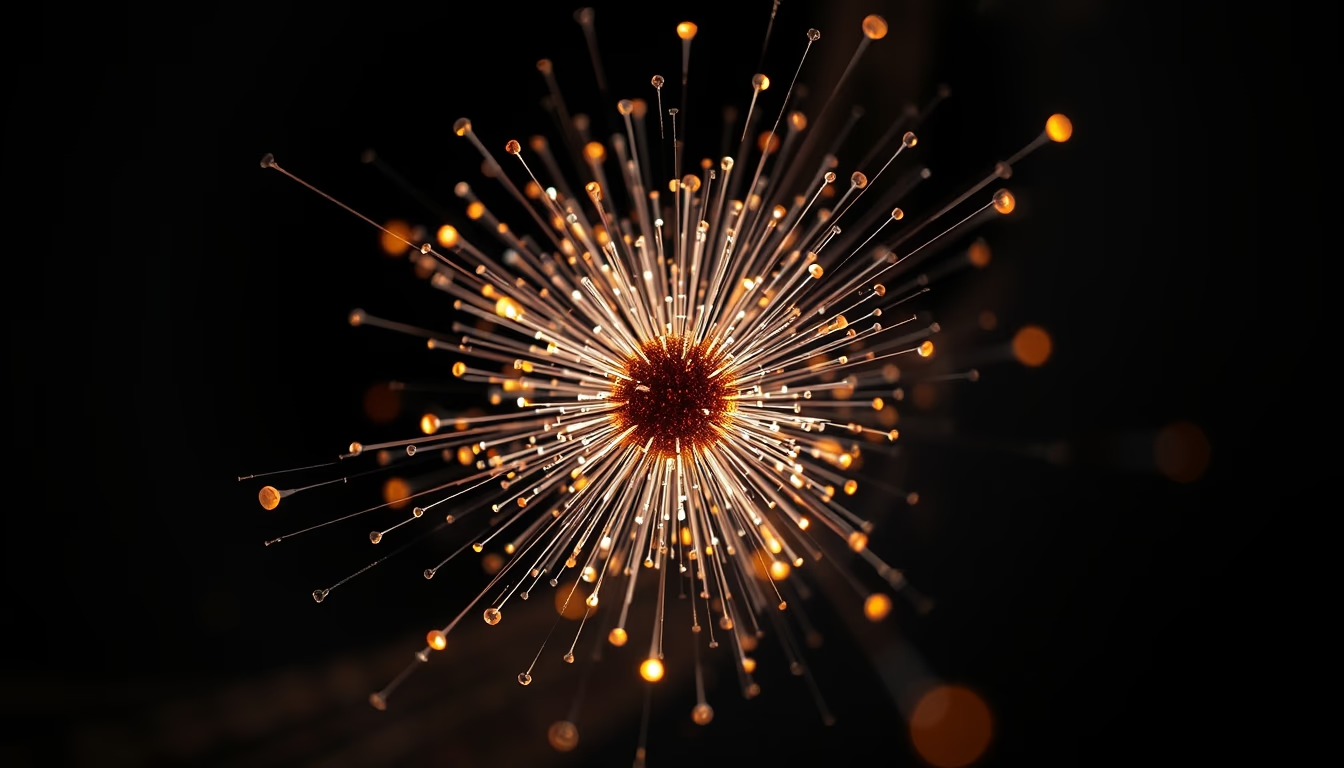
Interestingly, the interpretation of duality still sparks philosophical debates, such as the Copenhagen interpretation versus hidden variable theories. The photon, in particular, remains a subject of study in quantum optics, with applications in quantum communication and cryptography. A long-exposure photograph of a light beam, like the image, visually illustrates the continuous, wave-like character of light.
Frequently Asked Questions
What is the wave-particle duality of the photon?
It is the property of the photon to behave as a wave (interference, diffraction) or a particle (photoelectric effect) depending on the experimental setup.
How does the double-slit experiment demonstrate duality?
When photons are fired one by one at two slits, they form an interference pattern (wave), but if we detect which slit they go through, the pattern disappears (particle).
Is duality only for light?
No, particles like electrons and protons also exhibit duality, confirmed by similar experiments.
Direct URL
https://pub-c7d6a6ea828543ac903a74a341ccb2e1.r2.dev/imagens/photon-wave-particle-long-exposure-p7.avifHow to credit
Include a visible link back to UtilizAí. Copy one of the snippets below:
<a href="https://xn--utiliza-eza.com/en/midia/imagens/photon-wave-particle-long-exposure-p7">Photon wave particle</a> by <a href="https://xn--utiliza-eza.com">UtilizAí</a>, licensed under <a href="https://creativecommons.org/licenses/by/4.0/">CC BY 4.0</a>.
[Photon wave particle](https://xn--utiliza-eza.com/en/midia/imagens/photon-wave-particle-long-exposure-p7) by [UtilizAí](https://xn--utiliza-eza.com), CC BY 4.0
License: CC-BY-4.0