Photon wave particle
1344×768 · AVIF · CC BY 4.0

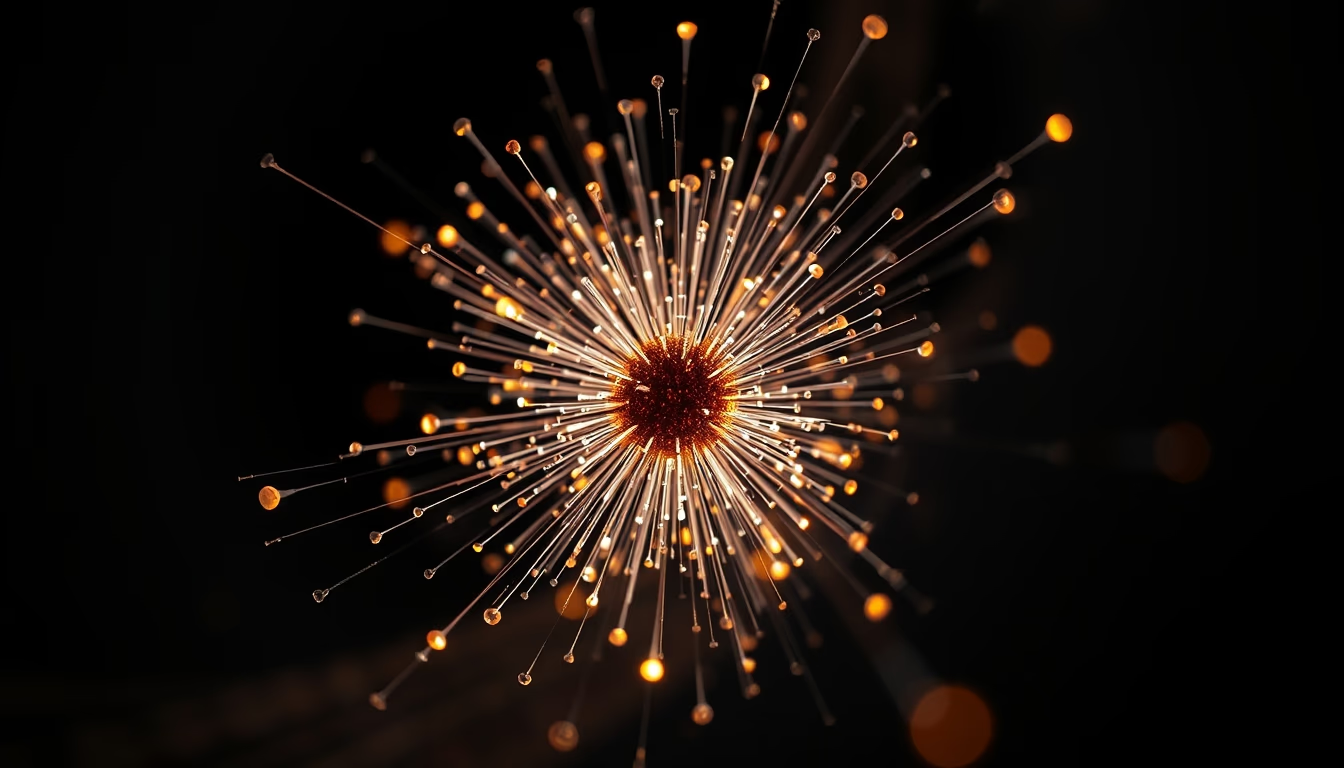
Photons are light particles that behave both as waves and as particles, a central phenomenon in quantum mechanics.
About this subject
The photon is the elementary particle mediating the electromagnetic force, responsible for all electromagnetic radiation, including visible light, X-rays, and radio waves. Its wave-particle duality was experimentally demonstrated by Thomas Young in the famous double-slit experiment in 1801, where light produced an interference pattern typical of waves. Later, in 1905, Albert Einstein explained the photoelectric effect, showing that light also behaves as discrete energy particles, photons, earning him the Nobel Prize in Physics in 1921.
Each photon carries a specific amount of energy proportional to its frequency, given by the equation E = hν, where h is Planck's constant. This quantization explains phenomena such as the emission and absorption of light by atoms. The wave-particle duality is not a choice between two modes but a complementary reality: depending on the experiment, the photon exhibits wave-like properties (interference, diffraction) or particle-like properties (momentum, location).
In modern physics, photons are described by quantum electrodynamics (QED), the most precise theory ever tested. They are spin-1 bosons with zero rest mass, always traveling at the speed of light in a vacuum. Practical applications include lasers, fiber-optic telecommunications, and quantum computing, where photons are used as qubits. The concept of the photon is also crucial for understanding the Compton effect and blackbody radiation.
Interestingly, a single photon can pass through both slits in an interferometer, interfering with itself. This behavior is explained by the principle of quantum superposition. The dual nature of photons inspired Schrödinger's cat and continues to challenge our intuition about reality.
Frequently Asked Questions
What is the wave-particle duality of the photon?
It is the property of a photon to behave as a wave in some experiments (like interference) and as a particle in others (like the photoelectric effect). It is not an alternation but a complementarity.
What is the energy of a photon?
The energy of a photon is given by E = hν, where h is Planck's constant (6.626 × 10⁻³⁴ J·s) and ν is the frequency of the radiation. Higher frequency photons, like X-rays, have more energy than visible light photons.
Do photons have mass?
No, photons have no rest mass. Their relativistic mass is zero because they always travel at the speed of light. However, they possess linear momentum, given by p = h/λ.
Direct URL
https://pub-c7d6a6ea828543ac903a74a341ccb2e1.r2.dev/imagens/photon-wave-particle-cinematic-wide-shot-p12.avifHow to credit
Include a visible link back to UtilizAí. Copy one of the snippets below:
<a href="https://xn--utiliza-eza.com/en/midia/imagens/photon-wave-particle-cinematic-wide-shot-p12">Photon wave particle</a> by <a href="https://xn--utiliza-eza.com">UtilizAí</a>, licensed under <a href="https://creativecommons.org/licenses/by/4.0/">CC BY 4.0</a>.
[Photon wave particle](https://xn--utiliza-eza.com/en/midia/imagens/photon-wave-particle-cinematic-wide-shot-p12) by [UtilizAí](https://xn--utiliza-eza.com), CC BY 4.0
License: CC-BY-4.0