Pcie expansion slot
1344×768 · AVIF · CC BY 4.0
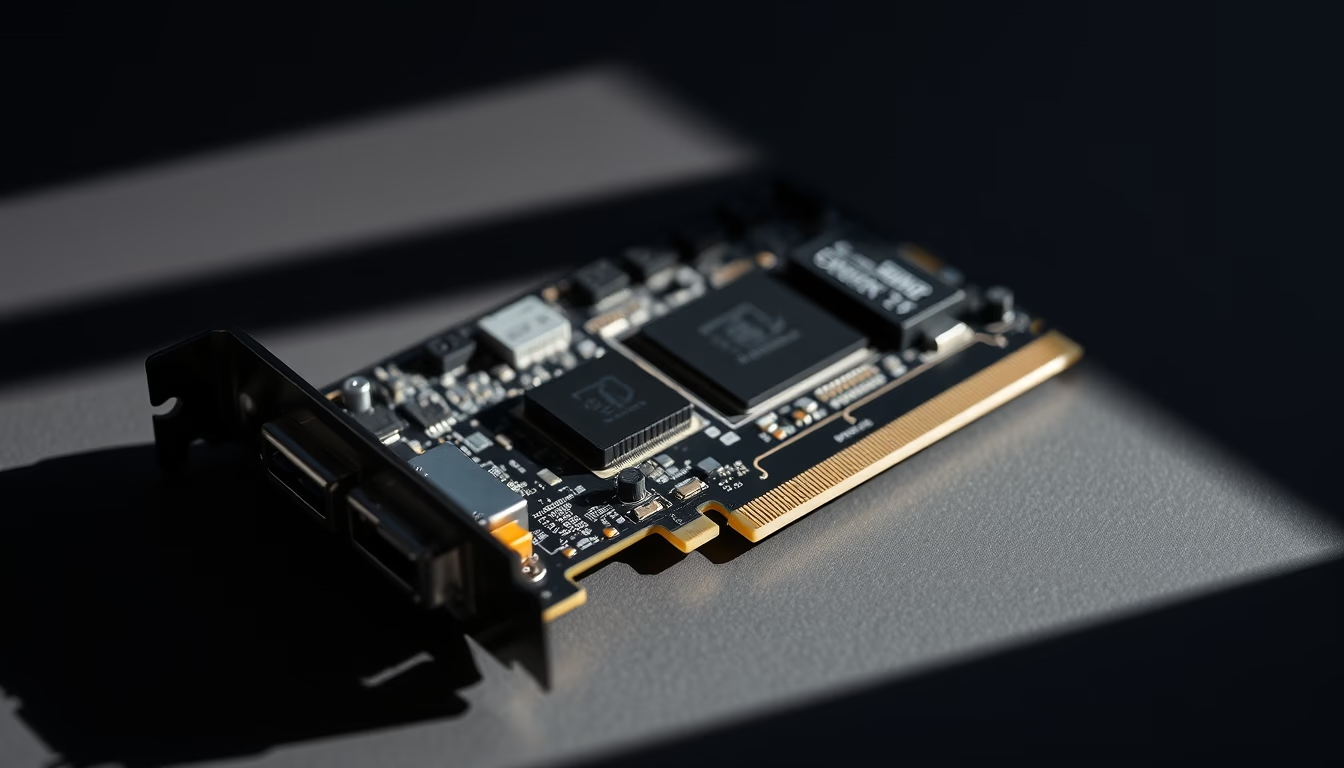
PCI Express expansion slot, a high-speed serial bus for graphics cards, SSDs, and other peripherals in computers.
About this subject
The PCI Express (PCIe) expansion slot is the dominant standard for connecting high-performance cards to computer motherboards. Developed by Intel in 2003, it replaced PCI and AGP buses, offering higher bandwidth and scalability. Common versions include PCIe 3.0, 4.0, and 5.0, each doubling the transfer rate per lane. For instance, a modern graphics card uses x16 lanes, providing up to 32 GB/s in PCIe 4.0. Beyond GPUs, NVMe SSDs connect via M.2 slots, which utilize multiple PCIe lanes. Backward compatibility ensures a PCIe 4.0 card works in a 3.0 slot, albeit at the slower speed. The standard is also used in servers and workstations for network cards, RAID controllers, and AI accelerators. Version 6.0, expected by 2025, will achieve 64 GB/s per lane using PAM-4 modulation. Slot pinout varies by lane count (x1, x4, x8, x16), visually distinguishable by length. On consumer motherboards, at least one x16 slot and several x1 or x4 slots are typical. Heat dissipation is critical for high-power cards like GPUs, which may require additional cooling. PCIe supports hot-swap in enterprise environments, allowing component replacement without powering down. The standard evolves alongside demand for faster graphics and storage, essential for gaming, video editing, and artificial intelligence.
Frequently Asked Questions
What is the difference between PCIe 3.0, 4.0, and 5.0?
Each generation doubles the transfer rate per lane: PCIe 3.0 offers ~1 GB/s per lane, PCIe 4.0 ~2 GB/s, and PCIe 5.0 ~4 GB/s. All are backwards compatible, but run at the slower slot's speed.
Can I use a PCIe 4.0 card in a 3.0 slot?
Yes. The card will function normally but limited to the slot's maximum speed (e.g., a x16 card in a 3.0 slot runs at ~16 GB/s instead of ~32 GB/s). No damage, just performance reduction.
Are all PCIe slots the same?
No. They differ in lane count (x1, x4, x8, x16) and physical length. x16 slots are longest and common for GPUs, while x1 slots are short and used for sound or network cards.
Direct URL
https://pub-c7d6a6ea828543ac903a74a341ccb2e1.r2.dev/imagens/pcie-expansion-slot-magazine-editorial-p6.avifHow to credit
Include a visible link back to UtilizAí. Copy one of the snippets below:
<a href="https://xn--utiliza-eza.com/en/midia/imagens/pcie-expansion-slot-magazine-editorial-p6">Pcie expansion slot</a> by <a href="https://xn--utiliza-eza.com">UtilizAí</a>, licensed under <a href="https://creativecommons.org/licenses/by/4.0/">CC BY 4.0</a>.
[Pcie expansion slot](https://xn--utiliza-eza.com/en/midia/imagens/pcie-expansion-slot-magazine-editorial-p6) by [UtilizAí](https://xn--utiliza-eza.com), CC BY 4.0
License: CC-BY-4.0