Particle accelerator interior cern
1344×768 · AVIF · CC BY 4.0
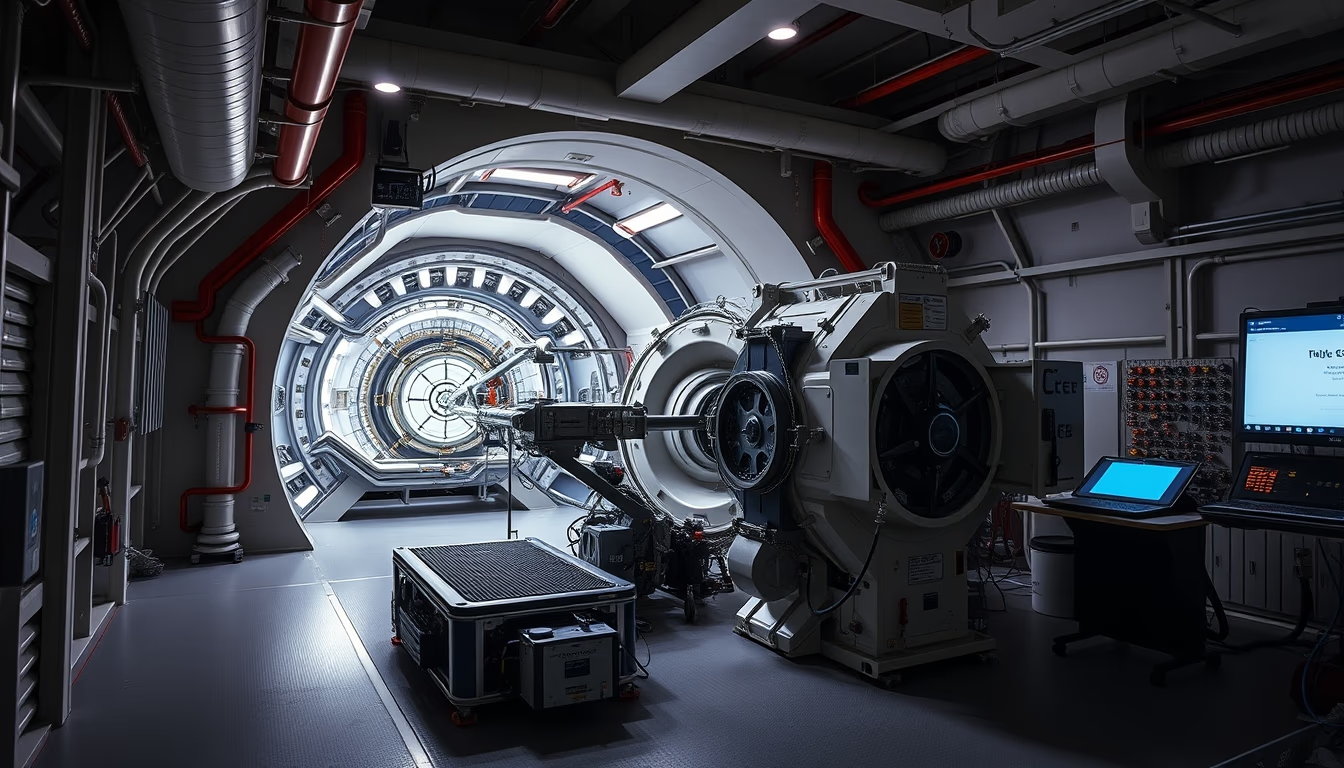
The interior of CERN's Large Hadron Collider (LHC) reveals the complex engineering of the world's largest and most powerful particle accelerator.
About this subject
The Large Hadron Collider (LHC) is the largest particle accelerator ever built, located in a 27-kilometer ring-shaped tunnel about 100 meters underground on the border between France and Switzerland, near Geneva. Operated by the European Organization for Nuclear Research (CERN), the LHC started operations in 2008 and has since enabled extraordinary advances in particle physics. Its primary goal is to collide beams of protons or heavy ions at extremely high energies, close to the speed of light, to recreate conditions similar to those just after the Big Bang.
The engineering behind the LHC is remarkable. Particle beams are accelerated by electric fields and guided by superconducting magnets that operate at temperatures colder than outer space, just 1.9 K (−271.3 °C). This requires complex cryogenic systems using liquid helium. Along the tunnel, giant detectors like ATLAS and CMS record the debris from collisions, allowing scientists to study fundamental particles and forces of nature.
One of the LHC's most famous discoveries was the Higgs boson in 2012, which confirmed the mechanism by which particles acquire mass. Additionally, the accelerator has investigated dark matter, antimatter, and extra dimensions, though no conclusive discovery beyond the Higgs has been made so far. The LHC is also a feat of international cooperation, involving more than 10,000 scientists and engineers from over 100 countries.
Despite its success, the LHC faces challenges. In 2024, it began its third operational phase (Run 3) with a record collision energy of 13.6 TeV. Planned upgrades for the High-Luminosity LHC (HL-LHC) starting in 2029 are expected to increase collision rates tenfold, enhancing discovery potential. The interior of the accelerator is a controlled, restricted-access environment, but virtual tours and exhibitions at CERN allow the public to explore this monument of modern science.
Frequently Asked Questions
How does the Large Hadron Collider (LHC) work?
The LHC accelerates two beams of particles (protons or ions) in opposite directions around its 27-km ring, using electric fields to boost energy and superconducting magnets to steer them. The beams collide at specific points where detectors record the resulting particles, enabling study of fundamental phenomena.
What important discoveries have been made at the LHC?
The most famous discovery was the Higgs boson in 2012, completing the Standard Model of particle physics. The LHC has also made precise measurements of particles like the top quark and observed new states of matter, such as quark-gluon plasma.
Is the LHC safe?
Yes. The LHC operates at safe energies, and particle collisions occur naturally in Earth's atmosphere. Rigorous safety studies, such as the LSAG report, concluded that there is no risk of dangerous black holes or other threats.
Direct URL
https://pub-c7d6a6ea828543ac903a74a341ccb2e1.r2.dev/imagens/particle-accelerator-interior-cern-magazine-editorial-p2.avifHow to credit
Include a visible link back to UtilizAí. Copy one of the snippets below:
<a href="https://xn--utiliza-eza.com/en/midia/imagens/particle-accelerator-interior-cern-magazine-editorial-p2">Particle accelerator interior cern</a> by <a href="https://xn--utiliza-eza.com">UtilizAí</a>, licensed under <a href="https://creativecommons.org/licenses/by/4.0/">CC BY 4.0</a>.
[Particle accelerator interior cern](https://xn--utiliza-eza.com/en/midia/imagens/particle-accelerator-interior-cern-magazine-editorial-p2) by [UtilizAí](https://xn--utiliza-eza.com), CC BY 4.0
License: CC-BY-4.0