Particle accelerator interior cern
1344×768 · AVIF · CC BY 4.0
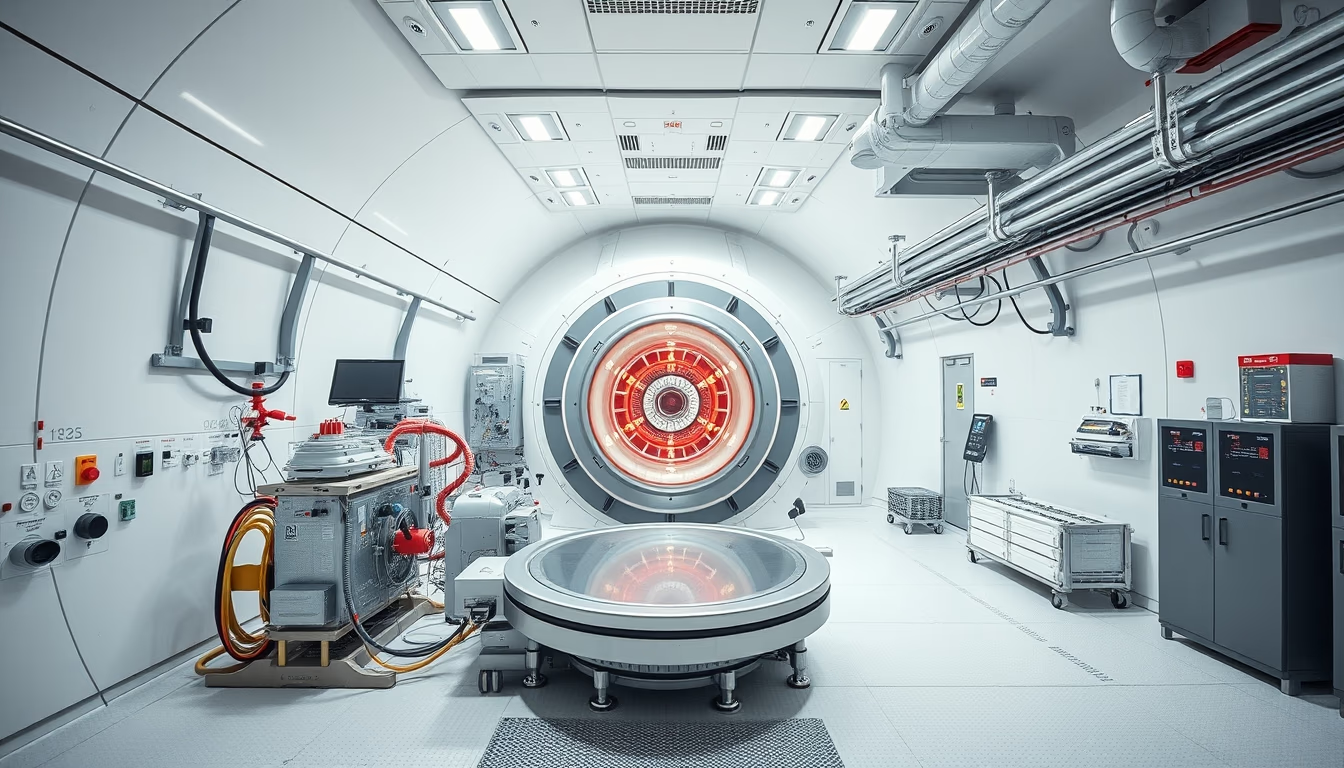
The interior of the Large Hadron Collider (LHC) at CERN, the world's largest particle accelerator, located on the Franco-Swiss border.
About this subject
The Large Hadron Collider (LHC) is the largest and most powerful particle accelerator ever built, operated by the European Organization for Nuclear Research (CERN). Its circular tunnel has a circumference of 27 kilometers, buried about 100 meters deep in the Geneva region, straddling the French-Swiss border. Inside the LHC, beams of protons are accelerated in opposite directions to near-light speeds, colliding at four points where major detectors are installed: ATLAS, CMS, ALICE, and LHCb.
Superconducting magnets, cooled to extremely low temperatures around 1.9 Kelvin (minus 271.3 degrees Celsius) using liquid helium, guide and focus the beams. This cooling allows the magnets to carry high electrical currents without resistance. The collisions produce enormous amounts of data, processed and analyzed through a global computing grid.
In 2012, the LHC enabled the discovery of the Higgs boson, a particle predicted by the Standard Model of particle physics, earning the Nobel Prize in Physics for François Englert and Peter Higgs. Currently, the LHC is undergoing an upgrade to the High-Luminosity LHC, which will increase the collision rate by a factor of 5 to 7, allowing more precise studies of rare phenomena. The facility has also been used to create quark-gluon plasma and investigate dark matter, among other frontier topics.
Frequently Asked Questions
What exactly is the LHC?
The LHC (Large Hadron Collider) is a particle accelerator at CERN, on the Franco-Swiss border. It collides beams of protons and ions at extremely high energies to study the fundamental particles of matter.
What temperature do the LHC's superconducting magnets operate at?
The magnets are cooled to approximately 1.9 Kelvin (about minus 271 degrees Celsius) using liquid helium to achieve the superconductivity needed for operation.
What is the most famous discovery made with the LHC?
In 2012, the LHC enabled the discovery of the Higgs boson, a particle that explains the origin of mass for elementary particles, confirming the Standard Model in physics.
Direct URL
https://pub-c7d6a6ea828543ac903a74a341ccb2e1.r2.dev/imagens/particle-accelerator-interior-cern-commercial-product-photography-p3.avifHow to credit
Include a visible link back to UtilizAí. Copy one of the snippets below:
<a href="https://xn--utiliza-eza.com/en/midia/imagens/particle-accelerator-interior-cern-commercial-product-photography-p3">Particle accelerator interior cern</a> by <a href="https://xn--utiliza-eza.com">UtilizAí</a>, licensed under <a href="https://creativecommons.org/licenses/by/4.0/">CC BY 4.0</a>.
[Particle accelerator interior cern](https://xn--utiliza-eza.com/en/midia/imagens/particle-accelerator-interior-cern-commercial-product-photography-p3) by [UtilizAí](https://xn--utiliza-eza.com), CC BY 4.0
License: CC-BY-4.0