Parker solar probe sun
1344×768 · AVIF · CC BY 4.0

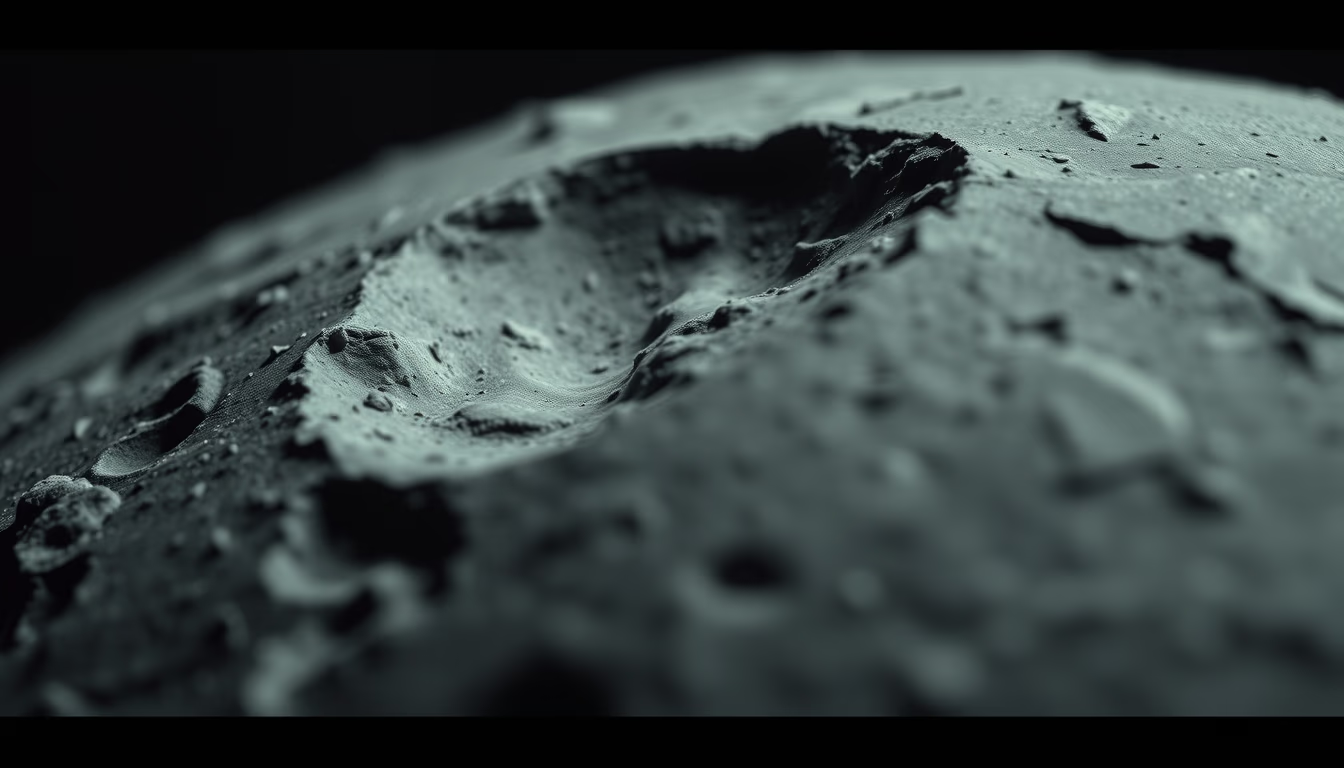
The Parker Solar Probe is NASA's groundbreaking mission that is revolutionizing the study of the Sun by getting closer than ever before to unravel its mysteries.
About this subject
The Parker Solar Probe, launched by NASA on August 12, 2018, is the first spacecraft to enter the outer atmosphere of the Sun, the corona. Its primary goal is to answer fundamental questions about solar physics, such as why the corona is hotter than the Sun's surface (the coronal heating paradox) and how the solar wind is accelerated. To achieve this, the probe makes extreme approaches, coming as close as 3.9 million miles (6.2 million kilometers) from the solar surface, enduring temperatures up to 2,500°F (1,400°C).
Protected by a carbon-composite heat shield 4.5 inches (11.4 cm) thick, Parker maintains its instruments at a comfortable room temperature of about 85°F (30°C). During its orbits, the spacecraft reaches incredible speeds: at its closest perihelion, it exceeds 430,000 mph (690,000 km/h), making it the fastest human-made object ever built. This velocity is achieved through gravity assists from Venus, which it has flown by seven times to adjust its trajectory.
Named after astrophysicist Eugene Parker, who predicted the existence of the solar wind in the 1950s, the mission has already yielded significant discoveries. In December 2021, Parker became the first spacecraft to fly through the solar corona, detecting zigzag-shaped magnetic structures and confirming that the solar wind originates from coronal holes. Data from the probe also revealed that the solar wind's rotation decreases as it moves away from the Sun, a phenomenon previously only modeled theoretically.
Beyond its scientific impact, the Parker Solar Probe represents the boldness of space engineering. Its innovative design allows it to survive a hostile environment of extreme radiation and heat. The mission is expected to continue until 2025, with ever-closer approaches to the Sun, promising further revelations about our star and its influence on the Solar System.
Frequently Asked Questions
What is the maximum speed of the Parker Solar Probe?
The Parker Solar Probe reaches speeds over 430,000 mph (690,000 km/h) at its closest approach to the Sun, making it the fastest human-made object ever.
How does the Parker Solar Probe withstand the Sun's extreme heat?
It is equipped with a carbon-composite heat shield 4.5 inches (11.4 cm) thick that reflects most solar radiation, keeping its instruments at about 85°F (30°C) even when the front faces temperatures of 2,500°F (1,400°C).
What discoveries has the Parker Solar Probe made about the Sun?
The probe confirmed that the solar wind originates from coronal holes, detected unexpected magnetic structures in the corona, and measured a decrease in the solar wind's rotation with distance from the Sun.
Direct URL
https://pub-c7d6a6ea828543ac903a74a341ccb2e1.r2.dev/imagens/parker-solar-probe-sun-film-grain-authentic-fresh4.avifHow to credit
Include a visible link back to UtilizAí. Copy one of the snippets below:
<a href="https://xn--utiliza-eza.com/en/midia/imagens/parker-solar-probe-sun-film-grain-authentic-fresh4">Parker solar probe sun</a> by <a href="https://xn--utiliza-eza.com">UtilizAí</a>, licensed under <a href="https://creativecommons.org/licenses/by/4.0/">CC BY 4.0</a>.
[Parker solar probe sun](https://xn--utiliza-eza.com/en/midia/imagens/parker-solar-probe-sun-film-grain-authentic-fresh4) by [UtilizAí](https://xn--utiliza-eza.com), CC BY 4.0
License: CC-BY-4.0