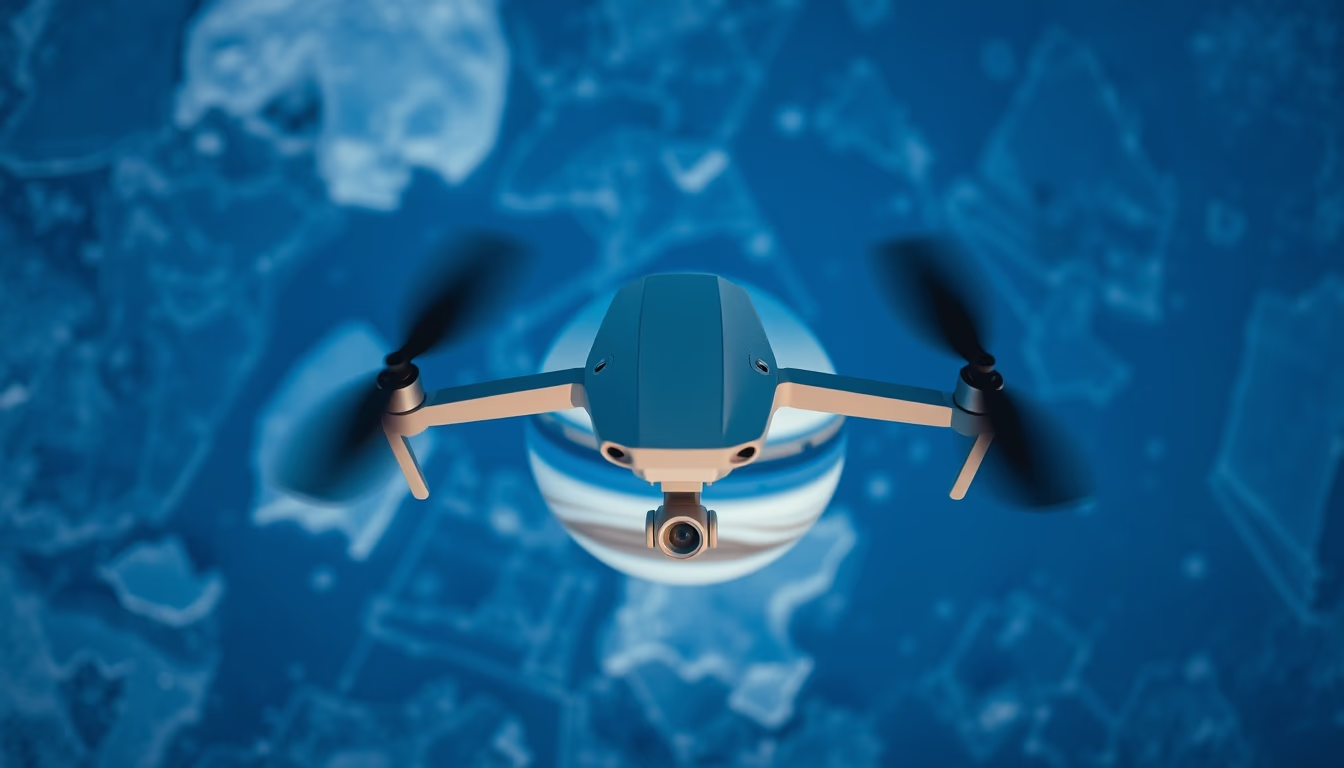
Parker solar probe sun
1344×768 · AVIF · CC BY 4.0

The Parker Solar Probe is the spacecraft that has come closest to the Sun, revolutionizing our understanding of the star.
About this subject
The Parker Solar Probe, launched by NASA in 2018, is a historic mission designed to study the Sun from a distance never before achieved. The spacecraft has set records for proximity, coming within 6.2 million kilometers of the solar surface, inside the solar corona, the Sun's outer atmosphere. To withstand extreme temperatures up to 1400°C, it uses a carbon-composite heat shield, the Thermal Protection System, which keeps its instruments at about 30°C.
The mission aims to answer fundamental questions about solar physics, such as why the corona is millions of degrees hotter than the Sun's surface and how the solar wind is accelerated. The Parker Solar Probe collects data on energetic particles, magnetic fields, and plasma, helping to predict solar storms that can affect Earth, including satellite disruptions and power grid failures.
By 2025, the probe will complete 24 orbits around the Sun, using Venus's gravity to get progressively closer. In 2024, it reached a record speed of 635,266 km/h, making it the fastest human-made object ever. Its mission is expected to last until 2025, when it will run out of fuel.
The Parker Solar Probe is named after astrophysicist Eugene Parker, who predicted the existence of the solar wind in the 1950s. It is the first NASA mission named after a living scientist, honoring his foundational contributions to heliophysics.
Frequently Asked Questions
What is the maximum temperature the Parker Solar Probe can withstand?
The probe withstands temperatures up to 1400°C, thanks to its carbon-composite heat shield, which keeps its instruments at about 30°C.
Why does the Parker Solar Probe get so close to the Sun?
To study the solar corona and solar wind directly, helping to understand phenomena such as coronal heating and solar wind acceleration, which affect space weather on Earth.
What is the top speed of the Parker Solar Probe?
In 2024, the probe reached 635,266 km/h, the fastest speed ever achieved by a human-made object, due to the Sun's strong gravity.
Direct URL
https://pub-c7d6a6ea828543ac903a74a341ccb2e1.r2.dev/imagens/parker-solar-probe-sun-cinematic-wide-shot-fresh13.avifHow to credit
Include a visible link back to UtilizAí. Copy one of the snippets below:
<a href="https://xn--utiliza-eza.com/en/midia/imagens/parker-solar-probe-sun-cinematic-wide-shot-fresh13">Parker solar probe sun</a> by <a href="https://xn--utiliza-eza.com">UtilizAí</a>, licensed under <a href="https://creativecommons.org/licenses/by/4.0/">CC BY 4.0</a>.
[Parker solar probe sun](https://xn--utiliza-eza.com/en/midia/imagens/parker-solar-probe-sun-cinematic-wide-shot-fresh13) by [UtilizAí](https://xn--utiliza-eza.com), CC BY 4.0
License: CC-BY-4.0