Osmosis membrane diagram
1344×768 · AVIF · CC BY 4.0
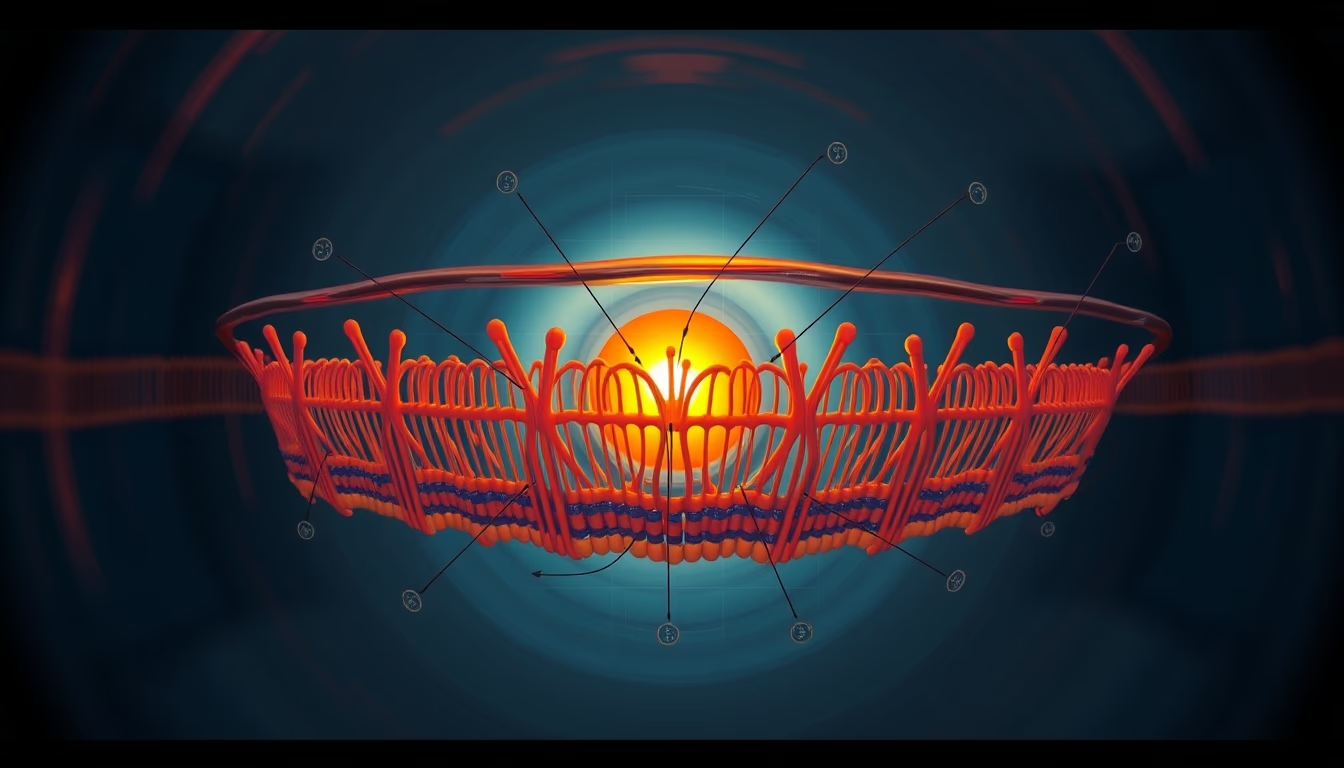
Educational diagram illustrating the process of osmosis through a semipermeable membrane, a key mechanism for cellular homeostasis.
About this subject
Osmosis is the spontaneous movement of water molecules across a semipermeable membrane from a region of lower solute concentration to one of higher concentration. This process is fundamental for regulating cell volume and osmotic pressure, being crucial in living organisms. For example, plant roots absorb water from the soil via osmosis, and human red blood cells depend on osmotic balance to avoid hemolysis or crenation.
The concept of osmosis was first described by German physiologist Wilhelm Pfeffer in the 19th century and later formalized by Jacobus Henricus van 't Hoff, who received the Nobel Prize in Chemistry in 1901 for his contributions. Van 't Hoff developed an equation relating osmotic pressure to solute concentration, analogous to the ideal gas law.
In practice, osmosis has important technological applications, such as reverse osmosis desalination, widely used to produce fresh water from seawater. This process involves applying external pressure to force water through a membrane, retaining salts and impurities. Additionally, osmosis is critical in industrial processes like juice concentration and the purification of blood products in medicine.
Frequently Asked Questions
What is osmosis?
Osmosis is the movement of water across a semipermeable membrane from a region of low solute concentration to a region of high solute concentration, until equilibrium is reached.
What is the difference between osmosis and diffusion?
In diffusion, solutes move from high to low concentration. In osmosis, only water moves through a selectively permeable membrane, driven by the solute concentration gradient.
What is osmotic pressure?
Osmotic pressure is the pressure required to stop the osmotic flow of pure water into a solution. It depends on the concentration of solute particles, as described by the van 't Hoff equation.
Direct URL
https://pub-c7d6a6ea828543ac903a74a341ccb2e1.r2.dev/imagens/osmosis-membrane-diagram-fish-eye-wide-angle-p10.avifHow to credit
Include a visible link back to UtilizAí. Copy one of the snippets below:
<a href="https://xn--utiliza-eza.com/en/midia/imagens/osmosis-membrane-diagram-fish-eye-wide-angle-p10">Osmosis membrane diagram</a> by <a href="https://xn--utiliza-eza.com">UtilizAí</a>, licensed under <a href="https://creativecommons.org/licenses/by/4.0/">CC BY 4.0</a>.
[Osmosis membrane diagram](https://xn--utiliza-eza.com/en/midia/imagens/osmosis-membrane-diagram-fish-eye-wide-angle-p10) by [UtilizAí](https://xn--utiliza-eza.com), CC BY 4.0
License: CC-BY-4.0