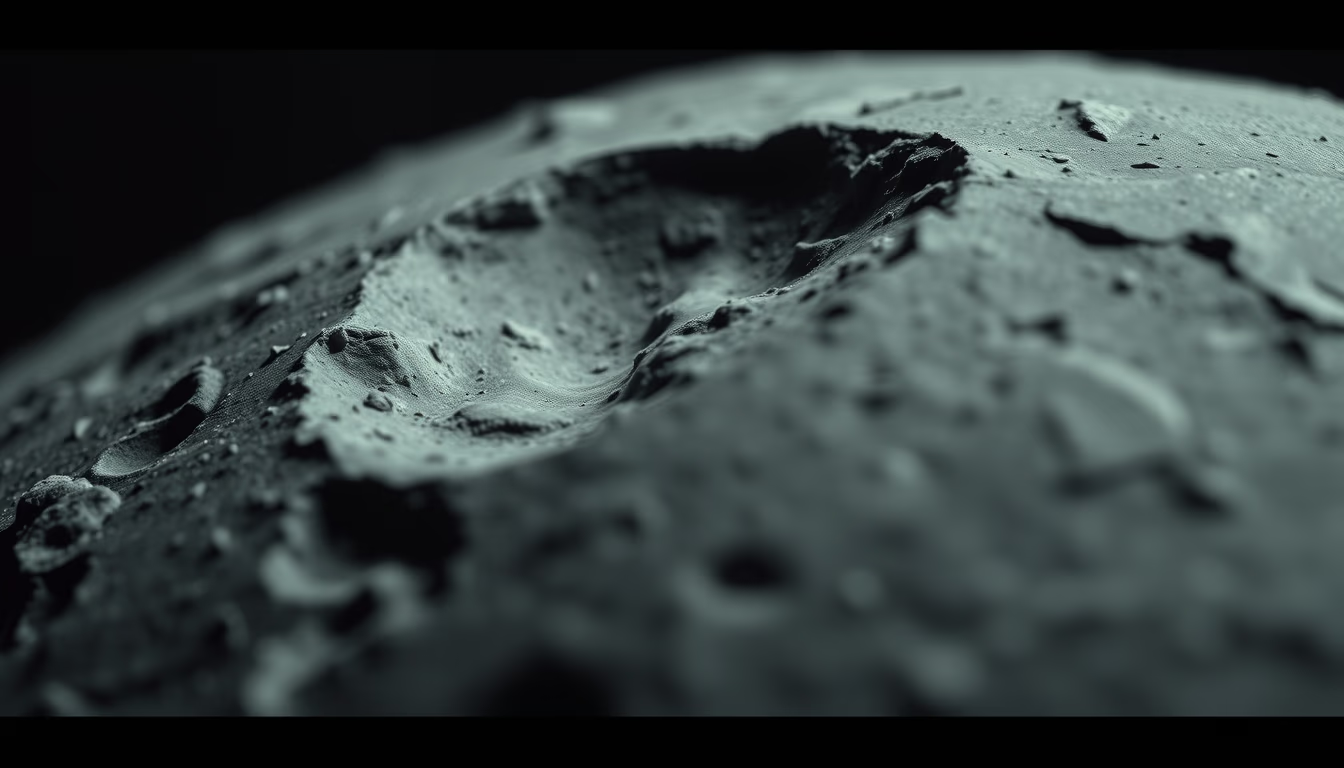
Osiris-rex bennu asteroid
1344×768 · AVIF · CC BY 4.0
NASA's OSIRIS-REx mission collected samples from asteroid Bennu, a primitive celestial body that may hold clues about the origin of the Solar System.
About this subject
The OSIRIS-REx spacecraft (Origins, Spectral Interpretation, Resource Identification, Security-Regolith Explorer) was launched on September 8, 2016, by NASA to study and collect material from asteroid Bennu. Bennu is a near-Earth asteroid classified as Apollo, with an average diameter of about 500 meters. It orbits the Sun every 1.2 years and has a calculated, albeit low, probability of impacting Earth in the 22nd century. Bennu was chosen for its carbon-rich composition, a remnant from the early Solar System over 4.5 billion years ago. It is believed that asteroids like Bennu may have delivered organic compounds and water to early Earth.
Sample collection occurred on October 20, 2020, when the spacecraft touched Bennu's surface for a few seconds and captured approximately 250 grams of regolith. This was the largest volume of extraterrestrial material collected since the Apollo missions. The sample capsule returned to Earth on September 24, 2023, landing in the Utah desert. After delivery, the spacecraft was renamed OSIRIS-APEX and is now heading to asteroid Apophis.
Bennu was named after the Egyptian mythological bird Bennu, associated with the sun and rebirth. The name was suggested by a nine-year-old boy from North Carolina, Michael Puzio, winner of a contest. Besides its scientific value, Bennu is also of interest for planetary defense, as its orbit is constantly monitored. Previous studies indicate its surface is covered with loose rocks and has low density, characteristics that made the spacecraft's landing challenging.
Frequently Asked Questions
Why was asteroid Bennu chosen for the OSIRIS-REx mission?
Bennu was chosen because it is a primitive, carbon-rich near-Earth asteroid of suitable size for sample collection. Its composition may contain organic molecules and water, clues about the origin of life in the Solar System.
How much sample was collected and when did it return to Earth?
Approximately 250 grams of regolith were collected from Bennu's surface. The sample capsule successfully returned on September 24, 2023, landing in Utah, USA.
What happened to the OSIRIS-REx spacecraft after delivering the samples?
After delivering the capsule, the spacecraft was renamed OSIRIS-APEX and is now heading to asteroid Apophis, which it will visit in 2029 for further studies.
Direct URL
https://pub-c7d6a6ea828543ac903a74a341ccb2e1.r2.dev/imagens/osiris-rex-bennu-asteroid-documentary-photography-fresh13.avifHow to credit
Include a visible link back to UtilizAí. Copy one of the snippets below:
<a href="https://xn--utiliza-eza.com/en/midia/imagens/osiris-rex-bennu-asteroid-documentary-photography-fresh13">Osiris-rex bennu asteroid</a> by <a href="https://xn--utiliza-eza.com">UtilizAí</a>, licensed under <a href="https://creativecommons.org/licenses/by/4.0/">CC BY 4.0</a>.
[Osiris-rex bennu asteroid](https://xn--utiliza-eza.com/en/midia/imagens/osiris-rex-bennu-asteroid-documentary-photography-fresh13) by [UtilizAí](https://xn--utiliza-eza.com), CC BY 4.0
License: CC-BY-4.0