Oscilloscope display waveform
1344×768 · AVIF · CC BY 4.0
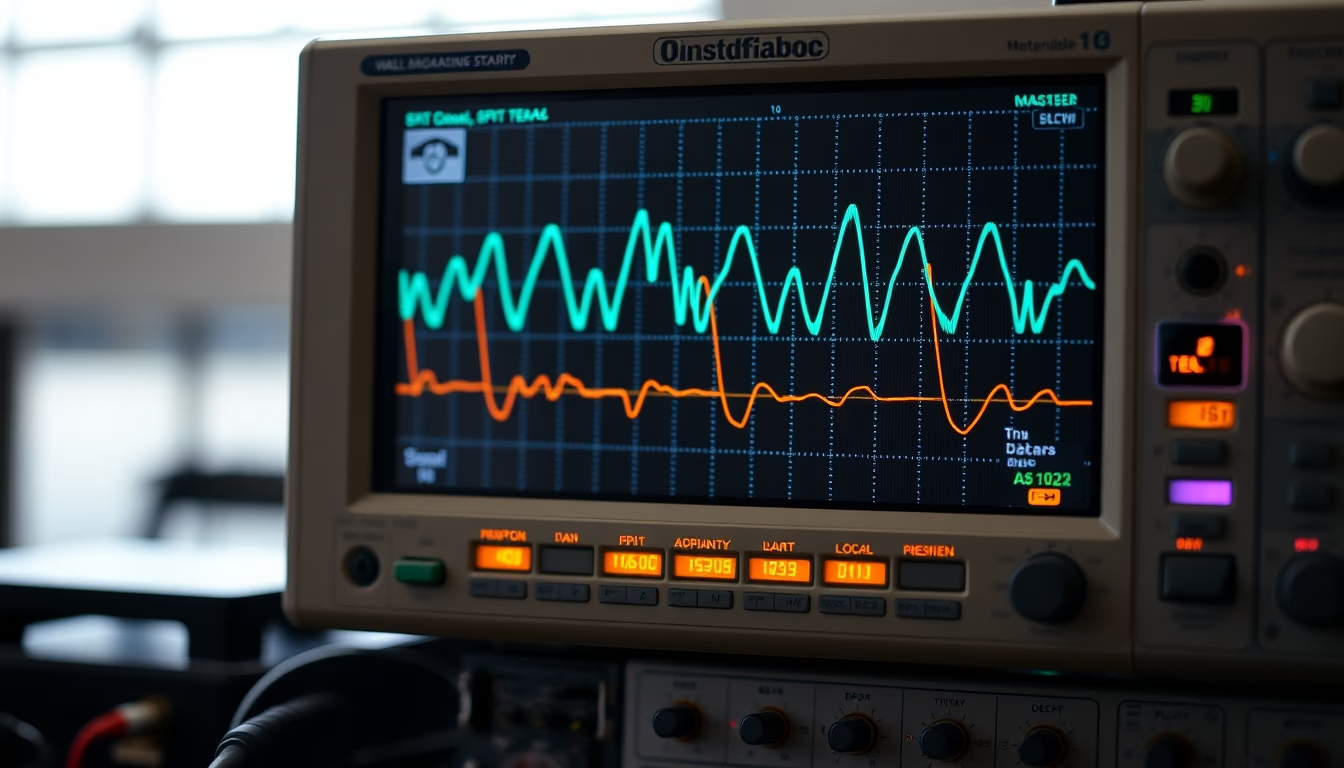
The oscilloscope displays electrical waveforms, an essential tool for engineers and technicians in electronics, allowing voltage visualization over time.
About this subject
The oscilloscope is an electronic measuring instrument that graphically represents varying electrical signals over time. The displayed waveform can be sinusoidal, square, triangular, or pulsed, depending on the circuit under analysis. The vertical axis represents voltage, while the horizontal axis represents time. This visualization helps diagnose distortion, noise, and interference in equipment such as amplifiers, power supplies, and digital systems.
The first practical oscilloscope was developed in the 1930s, but the principle dates back to the cathode ray tube invented by Karl Ferdinand Braun in 1897. Today, modern digital oscilloscopes with signal processing and memory complement traditional analog models. In laboratories, workshops, and industries worldwide, oscilloscopes are crucial for testing and troubleshooting.
A typical 60 Hz power grid waveform in Brazil is sinusoidal. In digital circuits, square waves indicate transitions between high and low logic levels. An oscilloscope measures frequency, amplitude, period, and phase. Engineers rely on these parameters to ensure devices meet technical specifications set by standards such as those from IEC or ANSI.
Interesting fact: cathode-ray oscilloscopes, still used in teaching labs, consume more power and offer lower precision than digital ones but provide real-time response without aliasing. Digital oscilloscopes can store waveforms for later analysis, a valuable feature for solving intermittent faults.
Frequently Asked Questions
What is the purpose of a waveform on an oscilloscope?
The waveform displays voltage variation over time, helping to analyze amplitude, frequency, period, and signal distortions.
What is the difference between analog and digital oscilloscopes?
Analog oscilloscopes use a cathode-ray tube and display signals in real time without aliasing. Digital oscilloscopes digitize the signal, allowing storage and analysis, but may exhibit aliasing if the sample rate is inadequate.
What does a sine wave on an oscilloscope indicate?
A sine wave indicates that voltage varies smoothly and periodically, like the alternating current from the power grid (60 Hz in Brazil). It is common in signal generators and audio circuits.
Direct URL
https://pub-c7d6a6ea828543ac903a74a341ccb2e1.r2.dev/imagens/oscilloscope-display-waveform-documentary-photography-p7.avifHow to credit
Include a visible link back to UtilizAí. Copy one of the snippets below:
<a href="https://xn--utiliza-eza.com/en/midia/imagens/oscilloscope-display-waveform-documentary-photography-p7">Oscilloscope display waveform</a> by <a href="https://xn--utiliza-eza.com">UtilizAí</a>, licensed under <a href="https://creativecommons.org/licenses/by/4.0/">CC BY 4.0</a>.
[Oscilloscope display waveform](https://xn--utiliza-eza.com/en/midia/imagens/oscilloscope-display-waveform-documentary-photography-p7) by [UtilizAí](https://xn--utiliza-eza.com), CC BY 4.0
License: CC-BY-4.0