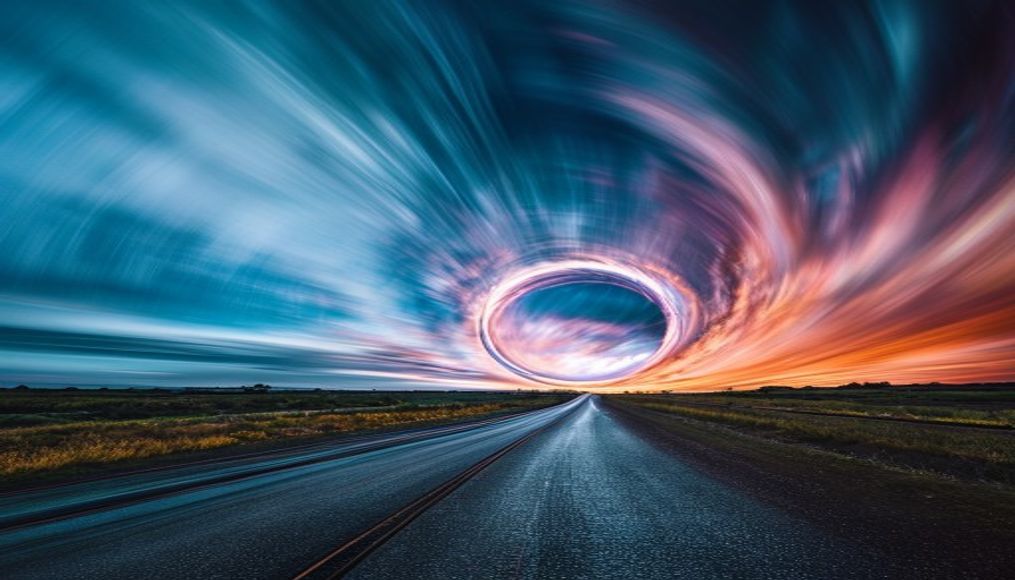
Orion nebula glowing
1344×768 · AVIF · CC BY 4.0

The Orion Nebula (M42) is one of the brightest and closest star-forming regions to Earth, visible to the naked eye in Orion's Belt.
About this subject
The Orion Nebula, also designated M42 or NGC 1976, is an emission and reflection nebula located in the constellation Orion, approximately 1,344 light-years from Earth. It is part of the Orion Molecular Cloud Complex, a vast region of gas and dust where stars are born. Its position in the night sky is easy to identify: just below Orion's Belt, which in Brazilian culture is known as the 'Três Marias' (Three Marys) formed by the stars Alnitak, Alnilam, and Mintaka.
The nebula shines brightly due to the ionization of hydrogen gas by ultraviolet radiation from young, massive stars in the Trapezium Cluster at its core. This ionization produces the characteristic reddish hue, while dust regions reflect blue starlight, creating striking contrasts. The Orion Nebula is one of the most studied stellar nurseries, hosting hundreds of protostars and protoplanetary disks (proplyds) that may eventually form planetary systems.
Historically, the nebula was known to ancient astronomers, but its nebulous nature was first recognized in 1610 by French scientist Nicolas-Claude Fabri de Peiresc. Charles Messier cataloged it in 1769. Since then, it has become a prime target for telescopes such as Hubble and James Webb, which have revealed unprecedented details about star formation. The nebula spans about 24 light-years in diameter and has a total mass equivalent to roughly 2,000 solar masses.
Interestingly, the Orion Nebula is visible to the naked eye on dark nights as a fuzzy patch, requiring no special equipment. For Brazilians, the constellation Orion is particularly familiar because its main stars, the Three Marys, are a cultural and popular reference. The nebula, located in Orion's Sword (a line of three stars below the belt), invites sky observation and reflection on the cosmic processes surrounding us.
Frequently Asked Questions
Why does the Orion Nebula appear pinkish?
The pinkish color comes from ionized hydrogen emission. Ultraviolet radiation from hot, young stars at the center excites hydrogen atoms, which emit light at specific wavelengths, mainly in the red range (H-alpha), giving the characteristic pinkish glow.
Where is the Orion Nebula located in the night sky?
It is in the constellation Orion, just below the belt (the Three Marys in Brazil). It lies in Orion's Sword, a line of three stars (the middle one is the nebula) hanging from the belt. On dark nights, it appears as a fuzzy patch to the naked eye.
How important is the Orion Nebula for astronomy?
It is one of the most studied star-forming regions, due to its proximity and brightness. It helps scientists understand how stars and planetary systems form. Telescopes like Hubble and James Webb have obtained detailed images of protoplanetary disks (proplyds) and young stars in their early stages.
Direct URL
https://pub-c7d6a6ea828543ac903a74a341ccb2e1.r2.dev/imagens/orion-nebula-glowing-studio-still-life-p1.avifHow to credit
Include a visible link back to UtilizAí. Copy one of the snippets below:
<a href="https://xn--utiliza-eza.com/en/midia/imagens/orion-nebula-glowing-studio-still-life-p1">Orion nebula glowing</a> by <a href="https://xn--utiliza-eza.com">UtilizAí</a>, licensed under <a href="https://creativecommons.org/licenses/by/4.0/">CC BY 4.0</a>.
[Orion nebula glowing](https://xn--utiliza-eza.com/en/midia/imagens/orion-nebula-glowing-studio-still-life-p1) by [UtilizAí](https://xn--utiliza-eza.com), CC BY 4.0
License: CC-BY-4.0