Orion nebula glowing
1344×768 · AVIF · CC BY 4.0
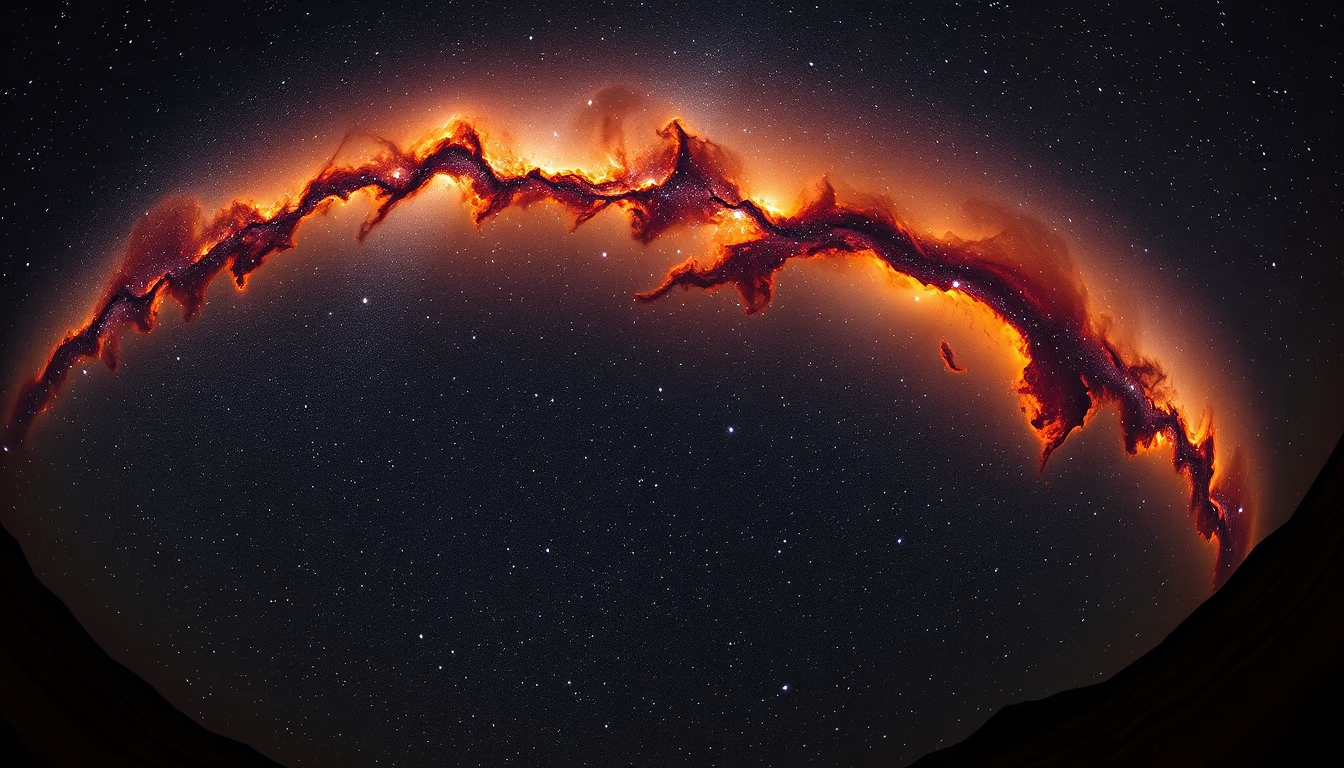
The Orion Nebula is one of the brightest and most studied stellar nurseries in the night sky, visible to the naked eye in the constellation Orion.
About this subject
The Orion Nebula, also designated Messier 42 or M42, is an emission nebula located approximately 1,344 light-years from Earth in the Milky Way. It is one of the closest and most active stellar nurseries, where new stars are born from clouds of gas and dust. The nebula is easily identifiable in Orion's Belt, forming the "sword" of the constellation. With an apparent magnitude of 4.0, it is visible to the naked eye under dark skies.
Discovered around 1610 by Nicolas-Claude Fabri de Peiresc, the nebula was later cataloged by Charles Messier in 1769. It spans about 24 light-years across and has a mass equivalent to 2,000 Suns. At its core lies the Trapezium Cluster, a group of young, massive stars that illuminate the surrounding gas. The Hubble Space Telescope has revealed hundreds of protoplanetary disks, called proplyds, indicating that planetary systems are forming.
The Orion Nebula is a crucial laboratory for studying star formation. Astronomers use observations across the electromagnetic spectrum (infrared, X-ray) to investigate processes such as accretion and stellar winds. The region also contains giant molecular clouds and Herbig-Haro objects, jets of gas ejected by newborn stars. In 2020, the SOFIA observatory detected water vapor in the nebula, supporting the idea that similar environments may have supplied water to early Earth.
For observers in the Southern Hemisphere, Orion is prominent during summer and autumn, particularly from June to September. With a small telescope, one can see the nebula's greenish glow, caused by doubly ionized oxygen. The Orion Nebula remains a prime target for scientific research and astrophotography, inspiring both professional astronomers and amateur stargazers.
Frequently Asked Questions
How far is the Orion Nebula from Earth?
The Orion Nebula is approximately 1,344 light-years away from Earth, making it one of the closest stellar nurseries to our solar system.
Can the Orion Nebula be seen with the naked eye?
Yes, under dark skies with minimal light pollution, the Orion Nebula is visible to the naked eye as a fuzzy patch in the sword of the Orion constellation.
What are proplyds found in the Orion Nebula?
Proplyds are protoplanetary disks, structures of gas and dust around young stars where planets may form. The Hubble Telescope discovered hundreds of them in the Orion Nebula.
Direct URL
https://pub-c7d6a6ea828543ac903a74a341ccb2e1.r2.dev/imagens/orion-nebula-glowing-fish-eye-wide-angle-p4.avifHow to credit
Include a visible link back to UtilizAí. Copy one of the snippets below:
<a href="https://xn--utiliza-eza.com/en/midia/imagens/orion-nebula-glowing-fish-eye-wide-angle-p4">Orion nebula glowing</a> by <a href="https://xn--utiliza-eza.com">UtilizAí</a>, licensed under <a href="https://creativecommons.org/licenses/by/4.0/">CC BY 4.0</a>.
[Orion nebula glowing](https://xn--utiliza-eza.com/en/midia/imagens/orion-nebula-glowing-fish-eye-wide-angle-p4) by [UtilizAí](https://xn--utiliza-eza.com), CC BY 4.0
License: CC-BY-4.0