Orion nebula glowing
1344×768 · AVIF · CC BY 4.0
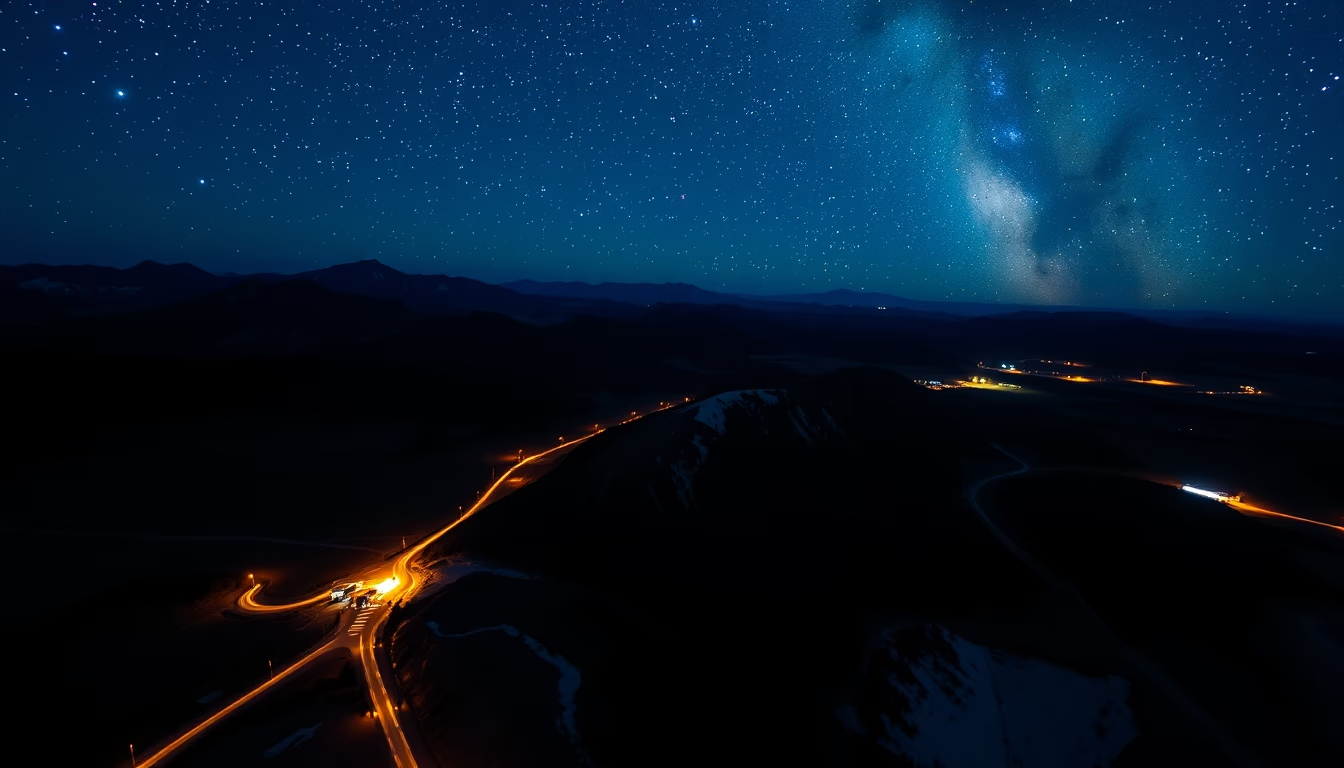
The Orion Nebula is one of the brightest and most studied star-forming regions in the night sky, located in the constellation Orion.
About this subject
The Orion Nebula, also known as Messier 42 (M42) or NGC 1976, is a diffuse emission nebula located approximately 1,344 light-years from Earth. It is part of the Orion Molecular Cloud, a vast region of gas and dust that hosts several other astronomical objects, such as the Horsehead Nebula and Barnard's Loop. With an apparent magnitude of 4.0, it is visible to the naked eye under dark skies, appearing as a fuzzy patch south of Orion's Belt.
At the center of the nebula lies the Trapezium Cluster, a group of young, massive stars that illuminate and sculpt the surrounding gas with their intense ultraviolet radiation. These stars are only about 1 million years old, making the region a natural laboratory for studying star formation. The Hubble Space Telescope has revealed hundreds of protoplanetary disks (proplyds) within the nebula, indicating that planetary systems are actively forming.
The Orion Nebula is one of the most photographed and studied celestial objects in astronomy. Its relative proximity and wealth of detail have led to significant advances in understanding how stars and planets are born. Furthermore, the nebula emits light across multiple spectral bands, from radio to X-rays, and is a target for observatories such as Hubble, Spitzer, and ALMA. Interestingly, the nebula is slowly expanding, and it is estimated that in about 100,000 years it will dissipate into interstellar space.
Frequently Asked Questions
How far is the Orion Nebula from Earth?
The Orion Nebula is located approximately 1,344 light-years away from Earth.
Why is the Orion Nebula important for astronomy?
It is one of the closest and most active star-forming regions, allowing detailed study of the birth of stars and planetary systems.
Can the Orion Nebula be seen with the naked eye?
Yes, under dark skies and away from light pollution, it appears as a fuzzy patch south of Orion's Belt.
Direct URL
https://pub-c7d6a6ea828543ac903a74a341ccb2e1.r2.dev/imagens/orion-nebula-glowing-aerial-drone-shot-p9.avifHow to credit
Include a visible link back to UtilizAí. Copy one of the snippets below:
<a href="https://xn--utiliza-eza.com/en/midia/imagens/orion-nebula-glowing-aerial-drone-shot-p9">Orion nebula glowing</a> by <a href="https://xn--utiliza-eza.com">UtilizAí</a>, licensed under <a href="https://creativecommons.org/licenses/by/4.0/">CC BY 4.0</a>.
[Orion nebula glowing](https://xn--utiliza-eza.com/en/midia/imagens/orion-nebula-glowing-aerial-drone-shot-p9) by [UtilizAí](https://xn--utiliza-eza.com), CC BY 4.0
License: CC-BY-4.0