Origami paper folded
1344×768 · AVIF · CC BY 4.0
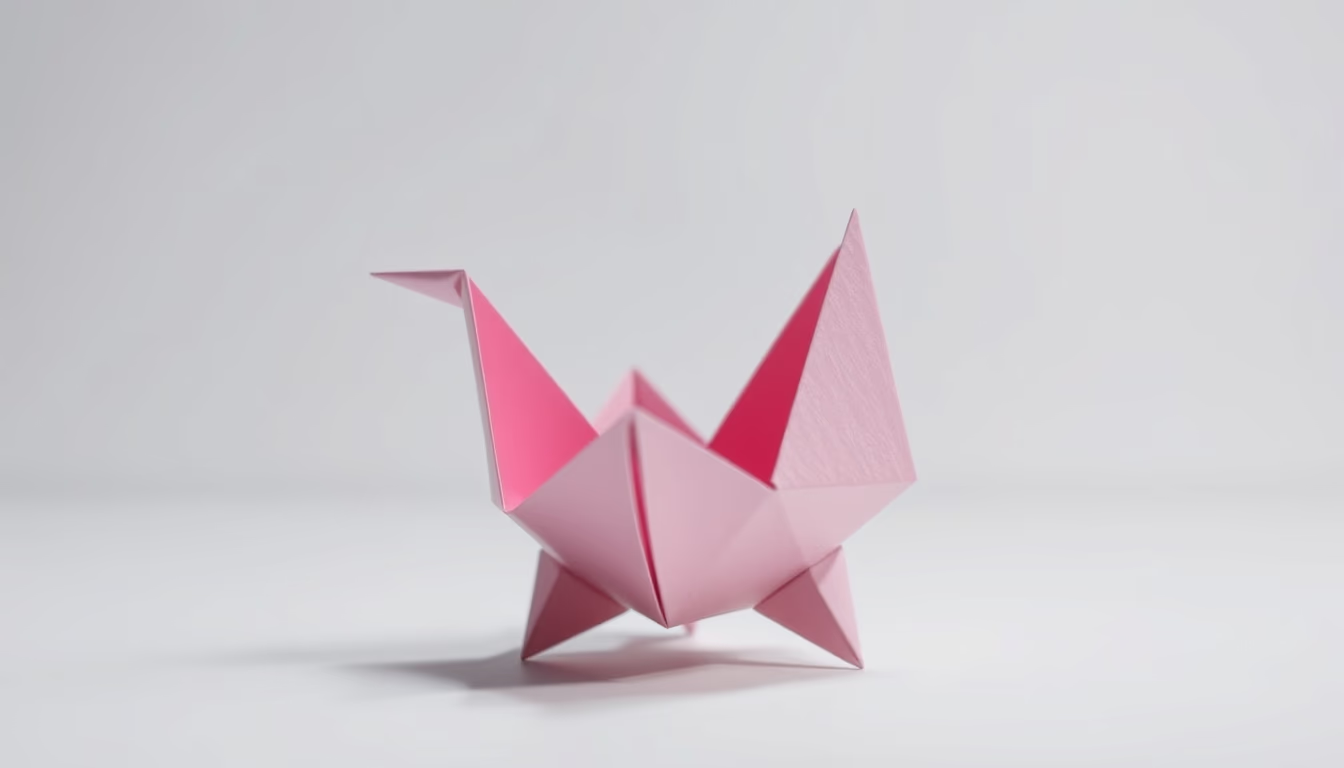
Origami, the Japanese art of paper folding, creates three-dimensional sculptures from flat sheets, combining tradition and geometry.
About this subject
Origami is an ancient practice that emerged in Japan around the 17th century, though records of paper folding in China and Europe are even older. The word origami comes from Japanese 'oru' (to fold) and 'kami' (paper). Initially restricted to religious ceremonies and Shinto rituals, origami became popular during the Edo period (1603, 1868) with the mass production of paper. The tsuru (crane) is the most iconic model, symbolizing peace and longevity; legend says that folding a thousand cranes grants a wish.
In contemporary culture, origami has transcended crafts and influenced fields like mathematics, engineering, and design. The principle of folding flat surfaces into complex shapes is used in solar panel arrays for satellites, medical stents, and airbags. Artists like Robert Lang apply computation to create realistic models, such as insects and dinosaurs. The lo-fi aesthetic, often associated with disposable cameras and grainy photography, resonates with origami by valuing handmade, imperfect, and tactile nostalgia.
Origami is also a powerful educational tool. In schools worldwide, folding paper teaches geometry, fine motor skills, and patience. Each fold involves precise angles and symmetry, transforming a square sheet into a polyhedron or animal. There are modalities like modular origami, where identical pieces fit without glue, and kirigami, which allows cuts. The practice requires only paper and creativity, making it accessible to all ages and cultures.
Frequently Asked Questions
What is the difference between origami and kirigami?
In origami, only folding is allowed; the paper cannot be cut. Kirigami allows cuts and slits, resulting in pop-up and relief effects.
What basic materials are needed to start origami?
Square paper (special origami paper or cut copy paper), a flat surface, and for beginners, tutorials with step-by-step diagrams. Traditional options include kami or washi paper.
Can origami be used in scientific fields?
Yes. Engineering draws on folding patterns to create compact and expandable structures, such as space telescopes, cardiac stents, and foldable solar panels.
Direct URL
https://pub-c7d6a6ea828543ac903a74a341ccb2e1.r2.dev/imagens/origami-paper-folded-lo-fi-disposable-camera-p1.avifHow to credit
Include a visible link back to UtilizAí. Copy one of the snippets below:
<a href="https://xn--utiliza-eza.com/en/midia/imagens/origami-paper-folded-lo-fi-disposable-camera-p1">Origami paper folded</a> by <a href="https://xn--utiliza-eza.com">UtilizAí</a>, licensed under <a href="https://creativecommons.org/licenses/by/4.0/">CC BY 4.0</a>.
[Origami paper folded](https://xn--utiliza-eza.com/en/midia/imagens/origami-paper-folded-lo-fi-disposable-camera-p1) by [UtilizAí](https://xn--utiliza-eza.com), CC BY 4.0
License: CC-BY-4.0