Origami paper folded
1344×768 · AVIF · CC BY 4.0
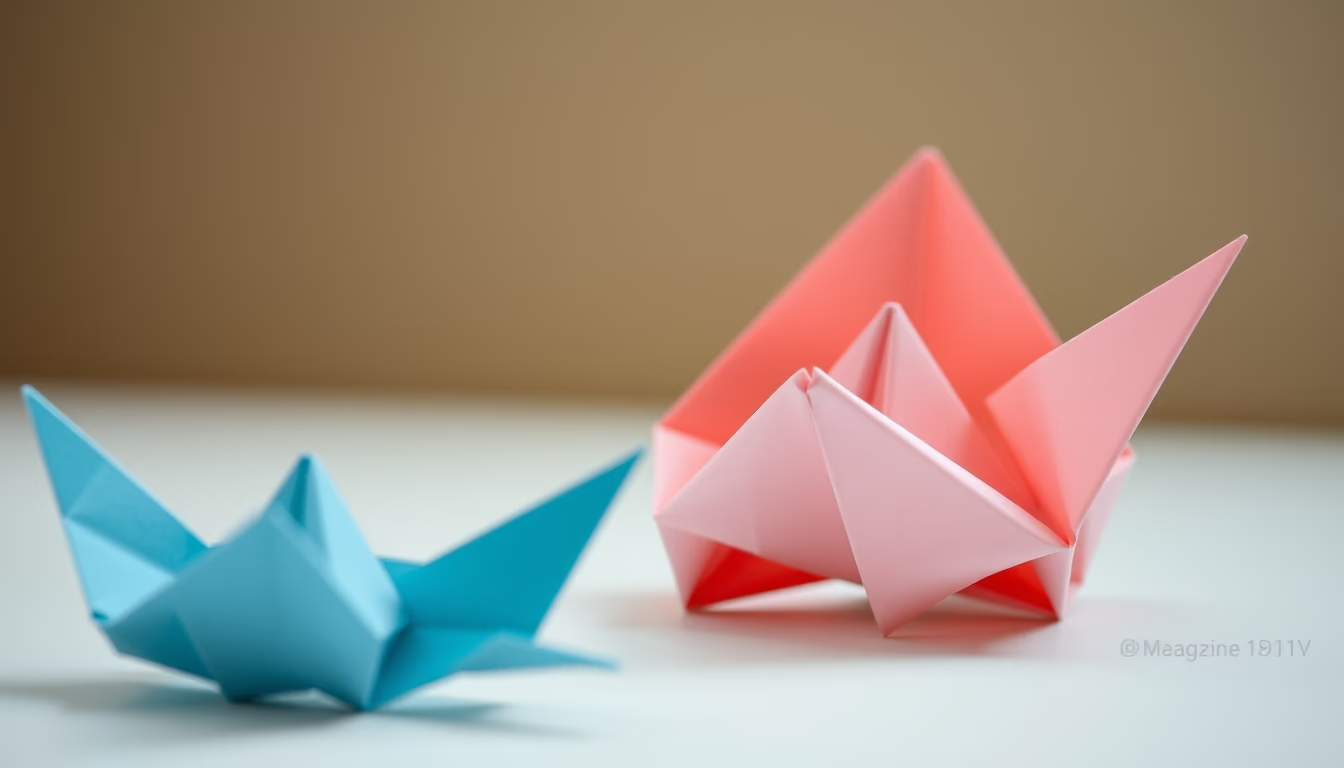
Origami, the Japanese art of paper folding, transforms flat sheets into intricate three-dimensional sculptures.
About this subject
Origami is an ancient technique that originated in Japan around the 17th century, evolving from Shinto ceremonial practices where paper was folded to create offerings. The word origami comes from the Japanese terms oru (to fold) and kami (paper). Unlike other paper arts, classical origami uses only a single square sheet, with no cutting or gluing, to create shapes such as animals, flowers, and geometric objects. The tsuru, or paper crane, is the most iconic model and symbolizes peace and longevity, often used in celebrations and rituals.
In the 20th century, artist Akira Yoshizawa revolutionized origami by developing a diagramming system that standardized instructions worldwide. Yoshizawa created over 50,000 models and is considered the father of modern origami. Today, the practice has expanded into fields like mathematics, engineering, and design. Origami has inspired everything from space satellite structures to medical implants, highlighting its versatility beyond a hobby.
There are various styles of origami, including modular, where multiple pieces are assembled into a larger structure, and action origami, which produces figures with moving parts like jumping frogs. Many enthusiasts seek origami for stress reduction and cognitive benefits, as the focus on precise folds exercises concentration and motor coordination. Workshops and exhibitions around the world celebrate the art that connects tradition and innovation.
Frequently Asked Questions
What is the difference between origami and kirigami?
Origami uses only folding, without cuts or glue. Kirigami allows cutting the paper to create three-dimensional shapes.
What materials are used for origami?
Thin square papers are ideal, such as kami paper, washi, or cut printer paper. Very thick paper makes precise folds difficult.
Can origami be used in science?
Yes, origami principles are applied in airbag design, space telescopes, and medical implant structures, using fold patterns for compacting and deploying.
Direct URL
https://pub-c7d6a6ea828543ac903a74a341ccb2e1.r2.dev/imagens/origami-paper-folded-documentary-photography-p2.avifHow to credit
Include a visible link back to UtilizAí. Copy one of the snippets below:
<a href="https://xn--utiliza-eza.com/en/midia/imagens/origami-paper-folded-documentary-photography-p2">Origami paper folded</a> by <a href="https://xn--utiliza-eza.com">UtilizAí</a>, licensed under <a href="https://creativecommons.org/licenses/by/4.0/">CC BY 4.0</a>.
[Origami paper folded](https://xn--utiliza-eza.com/en/midia/imagens/origami-paper-folded-documentary-photography-p2) by [UtilizAí](https://xn--utiliza-eza.com), CC BY 4.0
License: CC-BY-4.0