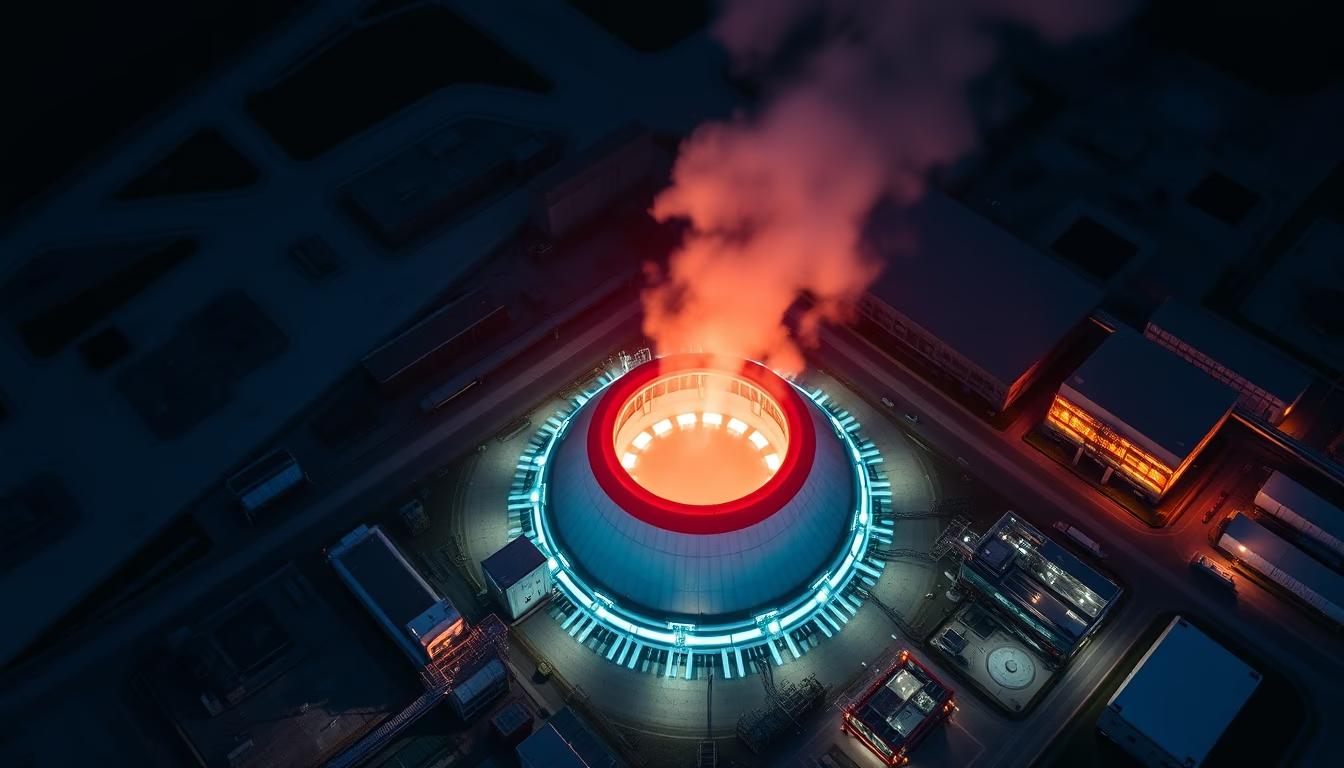
Nuclear reactor core glow
1344×768 · AVIF · CC BY 4.0

The distinctive blue glow from a nuclear reactor core is caused by Cherenkov radiation, a fascinating optical phenomenon and a safe indicator of reactor operation.
About this subject
The intense blue glow emitted from a nuclear reactor core is caused by Cherenkov radiation. This phenomenon occurs when charged particles, such as electrons, travel through a dielectric medium (like water) at a speed greater than the speed of light in that medium. The acoustic equivalent is the sonic boom of a supersonic aircraft. In practice, the water surrounding the reactor core serves as a moderator and coolant, as well as shielding against radiation.
Cherenkov radiation is not associated with leaks or immediate danger. On the contrary, its presence indicates that the reactor is generating power and that the cooling system is working. The glow is most visible in spent fuel pools, where water also protects operators from radiation. The blue color is due to the sensitivity of the human eye and the spectral distribution of the radiation, which peaks in the near-ultraviolet and blue regions.
Interestingly, the phenomenon was discovered by Soviet physicist Pavel Cherenkov in 1934, under the guidance of Sergey Vavilov. The theoretical explanation was provided by Igor Tamm and Ilya Frank, and the three shared the Nobel Prize in Physics in 1958. Today, Cherenkov radiation detectors are used in particle physics experiments, such as the Sudbury Neutrino Observatory in Canada, to study solar neutrinos.
In nuclear power plants, observing the Cherenkov glow is a visual monitoring tool. Trained operators can assess the reaction intensity and shielding effectiveness. Although the glow is beautiful, it should never be viewed directly without proper protection, as the associated radiation is harmful. However, water absorbs most of the radiation, making the environment safe for maintenance work on fuel pools.
Frequently Asked Questions
Why is the nuclear reactor core glow blue?
The blue glow is due to Cherenkov radiation, which emits light most intensely in the near-ultraviolet and blue range. The human eye is most sensitive to that color, so we perceive the glow as blue.
Is Cherenkov radiation dangerous?
The glow itself is not dangerous, but it indicates the presence of intense radiation. The water surrounding the core shields most of the radiation, making observation safe when proper precautions are taken.
Where else can Cherenkov radiation be observed besides nuclear reactors?
Cherenkov radiation is observed in spent fuel pools, particle accelerators, and physics experiments such as neutrino detectors, like the Super-Kamiokande in Japan.
Direct URL
https://pub-c7d6a6ea828543ac903a74a341ccb2e1.r2.dev/imagens/nuclear-reactor-core-glow-lo-fi-disposable-camera-p3.avifHow to credit
Include a visible link back to UtilizAí. Copy one of the snippets below:
<a href="https://xn--utiliza-eza.com/en/midia/imagens/nuclear-reactor-core-glow-lo-fi-disposable-camera-p3">Nuclear reactor core glow</a> by <a href="https://xn--utiliza-eza.com">UtilizAí</a>, licensed under <a href="https://creativecommons.org/licenses/by/4.0/">CC BY 4.0</a>.
[Nuclear reactor core glow](https://xn--utiliza-eza.com/en/midia/imagens/nuclear-reactor-core-glow-lo-fi-disposable-camera-p3) by [UtilizAí](https://xn--utiliza-eza.com), CC BY 4.0
License: CC-BY-4.0