Neutron star pulsar
1344×768 · AVIF · CC BY 4.0
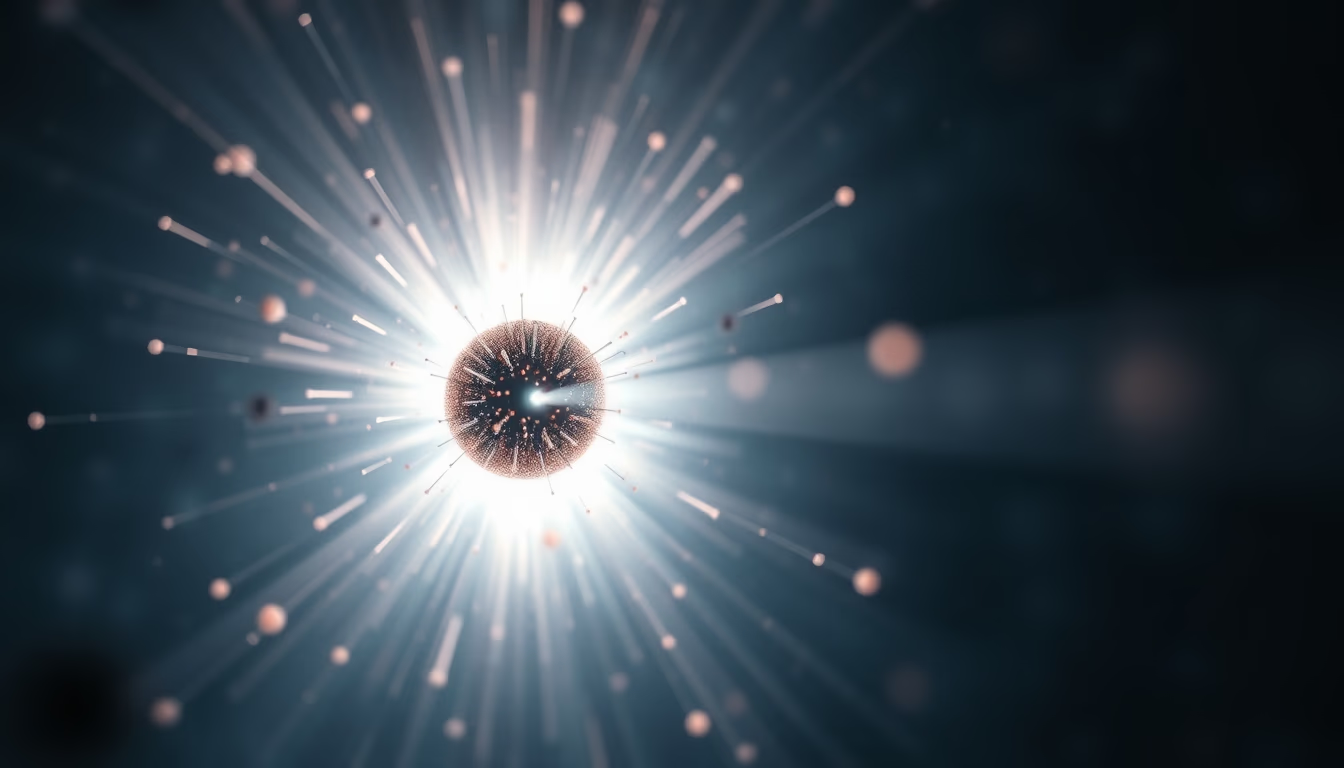
Pulsars are rapidly rotating neutron stars that emit beams of radiation, acting as cosmic lighthouses.
About this subject
Neutron stars are the collapsed cores of massive stars that have exploded as supernovae. With masses between 1 and 2 solar masses compressed into a sphere just 20 km in diameter, these objects have extreme densities: a teaspoon of neutron star matter would weigh billions of tons on Earth. Their surface gravity is hundreds of billions of times stronger than Earth's.
Pulsars are a specific type of neutron star that emit regular pulses of electromagnetic radiation, from radio waves to X-rays and gamma rays. This emission occurs because the pulsar's magnetic axis is misaligned with its rotation axis. Thus, the radiation beams sweep through space like a lighthouse beam, and an observer on Earth detects a pulse each rotation. The first pulsar was discovered in 1967 by Jocelyn Bell Burnell and Anthony Hewish, a finding that earned the Nobel Prize in Physics in 1974.
The rotation of pulsars is incredibly stable, with periods ranging from milliseconds to several seconds. The fastest known pulsar, PSR J1748-2446ad, spins 716 times per second, while the famous Crab Pulsar has a period of 33 ms and is the remnant of supernova SN 1054 observed by Chinese and Arab astronomers. Besides being natural laboratories for high-energy physics, pulsars are used as precise cosmic clocks, aiding in the detection of gravitational waves and the study of the interstellar medium.
Frequently Asked Questions
What causes the pulsation of a pulsar?
The pulsation occurs because the pulsar's magnetic axis is misaligned with its rotation axis. The emitted radiation beams sweep through space, and when they point toward Earth, we observe a pulse. It is similar to a rotating lighthouse.
How are pulsars used in astronomy?
The extremely stable rotation of pulsars makes them excellent cosmic clocks. They are used to test theories of gravity, detect gravitational waves, study the interstellar medium, and even as distance markers.
What is the density of a neutron star?
The density of a neutron star is comparable to that of an atomic nucleus, about 10^17 kg/m³. A teaspoon of this material would weigh billions of tons.
Direct URL
https://pub-c7d6a6ea828543ac903a74a341ccb2e1.r2.dev/imagens/neutron-star-pulsar-macro-closeup-p8.avifHow to credit
Include a visible link back to UtilizAí. Copy one of the snippets below:
<a href="https://xn--utiliza-eza.com/en/midia/imagens/neutron-star-pulsar-macro-closeup-p8">Neutron star pulsar</a> by <a href="https://xn--utiliza-eza.com">UtilizAí</a>, licensed under <a href="https://creativecommons.org/licenses/by/4.0/">CC BY 4.0</a>.
[Neutron star pulsar](https://xn--utiliza-eza.com/en/midia/imagens/neutron-star-pulsar-macro-closeup-p8) by [UtilizAí](https://xn--utiliza-eza.com), CC BY 4.0
License: CC-BY-4.0