Neutron star pulsar
1344×768 · AVIF · CC BY 4.0
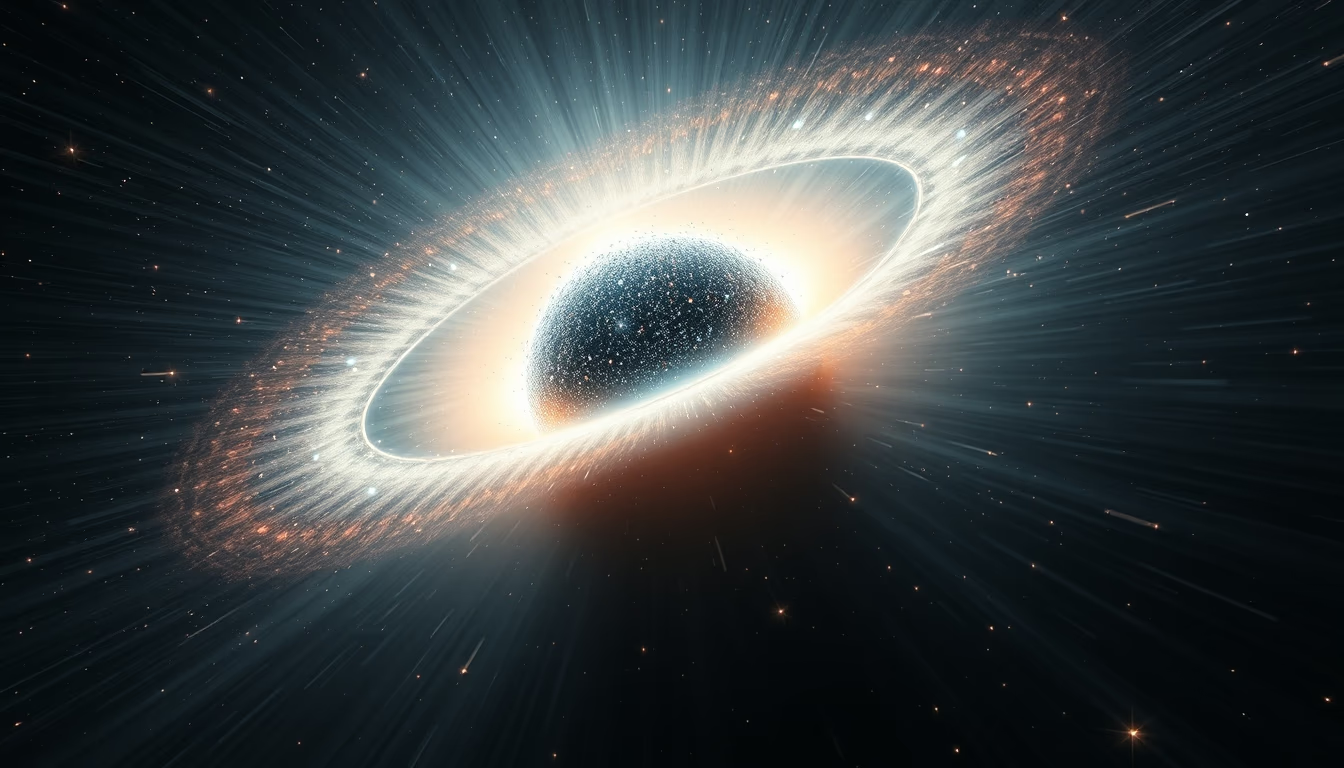
Pulsars are rapidly rotating neutron stars emitting beams of radiation, acting as cosmic lighthouses discovered in 1967.
About this subject
Pulsars are highly magnetized neutron stars that rotate at astonishing speeds, emitting regular beams of electromagnetic radiation. These objects are the remnants of supernovae, stellar explosions that occur when massive stars exhaust their nuclear fuel. The first pulsar was detected in 1967 by Jocelyn Bell Burnell and Antony Hewish in the United Kingdom using a radio telescope. The discovery was so unexpected that the pulsing signal was initially nicknamed LGM-1, for "little green men," hinting at the possibility of extraterrestrial communication.
The fastest known pulsars, called millisecond pulsars, can spin hundreds of times per second. A notable example is PSR J1748-2446ad, located in the globular cluster Terzan 5, which completes 716 rotations per second. This extreme speed is explained by the accretion process: the pulsar siphons matter from a companion star, gaining angular momentum. Moreover, pulsars emit radiation across multiple bands of the spectrum, from radio waves to gamma rays, enabling their study by various observatories.
The significance of pulsars extends beyond stellar astrophysics. The regularity of their pulses rivals atomic clocks, making them unique tools for testing theories of gravitation, such as Einstein's general relativity. The first binary pulsar system, PSR B1913+16, discovered by Russell Hulse and Joseph Taylor in 1974, provided indirect evidence for the existence of gravitational waves, a work that earned them the Nobel Prize in Physics in 1993. Today, pulsars are also used as galactic beacons for interstellar navigation, in projects aiming to map the Milky Way with high precision.
Frequently Asked Questions
What causes the regular pulses of a pulsar?
The pulses are caused by the rotation of the neutron star, which has an intense magnetic field with misaligned axes. The radiation beams sweep through space like lighthouses, and when they point toward Earth, we detect a pulse.
What is the difference between a pulsar and a quasar?
Pulsars are rotating neutron stars, remnants of supernovae. Quasars are extremely luminous active galactic nuclei powered by supermassive black holes. Both emit radiation but on completely different scales and processes.
Can pulsars be used for space navigation?
Yes, projects like NASA's NICER use pulsars as beacons to determine the position of spacecraft in deep space. The regularity of their signals allows for an autonomous and precise navigation system without relying on communication with Earth.
Direct URL
https://pub-c7d6a6ea828543ac903a74a341ccb2e1.r2.dev/imagens/neutron-star-pulsar-fine-art-photography-p10.avifHow to credit
Include a visible link back to UtilizAí. Copy one of the snippets below:
<a href="https://xn--utiliza-eza.com/en/midia/imagens/neutron-star-pulsar-fine-art-photography-p10">Neutron star pulsar</a> by <a href="https://xn--utiliza-eza.com">UtilizAí</a>, licensed under <a href="https://creativecommons.org/licenses/by/4.0/">CC BY 4.0</a>.
[Neutron star pulsar](https://xn--utiliza-eza.com/en/midia/imagens/neutron-star-pulsar-fine-art-photography-p10) by [UtilizAí](https://xn--utiliza-eza.com), CC BY 4.0
License: CC-BY-4.0