Neutron star pulsar
1344×768 · AVIF · CC BY 4.0
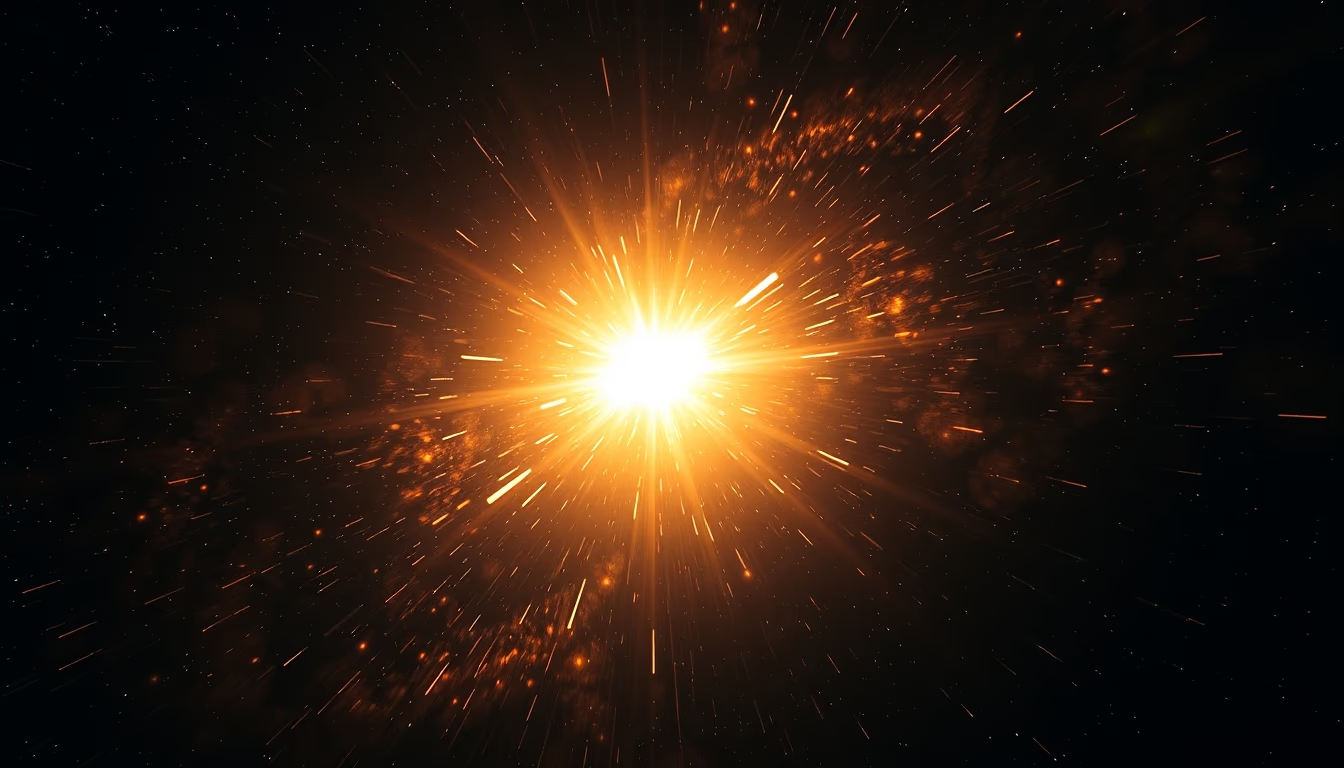
Pulsars are neutron stars that emit beams of radiation at regular intervals, acting like cosmic lighthouses.
About this subject
A neutron star is the collapsed core of a massive star that exploded as a supernova. With a mass comparable to the Sun but compressed into a sphere only 20 kilometers in diameter, these objects are incredibly dense: a teaspoon of neutron star matter would weigh billions of tons. When a neutron star has an intense magnetic field and rotates rapidly, it can emit beams of radiation from its magnetic poles, creating the pulsar effect that sweeps across space like a lighthouse.
Pulsars were discovered in 1967 by Jocelyn Bell Burnell and Antony Hewish, who noticed a pulsating, extremely regular radio signal. Initially dubbed "LGM" (little green men) because of a suspected artificial origin, we now know that pulsar rotation periods range from milliseconds to a few seconds. The fastest known, PSR J1748-2446ad, spins 716 times per second, while some older pulsars may take several seconds per rotation.
These objects are natural laboratories for extreme physics. Studies of pulsars allow tests of general relativity, indirect detection of gravitational waves (as in the binary system PSR B1913+16, which earned the 1993 Nobel Prize in Physics), and even mapping of interstellar space. The Crab Pulsar, remnant of the supernova of 1054, is one of the most studied and emits radiation across the entire electromagnetic spectrum, from radio to gamma rays.
Pulsars are so precise that some are used as cosmic clocks, rivaling atomic clocks. In 1974, Russell Hulse and Joseph Taylor discovered the first binary pulsar, whose orbital decay provided the first indirect evidence of gravitational waves. Today, China's FAST telescope and the US-based NANOGrav project monitor pulsars to detect low-frequency gravitational waves, expanding our understanding of the universe.
Frequently Asked Questions
What distinguishes a pulsar from a common neutron star?
Every pulsar is a neutron star, but not every neutron star is a pulsar. The difference lies in rotation and magnetic field: pulsars are neutron stars that spin rapidly and have strong magnetic fields, emitting beams of radiation that, aligned with Earth, produce regular pulses.
Why are pulsars important for science?
Pulsars allow tests of general relativity, detection of gravitational waves, study of matter under extreme conditions, and use as precise clocks for interstellar navigation. The first binary pulsar system provided indirect evidence of gravitational waves, earning a Nobel Prize.
How are pulsars detected?
Pulsars are mainly detected by radio telescopes, which capture the periodic radio pulses. They can also be observed in X-rays and gamma rays, as in the Crab Pulsar case. Telescopes like FAST in China and the decommissioned Arecibo have cataloged thousands of them.
Direct URL
https://pub-c7d6a6ea828543ac903a74a341ccb2e1.r2.dev/imagens/neutron-star-pulsar-documentary-photography-p4.avifHow to credit
Include a visible link back to UtilizAí. Copy one of the snippets below:
<a href="https://xn--utiliza-eza.com/en/midia/imagens/neutron-star-pulsar-documentary-photography-p4">Neutron star pulsar</a> by <a href="https://xn--utiliza-eza.com">UtilizAí</a>, licensed under <a href="https://creativecommons.org/licenses/by/4.0/">CC BY 4.0</a>.
[Neutron star pulsar](https://xn--utiliza-eza.com/en/midia/imagens/neutron-star-pulsar-documentary-photography-p4) by [UtilizAí](https://xn--utiliza-eza.com), CC BY 4.0
License: CC-BY-4.0