Neutron star pulsar
1344×768 · AVIF · CC BY 4.0
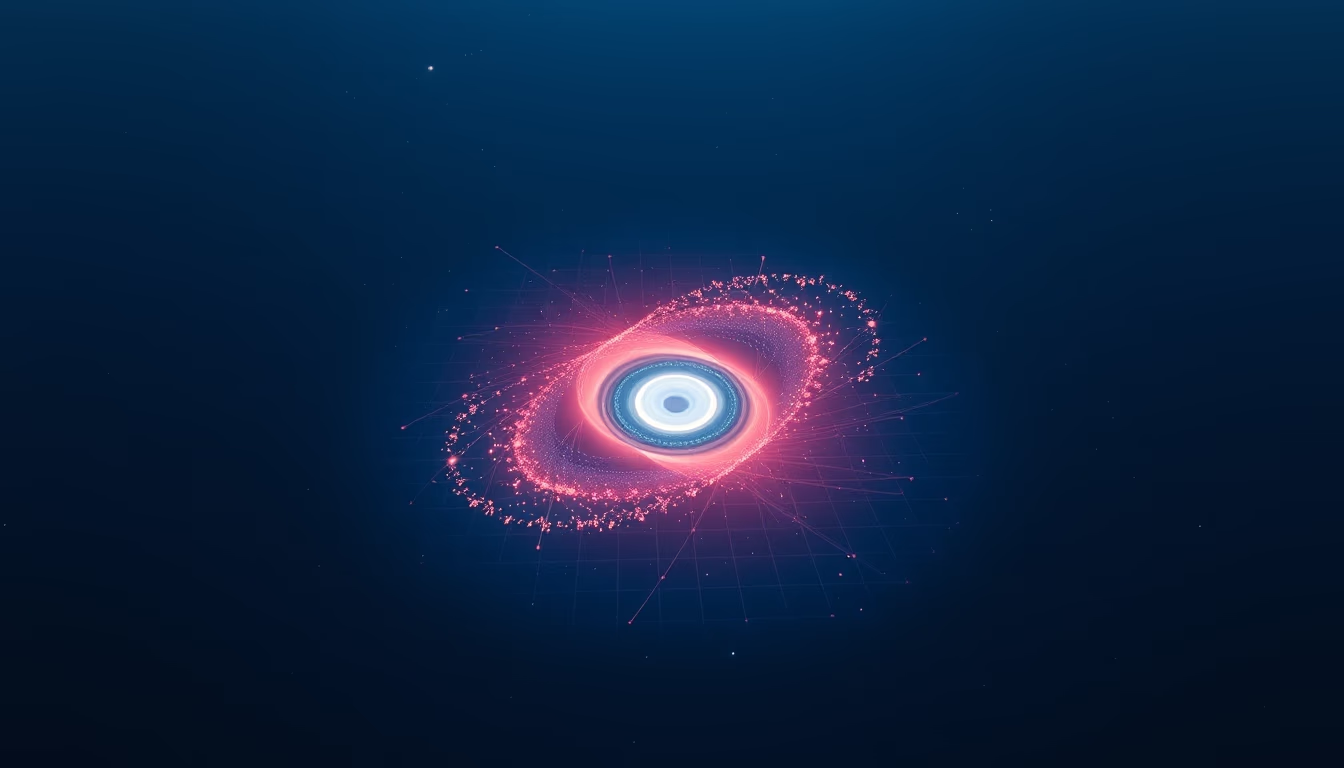
Pulsars are rapidly spinning neutron stars that emit beams of radiation, sweeping across space like cosmic lighthouses.
About this subject
Pulsars, discovered in 1967 by Jocelyn Bell Burnell, are highly magnetized neutron stars that rotate tens to hundreds of times per second. These compact, dense objects, with a mass comparable to the Sun but compressed into a sphere only 20 kilometers in diameter, result from the gravitational collapse of massive stars in supernovae. Their radiation beams, usually in radio waves, are only detectable when aligned with Earth, producing regular pulses that gave them the name "pulsar".
The incredible regularity of these pulses makes pulsars extremely precise cosmic clocks. The Crab Pulsar, for example, has a period of about 33 milliseconds and slows down by only 38 nanoseconds per day. Observations of pulsars in binary systems have allowed tests of Einstein's general relativity, including the indirect detection of gravitational waves. The binary pulsar PSR B1913+16, discovered by Hulse and Taylor in 1974, provided the first evidence of energy loss through gravitational waves.
There are different classes of pulsars: common radio pulsars, X-ray pulsars (accreting matter from a companion), and millisecond pulsars, which spin hundreds of times per second due to spin-up by accretion. The fastest known, PSR J1748-2446ad, rotates 716 times per second, corresponding to a surface speed of about 24% of the speed of light. These objects are natural laboratories for studying matter under extreme density and magnetic field conditions.
Interestingly, pulsars can gradually lose their rotation until they become "dead", when the radiation beam ceases. It is believed that millions of pulsars exist in the Milky Way, but only about 2,000 are known due to the need for beam alignment. Modern telescopes, such as FAST in China and MeerKAT in South Africa, continue to discover new pulsars, expanding our understanding of the universe.
Frequently Asked Questions
What distinguishes a pulsar from a regular neutron star?
All pulsars are neutron stars, but not every neutron star is a pulsar. Pulsars are those that emit beams of radiation which, due to orientation and rotation, are detected as regular pulses from Earth.
How are pulsars used to test general relativity?
Pulsars in binary systems serve as precise clocks. By measuring changes in their orbital periods, scientists have confirmed energy loss through gravitational waves, as predicted by Einstein. The PSR B1913+16 system was the first to provide this evidence.
What is the significance of millisecond pulsars?
Millisecond pulsars spin hundreds of times per second, enabling studies of high-density physics and use as extremely stable cosmic clocks. They are also key to detecting low-frequency gravitational waves through pulsar timing arrays.
Direct URL
https://pub-c7d6a6ea828543ac903a74a341ccb2e1.r2.dev/imagens/neutron-star-pulsar-aerial-drone-shot-p7.avifHow to credit
Include a visible link back to UtilizAí. Copy one of the snippets below:
<a href="https://xn--utiliza-eza.com/en/midia/imagens/neutron-star-pulsar-aerial-drone-shot-p7">Neutron star pulsar</a> by <a href="https://xn--utiliza-eza.com">UtilizAí</a>, licensed under <a href="https://creativecommons.org/licenses/by/4.0/">CC BY 4.0</a>.
[Neutron star pulsar](https://xn--utiliza-eza.com/en/midia/imagens/neutron-star-pulsar-aerial-drone-shot-p7) by [UtilizAí](https://xn--utiliza-eza.com), CC BY 4.0
License: CC-BY-4.0