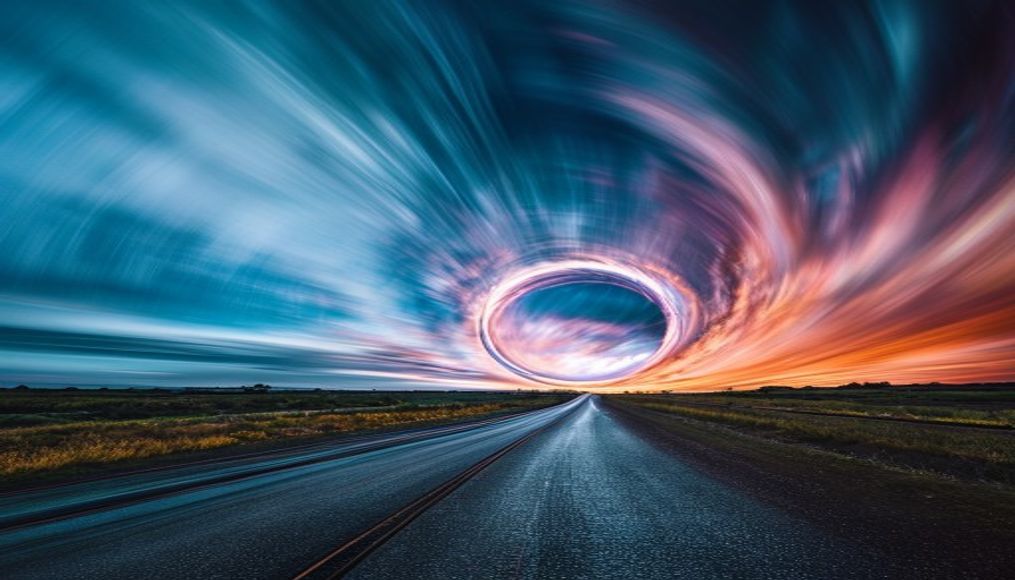
Neptune deep blue storms
1344×768 · AVIF · CC BY 4.0
Neptune, the icy giant of the Solar System, displays deep blue storms in its dynamic atmosphere. Discover the secrets of this distant planet.
About this subject
Neptune is the eighth and most distant planet in the Solar System, known for its intense blue color and for hosting the most violent storms ever observed on a planet. Its atmosphere is composed mainly of hydrogen, helium, and methane, the latter responsible for absorbing red light and reflecting blue, giving it its characteristic hue. Ultrarapid winds, reaching up to 2,100 km/h, sweep its surface and create enormous storm systems, such as the Great Dark Spot, discovered by the Voyager 2 probe in 1989.
Voyager 2 was the only spacecraft to visit Neptune, passing approximately 4,950 km from its atmosphere in August 1989. During the flyby, it recorded the Great Dark Spot, an anticyclone the size of Earth, along with other features like the Small Dark Spot and the bright cloud known as Scooter. These storms are not permanent; later observations by the Hubble Space Telescope showed that the Great Dark Spot has disappeared and new storms have emerged, indicating an extremely dynamic and changing atmosphere.
Neptune's interior consists of a mantle of water, methane, and ammonia in a supercritical state, enveloping a rocky core. The planet emits about 2.6 times more heat than it receives from the Sun, which contributes to the intense atmospheric activity. It is believed that deep blue storms are formed by currents of heated gas that rise and expand, creating clouds of methane and ice crystals that reflect blue light more intensely. Recent studies suggest that winds on Neptune may carve crystals of hydrogen sulfide, forming dark storms that contrast with the planet's blue.
Neptune completes an orbit around the Sun every 164.8 Earth years. Its discovery in 1846, based on mathematical calculations of perturbations in Uranus's orbit, was a triumph of celestial mechanics. Today, Hubble continues to monitor seasonal changes and storms on Neptune, providing valuable data for understanding the dynamics of giant gas atmospheres. For astronomy enthusiasts, Neptune represents a natural laboratory of extreme weather phenomena under conditions very different from Earth's.
Frequently Asked Questions
Why is Neptune blue?
Neptune is blue due to methane in its atmosphere. Methane absorbs red light from the Sun and reflects blue light, giving the planet its characteristic color.
What are the most famous storms on Neptune?
The most famous storm is the Great Dark Spot, discovered by Voyager 2 in 1989. It was an anticyclone the size of Earth, but has since disappeared. Hubble has observed new dark storms in subsequent years.
How was Neptune discovered?
Neptune was discovered in 1846 by Johann Galle, based on mathematical calculations by Urbain Le Verrier and John Couch Adams, who predicted its existence from irregularities in Uranus's orbit.
Direct URL
https://pub-c7d6a6ea828543ac903a74a341ccb2e1.r2.dev/imagens/neptune-deep-blue-storms-travel-photography-p8.avifHow to credit
Include a visible link back to UtilizAí. Copy one of the snippets below:
<a href="https://xn--utiliza-eza.com/en/midia/imagens/neptune-deep-blue-storms-travel-photography-p8">Neptune deep blue storms</a> by <a href="https://xn--utiliza-eza.com">UtilizAí</a>, licensed under <a href="https://creativecommons.org/licenses/by/4.0/">CC BY 4.0</a>.
[Neptune deep blue storms](https://xn--utiliza-eza.com/en/midia/imagens/neptune-deep-blue-storms-travel-photography-p8) by [UtilizAí](https://xn--utiliza-eza.com), CC BY 4.0
License: CC-BY-4.0