Neptune deep blue storms
1344×768 · AVIF · CC BY 4.0
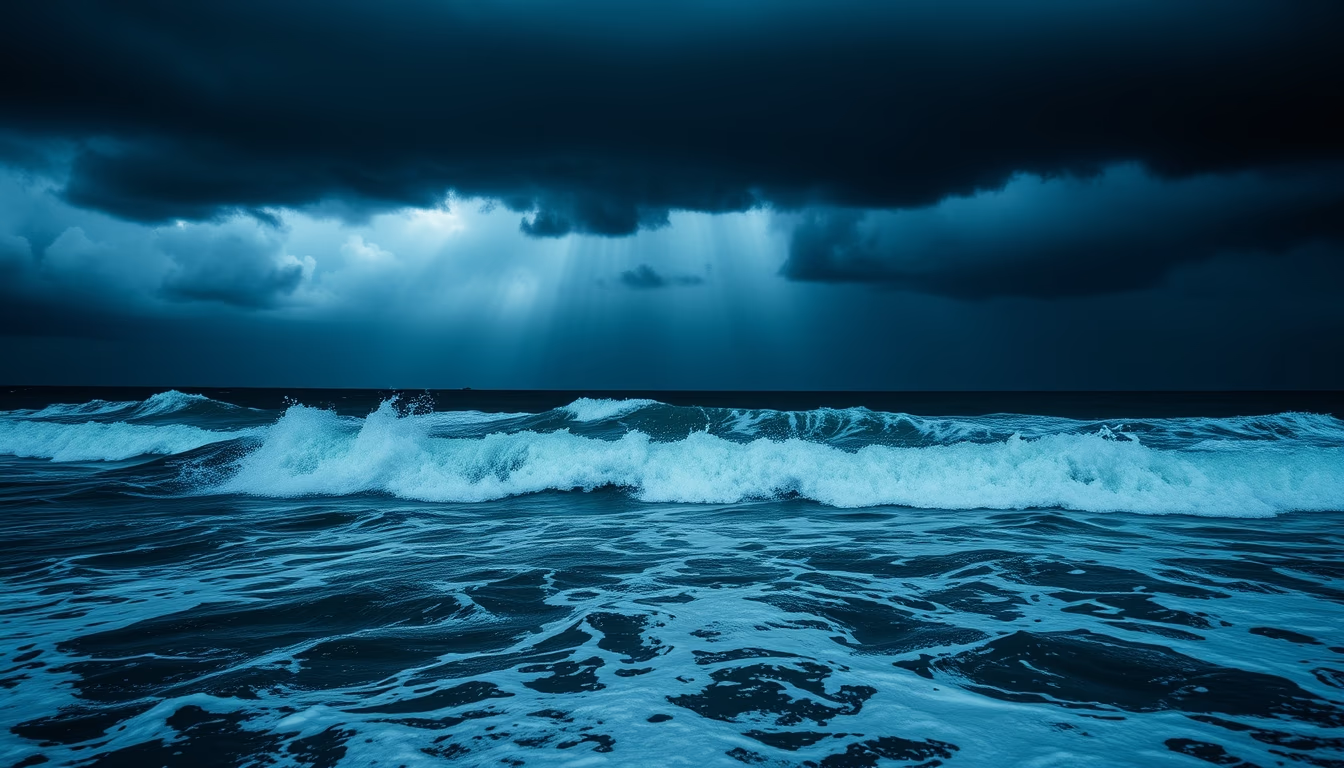
Neptune, the icy giant of the Solar System, hosts deep dark storms that have intrigued scientists for decades.
About this subject
Neptune is the eighth and most distant planet in the Solar System, known for its deep blue color and some of the most violent storms ever observed on a planet. These storms, called “great dark spots,” are high-pressure systems that can reach wind speeds exceeding 2,000 km/h, the fastest recorded on any planet in the Solar System. Unlike Jupiter's storms, which last for centuries, Neptune's are ephemeral, appearing and disappearing on timescales of a few years.
The origin of these storms lies in Neptune's dynamic atmosphere, composed mainly of hydrogen, helium, and methane. Methane absorbs red light, giving the planet its characteristic blue hue. The dark spots are regions where deeper, darker clouds are exposed, contrasting with the brighter upper layers. In 1989, the Voyager 2 spacecraft was the first to capture detailed images of these storms, revealing a turbulent atmosphere with fierce winds and bright cloud systems at the edges of the dark spots.
Subsequent observations with the Hubble Space Telescope have shown that these storms can arise and dissipate quickly. In 2018, Hubble detected a new great dark spot in Neptune's northern hemisphere, accompanied by bright clouds of methane ice. Studies suggest the storms are fueled by the planet's internal heat and the differential rotation of its atmospheric layers. Understanding these phenomena helps astronomers better grasp the meteorology of gas planets and Neptune's climatic evolution over time.
Frequently Asked Questions
What causes Neptune's deep blue color?
Neptune's intense blue color is caused by the absorption of red light by methane in its atmosphere. Methane reflects blue light, giving the planet its characteristic hue.
Do Neptune's storms last a long time?
No, unlike Jupiter's storms such as the Great Red Spot, Neptune's dark storms are ephemeral, typically lasting only a few years before dissipating.
Which spacecraft first photographed Neptune's storms?
NASA's Voyager 2 spacecraft was the first to capture detailed images of Neptune's storms during its flyby in 1989.
Direct URL
https://pub-c7d6a6ea828543ac903a74a341ccb2e1.r2.dev/imagens/neptune-deep-blue-storms-magazine-editorial-p6.avifHow to credit
Include a visible link back to UtilizAí. Copy one of the snippets below:
<a href="https://xn--utiliza-eza.com/en/midia/imagens/neptune-deep-blue-storms-magazine-editorial-p6">Neptune deep blue storms</a> by <a href="https://xn--utiliza-eza.com">UtilizAí</a>, licensed under <a href="https://creativecommons.org/licenses/by/4.0/">CC BY 4.0</a>.
[Neptune deep blue storms](https://xn--utiliza-eza.com/en/midia/imagens/neptune-deep-blue-storms-magazine-editorial-p6) by [UtilizAí](https://xn--utiliza-eza.com), CC BY 4.0
License: CC-BY-4.0