Nebula colorful deep space
1344×768 · AVIF · CC BY 4.0
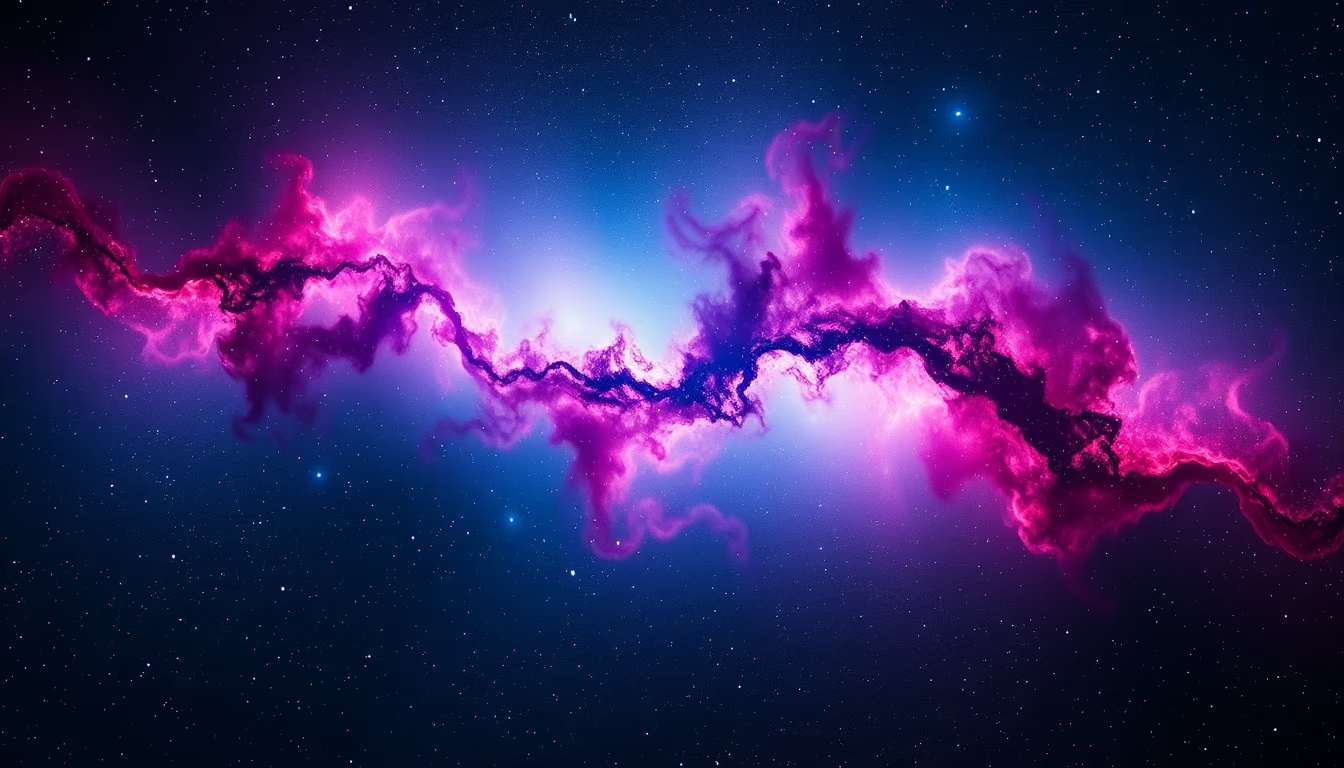
Colorful nebulas are interstellar clouds of gas and dust that glow in vibrant hues, revealing stellar nurseries across the cosmos.
About this subject
Nebulas are vast clouds of gas and dust in interstellar space, often illuminated by young stars or stellar remnants. The stunning colors seen in images like this come from different chemical elements excited by ultraviolet radiation. Hydrogen emits red light, doubly ionized oxygen glows green-blue, and ionized sulfur contributes reddish hues. These colors are often combined in image processing to create minimalist compositions that highlight the universe's beauty.
Famous nebulas such as the Eagle Nebula (M16), the Orion Nebula (M42), and the Carina Nebula are active stellar nurseries. Inside these clouds, gravity pulls gas and dust together to form new stars, which then sculpt the nebula with their winds and radiation. The Orion Nebula, about 1,344 light-years away, is one of the closest star-forming regions and can be seen with the naked eye as a fuzzy patch in the constellation Orion.
The chemical composition of nebulas varies by origin. Emission nebulas, like HII regions, are dominated by ionized hydrogen, while reflection nebulas scatter light from nearby stars, producing blueish colors due to preferential scattering of short wavelengths. Dark nebulas, such as the Horsehead, block background light and appear as silhouettes. The Hubble Space Telescope and the James Webb Space Telescope have revealed unprecedented details of these structures, enabling studies of stellar evolution and interstellar chemistry.
Colorful nebulas are not just visually stunning; they are natural laboratories for understanding the life cycle of stars. Massive stars are born in them, live fast, and explode as supernovae, enriching the interstellar medium with heavy elements that will later form planets and life. The minimalist image of a nebula captures this complexity in a frame of visual simplicity, inviting contemplation of the cosmos.
Frequently Asked Questions
What is a nebula?
A nebula is an interstellar cloud of gas (mainly hydrogen and helium) and dust. They can be star-forming regions or remnants of dead stars, such as supernovae.
Why are nebulas so colorful?
The colors come from chemical elements ionized by radiation from nearby stars. Each element emits light at specific wavelengths: hydrogen (red), oxygen (green/blue), sulfur (orange-red), among others.
How far away is a typical nebula from Earth?
Distances vary widely. The Orion Nebula is about 1,344 light-years away, while the Eagle Nebula is roughly 7,000 light-years. Some nebulas are in our galaxy, others in nearby galaxies.
Direct URL
https://pub-c7d6a6ea828543ac903a74a341ccb2e1.r2.dev/imagens/nebula-colorful-deep-space-minimalist-composition-p6.avifHow to credit
Include a visible link back to UtilizAí. Copy one of the snippets below:
<a href="https://xn--utiliza-eza.com/en/midia/imagens/nebula-colorful-deep-space-minimalist-composition-p6">Nebula colorful deep space</a> by <a href="https://xn--utiliza-eza.com">UtilizAí</a>, licensed under <a href="https://creativecommons.org/licenses/by/4.0/">CC BY 4.0</a>.
[Nebula colorful deep space](https://xn--utiliza-eza.com/en/midia/imagens/nebula-colorful-deep-space-minimalist-composition-p6) by [UtilizAí](https://xn--utiliza-eza.com), CC BY 4.0
License: CC-BY-4.0





