Nebula colorful deep space
1344×768 · AVIF · CC BY 4.0
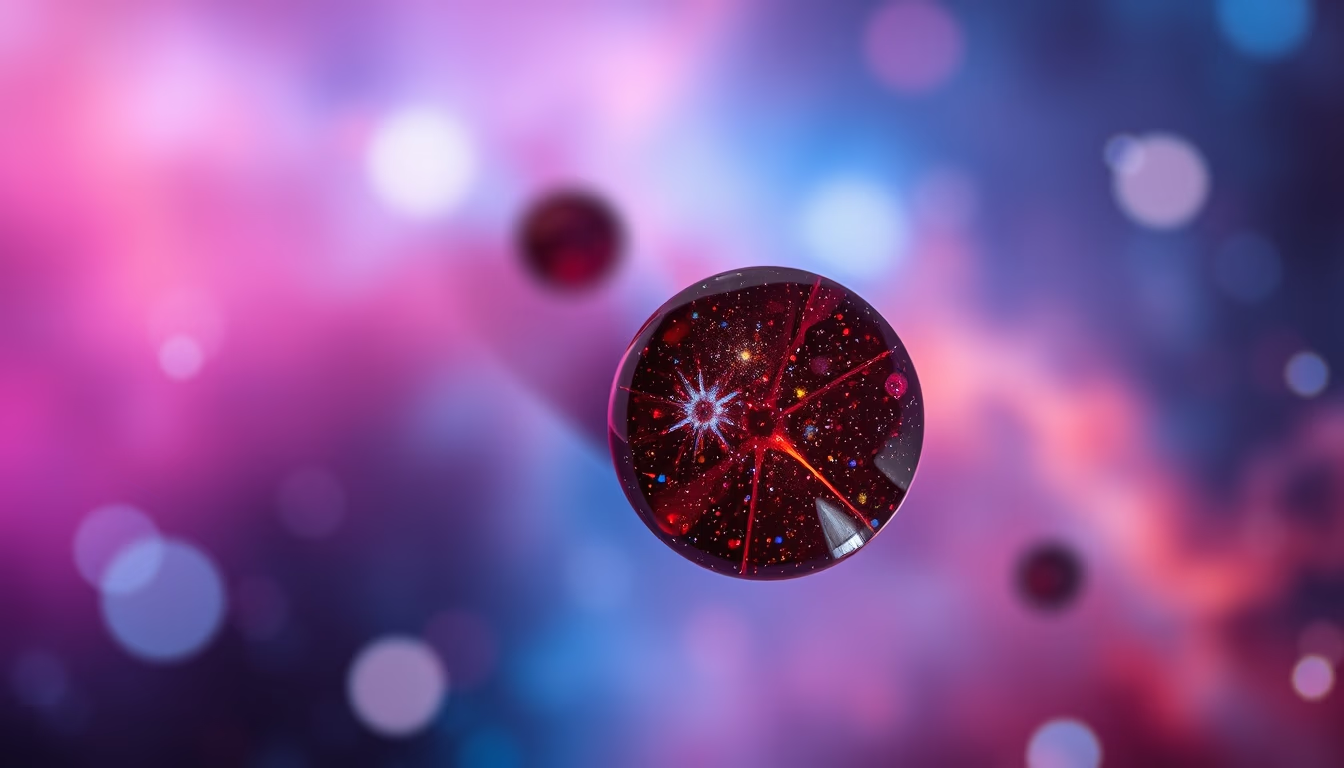
Nebulae are interstellar clouds of dust and gas, stellar nurseries that display vibrant colors in astronomical images.
About this subject
Nebulae are vast clouds of gas and dust in interstellar space, often illuminated by nearby stars or radiation from young stars. They are the sites of star formation, where gravitational collapse of dense regions gives rise to new stars. The colors observed in nebula images, such as those captured by the Hubble Space Telescope, result from chemical composition and physical conditions: hydrogen emits red light, oxygen blue-green, and sulfur red-orange. Notable examples include the Orion Nebula (M42), visible to the naked eye, and the Crab Nebula (M1), a supernova remnant. Emission nebulae, like the Lagoon Nebula, glow due to ionization of gas by hot stars, while reflection nebulae, such as the Pleiades, reflect light from neighboring stars, often showing blue hues. The Horsehead Nebula in Orion is an iconic dark nebula that blocks background light. Studies of nebulae provide crucial insights into the life cycle of stars and the chemical evolution of the galaxy. Macro-closeup images reveal details of filaments and complex structures, like the Pillars of Creation in the Eagle Nebula, which span light-years and show collapsing gas globules. Amateur astronomy can also capture such colors with telescopes equipped with specific filters, popularizing nebula photography.
Frequently Asked Questions
Why do nebulae have such vibrant colors?
The vibrant colors come from emission of light by ionized gases, such as hydrogen (red), oxygen (green/blue), and sulfur (red-orange), or from reflection of starlight by fine dust, which gives blue hues.
What is the largest known nebula?
The Carina Nebula in the Milky Way is about 300 light-years across. However, the Ring Nebula (M57) is a smaller planetary nebula, about 1 light-year in diameter.
Can you see nebulae with the naked eye?
Yes, some like the Orion Nebula (M42) and the Pleiades (M45) are visible to the naked eye in dark skies, but most require binoculars or telescopes for detailed observation.
Direct URL
https://pub-c7d6a6ea828543ac903a74a341ccb2e1.r2.dev/imagens/nebula-colorful-deep-space-macro-closeup-p5.avifHow to credit
Include a visible link back to UtilizAí. Copy one of the snippets below:
<a href="https://xn--utiliza-eza.com/en/midia/imagens/nebula-colorful-deep-space-macro-closeup-p5">Nebula colorful deep space</a> by <a href="https://xn--utiliza-eza.com">UtilizAí</a>, licensed under <a href="https://creativecommons.org/licenses/by/4.0/">CC BY 4.0</a>.
[Nebula colorful deep space](https://xn--utiliza-eza.com/en/midia/imagens/nebula-colorful-deep-space-macro-closeup-p5) by [UtilizAí](https://xn--utiliza-eza.com), CC BY 4.0
License: CC-BY-4.0