Nebula colorful deep space
1344×768 · AVIF · CC BY 4.0
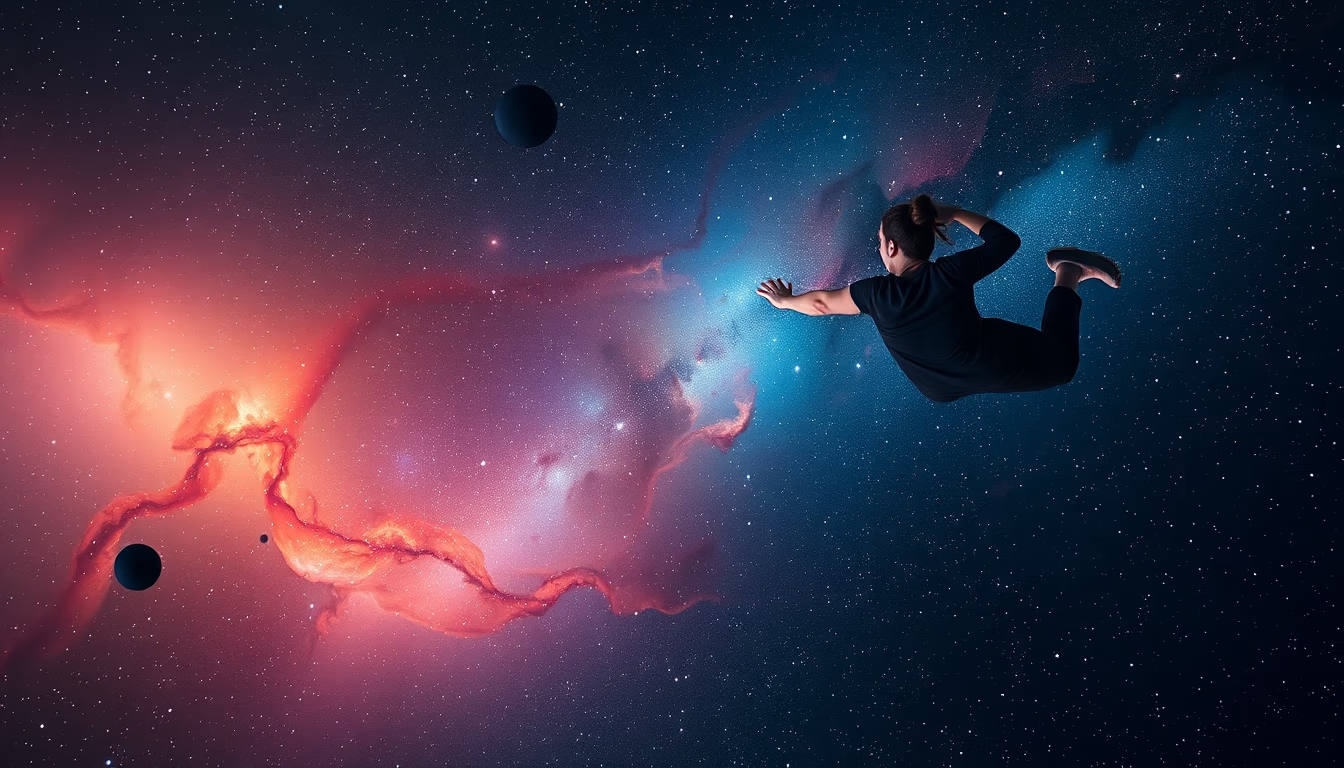
Colorful nebulae are interstellar clouds of gas and dust that glow in vibrant hues due to radiation from young, hot stars.
About this subject
Colorful nebulae are among the most fascinating structures in the cosmos. They consist mainly of hydrogen, helium, and interstellar dust. The intense coloration comes from ionization of gases by nearby massive stars: hydrogen emits reddish light (Hα), doubly ionized oxygen produces green and blue tones, and ionized sulfur contributes deeper reds. This combination is often captured by telescopes using specific filters, as in the so-called Hubble palette.
There are several types of colorful nebulae. Emission nebulae, such as the Orion Nebula (M42), are clouds where ultraviolet radiation from central stars excites the gas, making it glow. Reflection nebulae, like the Pleiades reflection nebula, do not emit their own light but reflect starlight, resulting in bluish hues. Planetary nebulae, such as the Ring Nebula (M57), are formed by dying stars that eject their outer layers.
The Carina Nebula, visible from the Southern Hemisphere, hosts the hypergiant star Eta Carinae and is an active stellar nursery. The Eagle Nebula (M16) became famous for the “Pillars of Creation” photographed by the Hubble telescope. Colorful nebulae are crucial for the formation of new stars and planetary systems, as gas and dust clump under gravity until nuclear fusion ignites.
Fun fact: the Crab Nebula (M1) is the remnant of a supernova observed in 1054 by Chinese and Arab astronomers. These structures range in size from a few light-years to hundreds of light-years across. Despite their beauty, most are invisible to the naked eye, requiring filters or long photographic exposures to reveal the colors. Images of colorful nebulae are often composites of multiple filters to scientifically represent chemical composition.
Frequently Asked Questions
What causes the vibrant colors in nebulae?
The vibrant colors are caused by the ionization of gases such as hydrogen, oxygen, and sulfur by ultraviolet radiation from young, massive stars. Each element emits light at specific wavelengths, like hydrogen's red and oxygen's green-blue.
What is the most famous colorful nebula?
The Orion Nebula (M42) is one of the most famous and studied. Others include the Carina Nebula, the Eagle Nebula (M16), and the Ring Nebula (M57). Each has unique color and shape characteristics.
How are colorful nebulae photographed?
They are photographed with telescopes equipped with filters that isolate specific wavelengths of gases. The images are composites of multiple black-and-white exposures, then artificially colored to represent chemical composition, a process called the Hubble palette.
Direct URL
https://pub-c7d6a6ea828543ac903a74a341ccb2e1.r2.dev/imagens/nebula-colorful-deep-space-documentary-photography-p1.avifHow to credit
Include a visible link back to UtilizAí. Copy one of the snippets below:
<a href="https://xn--utiliza-eza.com/en/midia/imagens/nebula-colorful-deep-space-documentary-photography-p1">Nebula colorful deep space</a> by <a href="https://xn--utiliza-eza.com">UtilizAí</a>, licensed under <a href="https://creativecommons.org/licenses/by/4.0/">CC BY 4.0</a>.
[Nebula colorful deep space](https://xn--utiliza-eza.com/en/midia/imagens/nebula-colorful-deep-space-documentary-photography-p1) by [UtilizAí](https://xn--utiliza-eza.com), CC BY 4.0
License: CC-BY-4.0