Motherboard atx detail
1344×768 · AVIF · CC BY 4.0
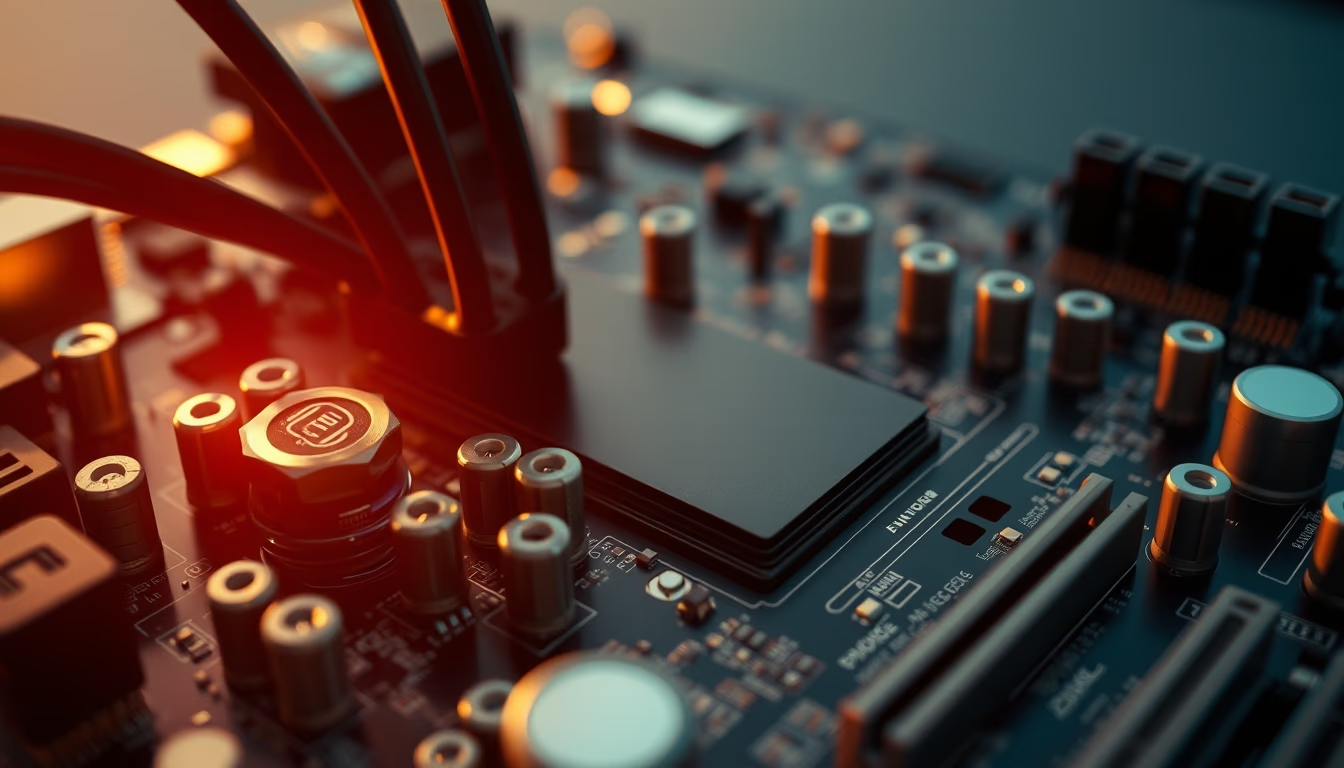
ATX motherboard: the standard defining modern desktop computer architecture, featuring expansion slots, connectors, and integrated circuits.
About this subject
The ATX (Advanced Technology Extended) motherboard is one of the most enduring standards in personal computing. Developed by Intel in 1995, it replaced the older AT format with significant improvements in component layout, airflow, and connectivity. The ATX standard defines dimensions of 305 mm × 244 mm (12 × 9.6 inches) and an orientation that allows more efficient power supply placement, with the power connector positioned near the processor.
A typical ATX motherboard houses the CPU socket, RAM slots (usually DIMM), PCIe expansion slots (for graphics, sound, network cards), chipset, SATA connectors for storage, USB ports, and a rear I/O panel. The chipset, consisting of northbridge and southbridge (or Platform Controller Hub in newer designs), manages communication between the processor, memory, and peripherals. The ATX standard also specifies power supply connectors, including a 24-pin main connector and 4/8-pin CPU power, delivering voltages of +3.3 V, +5 V, and +12 V.
Evolution of ATX brought variants such as microATX (244 mm × 244 mm) and Mini-ITX (170 mm × 170 mm), maintaining connector compatibility. Despite competition from other form factors (like BTX, which did not succeed), ATX remains dominant in the desktop market, used in gaming rigs, workstations, and home servers. The component layout aims to optimize cooling, with the processor aligned with the airflow from the power supply and case fans.
Interesting fact: the ATX standard was one of the first to integrate PS/2 keyboard and mouse connectors (now obsolete) and to support features like wake-on-LAN and ACPI power management. Still today, new revisions (such as ATX12VO) seek to improve energy efficiency by eliminating the 3.3 V rail from the power supply and letting the motherboard regulate it.
Frequently Asked Questions
What does ATX stand for in motherboards?
ATX stands for Advanced Technology Extended. It is a motherboard form factor standard developed by Intel in 1995, defining dimensions, component placement, and electrical specifications for desktop computers.
What is the difference between ATX and microATX?
An ATX motherboard measures 305 x 244 mm, while microATX is 244 x 244 mm, leading to fewer expansion slots (typically 4 PCIe vs. up to 7 on ATX). Both use the same CPU socket and power connector types.
How can I identify the main components of an ATX motherboard?
Main components include the CPU socket, RAM slots (DIMM), PCIe slots (often x16 for GPU and x1 for other cards), chipset (under heatsink), SATA connectors, power connectors (24-pin and 4/8-pin CPU), and rear I/O panel.
Direct URL
https://pub-c7d6a6ea828543ac903a74a341ccb2e1.r2.dev/imagens/motherboard-atx-detail-cinematic-wide-shot-p7.avifHow to credit
Include a visible link back to UtilizAí. Copy one of the snippets below:
<a href="https://xn--utiliza-eza.com/en/midia/imagens/motherboard-atx-detail-cinematic-wide-shot-p7">Motherboard atx detail</a> by <a href="https://xn--utiliza-eza.com">UtilizAí</a>, licensed under <a href="https://creativecommons.org/licenses/by/4.0/">CC BY 4.0</a>.
[Motherboard atx detail](https://xn--utiliza-eza.com/en/midia/imagens/motherboard-atx-detail-cinematic-wide-shot-p7) by [UtilizAí](https://xn--utiliza-eza.com), CC BY 4.0
License: CC-BY-4.0