Molten glass on rod
1344×768 · JPG · CC BY 4.0
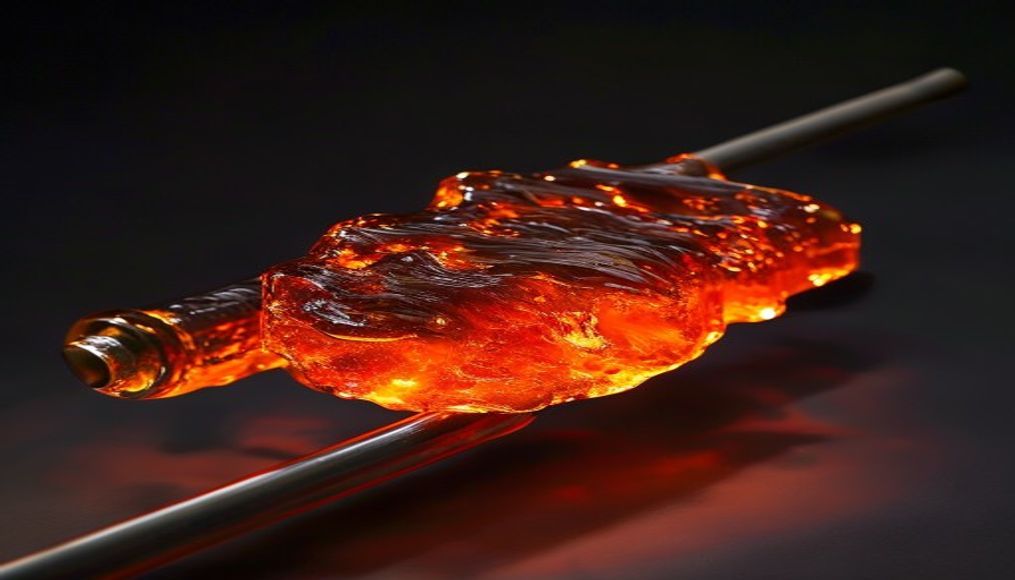
Close-up of molten glass on a rod, capturing the initial stage of the traditional glassblowing technique.
About this subject
Molten glass on a rod represents the initial stage of glassblowing, a millennia-old technique that transforms silica sand into functional and artistic objects. The temperature required to melt glass ranges from 1,400°C to 1,600°C, depending on the composition (soda-lime, lead crystal, or borosilicate). In this viscous state, glass is malleable and can be shaped by blowing, gravity, or hand tools.
The rod, traditionally made of stainless steel, acts as a support and heat conductor. Glass is gathered by dipping the rod into a pot furnace or by using a ladle to pick up a gob. This stage is critical because viscosity determines the piece's success. Experienced artisans evaluate color and flow to decide the exact moment to blow.
Historically, glassblowing was invented in Syria around the 1st century BCE, revolutionizing vessel production. Today, techniques like Murano glass in Italy and high-quality Czech glass rely on this fundamental gesture. The image may evoke the work of master glassblowers such as Dale Chihuly or the Brazilian handcraft scene, which thrives in regions like São Paulo and Minas Gerais.
A curious fact: molten glass emits a characteristic orange glow due to blackbody radiation in the near-infrared spectrum. Small air bubbles trapped in the mass are often intentional, creating decorative textures.
Frequently Asked Questions
What temperature is molten glass in glassblowing?
Molten glass reaches temperatures between 1,400°C and 1,600°C, depending on composition. Soda-lime glass melts at around 1,500°C, while borosilicate (e.g., Pyrex) requires over 1,600°C.
Why does molten glass glow orange?
The orange glow is due to blackbody radiation: incandescent glass emits light in the near-infrared spectrum, perceived as orange-red by the human eye. This is the same principle as heated metals.
What is the historical origin of glassblowing?
Glassblowing was invented in Syria around the 1st century BCE. The technique spread through the Roman Empire and reached Venice in the 13th century, where the Murano glass tradition flourished.
Direct URL
https://pub-c7d6a6ea828543ac903a74a341ccb2e1.r2.dev/imagens/molten-glass-on-rod-studio-still-life-p4.jpgHow to credit
Include a visible link back to UtilizAí. Copy one of the snippets below:
<a href="https://xn--utiliza-eza.com/en/midia/imagens/molten-glass-on-rod-studio-still-life-p4">Molten glass on rod</a> by <a href="https://xn--utiliza-eza.com">UtilizAí</a>, licensed under <a href="https://creativecommons.org/licenses/by/4.0/">CC BY 4.0</a>.
[Molten glass on rod](https://xn--utiliza-eza.com/en/midia/imagens/molten-glass-on-rod-studio-still-life-p4) by [UtilizAí](https://xn--utiliza-eza.com), CC BY 4.0
License: CC-BY-4.0