Modernist staircase spiral
1344×768 · AVIF · CC BY 4.0
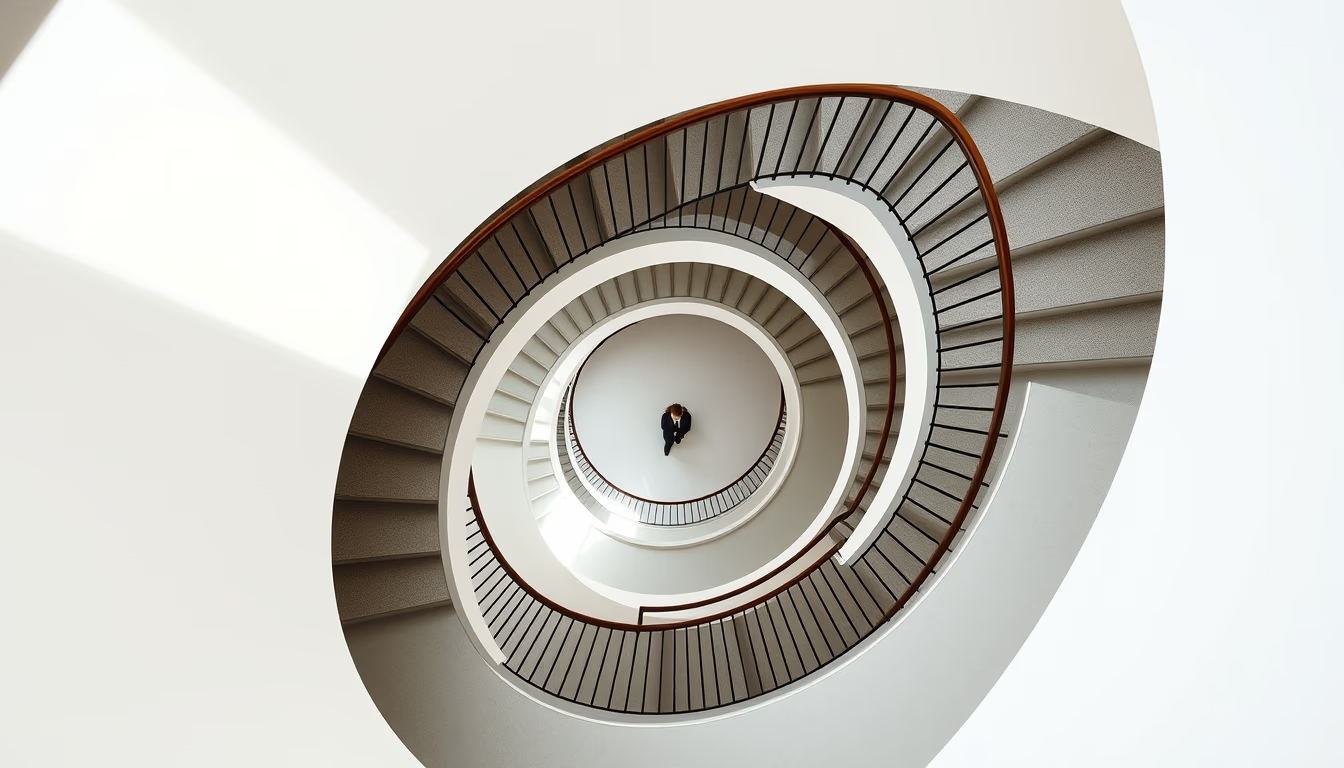
Modernist spiral staircase combines functionality and architectural sculpture, found in iconic 20th-century buildings.
About this subject
The modernist spiral staircase is one of the most expressive elements of 20th-century architecture, symbolizing the synthesis of form and function championed by the modern movement. Unlike the ornate helical stairs of previous eras, the modernist version favors clean lines, industrial materials such as reinforced concrete and steel, and integration with the surrounding space. Architects like Frank Lloyd Wright, Le Corbusier, and Oscar Niemeyer explored this element in iconic works.
In Brazil, Niemeyer used ramps and spirals in projects such as the Palácio do Itamaraty and the Niterói Contemporary Art Museum, where the spiral staircase stands out as an inhabitable sculpture. The spiral structure saves vertical space and creates a dynamic visual path. The absence of interrupted landings and the continuity of movement enhance the sensation of fluidity.
Beyond aesthetic value, modernist spiral staircases incorporate technical innovations. The use of structural cantilevers and cantilevered steps eliminated the need for central columns in some projects, as in the famous staircase of Frank Lloyd Wright's Johnson Wax Building (1939). This approach required precise engineering calculations to ensure stability, exemplifying the integration of art and science.
The spiral staircase also appears in residential and commercial contexts, valued for its spatial efficiency and visual impact. In modern buildings, it often serves as a central element in an atrium, connecting floors and inviting contemplation. Its minimalist design, often monochromatic, emphasizes geometric purity and the absence of superfluous ornamentation, core values of modernism.
Frequently Asked Questions
What is the difference between a spiral and a helical staircase?
In architecture, a spiral staircase refers to a continuous curved form, usually with a single central axis. A helical staircase has steps that rotate around a hollow core, like a helix. In modernism, both were used, but spiral is more common in compact spaces.
What materials are typical in modernist spiral staircases?
Reinforced concrete, steel, and glass are the most characteristic materials. They allow free forms, visual lightness, and integration with the building structure. Wood also appears in residential projects but with straight lines and no ornament.
Why are spiral staircases popular in modern public buildings?
They save vertical space, create a sculptural focal point, and facilitate circulation in areas with high ceilings. Additionally, their continuous design invites visitors to move through the space fluidly, enhancing the architectural experience.
Direct URL
https://pub-c7d6a6ea828543ac903a74a341ccb2e1.r2.dev/imagens/modernist-staircase-spiral-minimalist-composition-p3.avifHow to credit
Include a visible link back to UtilizAí. Copy one of the snippets below:
<a href="https://xn--utiliza-eza.com/en/midia/imagens/modernist-staircase-spiral-minimalist-composition-p3">Modernist staircase spiral</a> by <a href="https://xn--utiliza-eza.com">UtilizAí</a>, licensed under <a href="https://creativecommons.org/licenses/by/4.0/">CC BY 4.0</a>.
[Modernist staircase spiral](https://xn--utiliza-eza.com/en/midia/imagens/modernist-staircase-spiral-minimalist-composition-p3) by [UtilizAí](https://xn--utiliza-eza.com), CC BY 4.0
License: CC-BY-4.0